


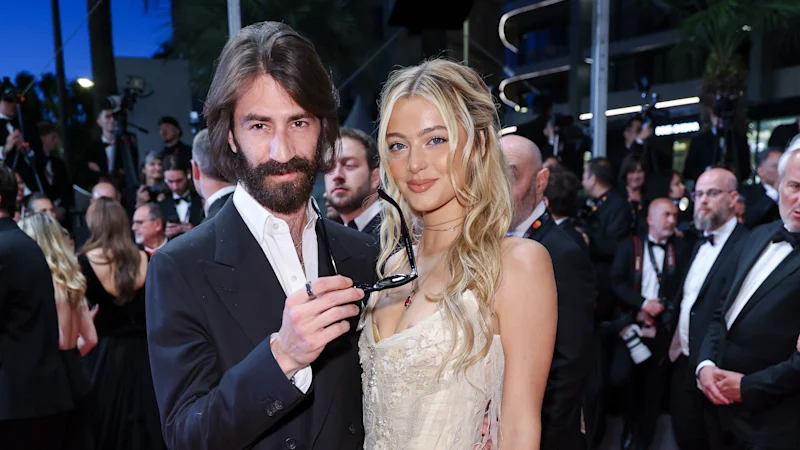
An increasingly public family feud is threatening to destabilise the €55 billion (£48 billion) fortune behind Ray-Ban, pitting Leonardo Maria Del Vecchio against Francesco Milleri, the chief executive chosen by his late father to run EssilorLuxottica.
The dispute has intensified since Del Vecchio, one of eight beneficiaries of the family holding company Delfin, resigned as EssilorLuxottica’s chief strategy officer and chairman of Ray-Ban in August. He accused the eyewear group’s management of losing touch with employees and said: “This is not the Luxottica I grew up in.”
He has also questioned Milleri’s leadership and blamed him for a fall in the company’s share price, saying: “The momentum from my father has run out.” Milleri dismissed the criticism as “useless and unfounded”.
The challenge to the chief executive comes at an awkward moment for Del Vecchio. EssilorLuxottica shares rose by about 15 per cent last week after the group reported better-than-expected results, strengthening Milleri’s position before a planned reappointment next year.
The succession dispute behind the Ray-Ban fortune
Leonardo Del Vecchio, who died in 2022, founded Luxottica in 1961 after rising from a difficult childhood in a Milan orphanage. He built a small spectacles workshop in Agordo, north-east Italy, into a global business through acquisitions and licensing agreements.
The company’s 2018 merger with French lens-maker Essilor created EssilorLuxottica, whose brands include Ray-Ban, Oakley and Persol. The group now also operates in vision care, medical technology and hearing solutions.
After Del Vecchio’s death, ownership of Delfin, the Luxembourg holding company controlling roughly a third of EssilorLuxottica, was divided equally between his six children, his widow Nicoletta Zampillo and her son from a previous marriage, Rocco Basilico.
Rules governing major decisions have since made it difficult for the heirs to agree on dividends, ownership and Delfin’s investments. Earlier this year, Leonardo Maria sought to buy the stakes held by two siblings, Luca and Paola, for about €10 billion, which could have increased his holding to 37.5 per cent.
Milleri backed the proposal, but Romolo Bardin, Delfin’s chief executive, opposed the holding company helping to finance the purchase. The plan failed to secure enough support, and Leonardo Maria subsequently turned against Milleri.
In an interview with Italian rapper Fedez, the 31-year-old heir described a privileged upbringing involving private jets, chefs, nannies and bodyguards. He also spoke about his relationship with his father and claimed that he had been expelled from the family home at 18 over a girlfriend.
Leonardo Maria had publicly supported Milleri as recently as March and had spoken of defending his father’s wishes. Milleri said he was “deeply sorry” about the heir’s departure, adding: “My affection for someone I have known since the day of his baptism cannot change, even during such an emotional period.”
He defended the company’s performance, saying EssilorLuxottica had grown from a mainly eyewear business with €7 billion in revenue and 85,000 employees 12 years ago to a group approaching €30 billion in revenue and employing 220,000 people.
Smart glasses add to pressure on EssilorLuxottica
The company’s share-price volatility has provided ammunition for Del Vecchio’s criticism. Shares surged last year as investors welcomed a partnership with Meta to develop Ray-Ban smart glasses capable of taking photographs, answering questions and translating conversations.
That enthusiasm later faded amid concerns about the profitability of smart glasses and the prospect of competition from Google and Samsung. At its lowest point, the sell-off had wiped almost half the value from EssilorLuxottica’s shares.
Analysts have nevertheless argued that the group’s core eyewear operation remains strong. Its latest trading update showed sales rising 9 per cent to €7.49 billion in the three months to September, while smart glasses and other wearable devices recorded 20 per cent growth.
The company’s board has reaffirmed its support for Milleri, who has reshuffled senior management since Del Vecchio’s departure. Analysts see little immediate prospect of the heir forcing him out, although Leonardo Maria has questioned whether he should be reappointed in 2027.
Delfin has reportedly considered buying back shares from some of the heirs, a move that could reduce the number of beneficiaries from eight to six and ease the deadlock. The wider challenge, according to family-business specialists, is whether the heirs can preserve the value of their father’s creation while deciding how much influence they should retain over its operations.
