


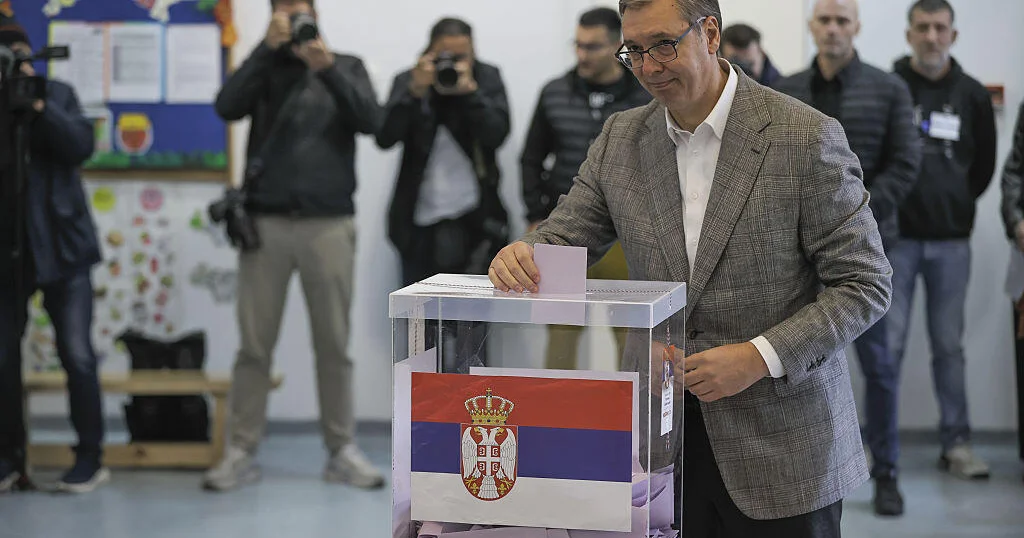
Serbia’s long-serving leader Aleksandar Vucic has conceded defeat in the parliamentary election, acknowledging that a student-backed opposition movement is expected to win a majority after two years of protests against his government.
Vucic told supporters that the Students’ List would take between 135 and 140 of the 250 seats in parliament, while his Serbian Progressive Party (SNS) would secure about 105. He said the movement had won around 2.2 million votes, compared with approximately 1.7 million for the SNS.
“The Students’ List has won,” Vucic said at his party’s election-night gathering. He blamed independent media, alleged interference by unnamed European countries and what he called an “American deep state” for the result.
The projected outcome represents a major political shift in Serbia, where Vucic and his party have held power for 14 years. He had been seeking to become prime minister after serving almost two full terms as president, stepping down from the presidency last month to lead the campaign.
Supporters of the Students’ List poured into the streets of Belgrade and other cities after the announcement, sounding car horns and chanting: “Aleksandar is gone.”
Student movement challenges Vucic’s grip on Serbia
The movement emerged from university-led protests after 16 people were killed in 2024 when a concrete canopy collapsed at a railway station in Novi Sad. Demonstrators blamed high-level corruption, cronyism and widespread graft during renovation work at the station.
Although the protests eroded support for Vucic, he retained a substantial following among voters who regarded him as a capable leader able to guide Serbia through international uncertainty. His opponents accused him of becoming increasingly authoritarian and of dismantling democratic institutions.
The Students’ List was formed by university students, although none of the students appeared on the ballot. Its candidates were described as little-known experts, athletes, farmers and artists, presenting the election as a non-partisan attempt to rebuild the economy and restore democracy.
The movement’s campaign reached beyond Serbia’s cities, with supporters cycling and walking through rural areas that had traditionally been strongholds of Vucic’s party. Its leaderless structure and emphasis on community helped it attract voters disillusioned with established politicians.
Turnout was expected to approach 70 per cent, a level not seen in Serbia since 2000. Long queues were reported at polling stations in Serbia and abroad, while some members of the diaspora were required to vote during the night after authorities linked polling hours to Serbian time.
Tensions were visible in Belgrade as voting took place. Riot police cordoned off an area around the election commission headquarters, special police vehicles were seen near a park where Vucic’s supporters had camped for more than a year, and groups of men dressed in black gathered at several locations.
Independent monitors reported dozens of alleged irregularities, including voters photographing their ballots and attempts at vote-buying. International and local observers had also raised concerns about the safety and fairness of a campaign marked by detentions, extensive government control of the media, and reported surveillance and cyberattacks targeting activists.
The European Union was closely monitoring the election in Serbia, which is a candidate for membership of the bloc. The previous parliamentary election, held in 2023, was followed by opposition protests alleging fraud.
