


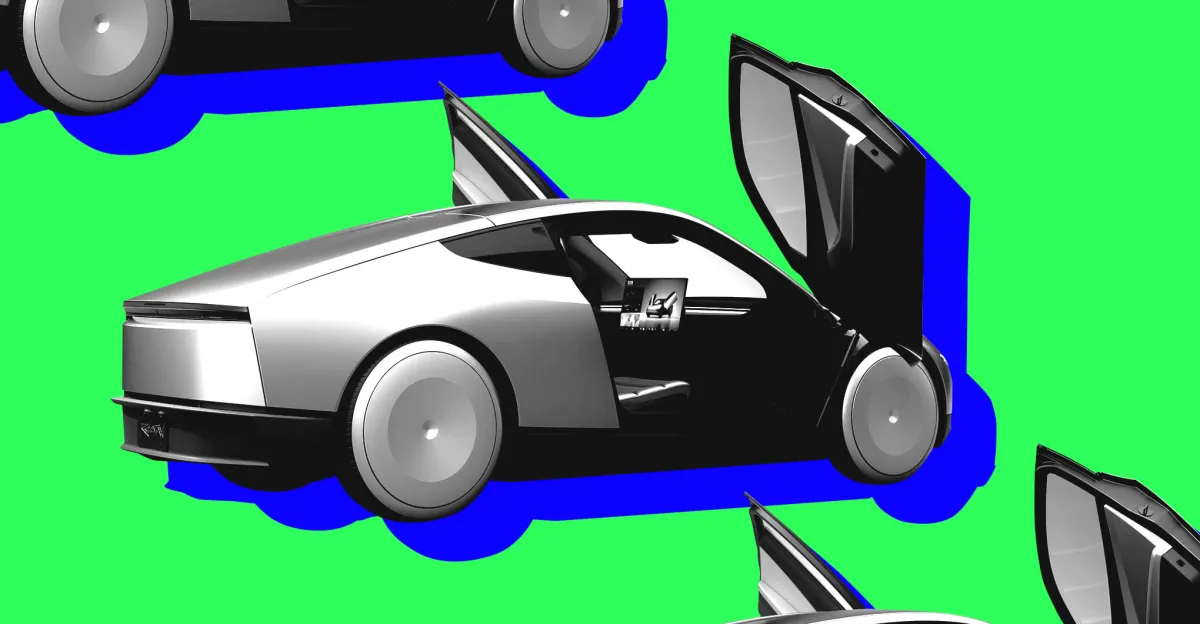
Tesla has begun offering public rides in its Cybercab robotaxis in Austin, Texas, nearly two years after Elon Musk unveiled the futuristic, steering-wheel-free vehicle as the centrepiece of the company’s autonomous driving ambitions.
The two-seater, with gull-wing doors and a distinctive gold-tinted finish, is being introduced as part of Tesla’s robotaxi service. The launch represents a major test of Mr Musk’s long-standing claim that a relatively simple, camera-based system can deliver fully driverless travel at scale.
Unlike most rival autonomous vehicles, the Cybercab does not use lidar – a laser-based sensor widely deployed to measure distance and build a three-dimensional picture of the road. Tesla has instead relied on cameras and artificial intelligence to interpret its surroundings.
Mr Musk has repeatedly dismissed lidar as unnecessary and too expensive. At Tesla’s 2019 Autonomy Day, he called the technology “a fool’s errand” and said companies relying on it were “doomed”. Tesla also removed radar from its vehicle perception systems in 2022, despite concerns from engineers that cameras could be compromised by glare, rain and other conditions.
The Cybercab will use a modified version of Tesla’s Full Self-Driving software. In the company’s existing vehicles, FSD remains a Level 2 driver-assistance system, meaning a human must continuously supervise the car and remains legally responsible for its operation.
For the purpose-built robotaxi, oversight is expected to come from remote operators who can intervene if the vehicle encounters difficulty. Because the Cybercab has no steering wheel or pedals, a breakdown or serious software fault could leave teleoperation as the principal method of moving it to safety.
Tesla has reportedly fitted the vehicles with Starlink connections, which could help maintain communication with remote support staff. Other autonomous vehicle operators, including Waymo, use remote assistance and can send technicians to deal with vehicles that become stranded.
Tesla’s camera-only approach faces scrutiny
The technology is being deployed against a backdrop of continuing questions over the safety record and capabilities of Tesla’s driver-assistance systems. FSD and Autopilot have been associated with thousands of reported crashes and dozens of deaths, although those systems are not equivalent to a fully autonomous Cybercab and Tesla disputes some interpretations of the data.
Tesla says its vehicles using supervised FSD have been involved in 40 to 90 per cent fewer crashes than manually driven cars, based on data covering about two billion miles. The company’s figures have not been independently validated, and the National Highway Traffic Safety Administration is investigating how Tesla reports crashes involving its driver-assistance technology.
Under an NHTSA reporting order, carmakers must disclose crashes in which an advanced driver-assistance system was engaged shortly before an incident that resulted in an injury, death or the vehicle being towed. Tesla accounts for the majority of such reports, in part because it has more vehicles equipped with these systems than other manufacturers.
Waymo, which combines cameras with lidar and radar, operates about 4,000 fully driverless vehicles across as many as 14 US cities, making it the most extensive commercial deployment of autonomous cars in the country. Dmitri Dolgov, the company’s co-chief executive, has said cameras can approach human driving performance but warned that “weak sensing” would limit efforts to achieve safety beyond human standards.
Tesla argues that the Cybercab’s simpler sensor package will make it cheaper and easier to manufacture. The absence of conventional driving controls, including mirrors, pedals and a steering wheel, is also intended to create more space for passengers and improve the economics of operating a robotaxi fleet.
Mr Musk said at Tesla’s “We, Robot” event last year that the vehicle would eventually cost less than 30,000 US dollars, allowing individuals to buy small fleets for their own taxi businesses. However, selling a vehicle without steering controls would require an exemption from US federal safety rules.
The regulatory path is complicated by the absence of a single federal framework governing driverless car deployments. Tesla must secure permission on a state-by-state or city-by-city basis, while California also requires companies to demonstrate that fully autonomous vehicles can operate safely before granting the necessary permits.
Tesla’s existing robotaxi operation in Austin has fluctuated in size and in the proportion of supervised and unsupervised journeys. Robotaxi Tracker estimates that about 110 Model Y vehicles were operating there, although the number of cars visible on the roads does not necessarily reflect how many are carrying paying passengers.
The arrival of the Cybercab is expected to expand that fleet substantially. But its performance in Austin will now be judged not only by how many vehicles Tesla puts on the road, but by whether passengers, regulators and investors are prepared to trust a car that has no human controls and depends on a camera-only view of the world.
