


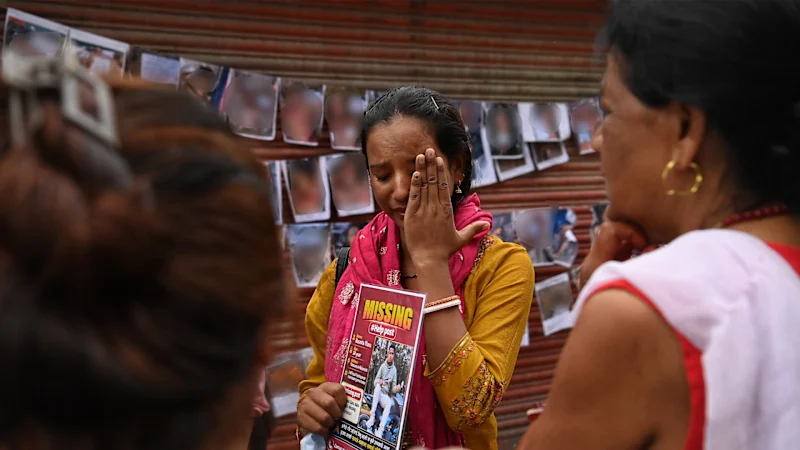
Families searching for relatives missing after Nepal’s devastating floods are gathering outside a Kathmandu morgue, facing the possibility that the bodies inside may hold the only answers to their desperate wait.
At Tribhuvan University Teaching Hospital, police, doctors and volunteers are working through a growing number of remains recovered from the Bhotekoshi River and other flood-hit areas. Relatives study photographs and examine personal details, hoping to recognise a loved one while dreading what they may find.
The hospital’s forensic medicine department said 177 bodies had been brought there for examination. Post-mortems had been completed on 129, while 21 bodies had been identified and released to families.
But the mortuary can hold about 150 bodies and has already exceeded capacity. Eighty-five unidentified victims have been sent for temporary burial at Gokarna after DNA samples were collected and the required legal procedures completed.
Dr Gopal Chaudhary, head of the hospital’s forensic medicine department, said some remains had deteriorated so badly that normal visual identification was no longer possible.
“Some of the bodies have deteriorated to the point where even their faces cannot be recognised,” he said.
Authorities are collecting DNA from the bodies at the hospital and from possible relatives at Nepal Police Hospital in Maharajgunj. The samples will be compared with those of close family members in an effort to establish identities and return the remains to the correct households.
Police have also displayed photographs showing identifiable features, while investigators record clothing, jewellery, tattoos and distinctive marks on the hands or feet. Officials say these clues can help narrow the search, but DNA testing is increasingly required to provide certainty.
“Tattoos, distinctive features of the hands or feet and other identifying marks can help in some cases,” said police superintendent Pradeep Singh. “But for most bodies, identification simply by looking at the face is no longer possible.”
The scale of the disaster has placed intense pressure on Nepal’s limited mortuary facilities. Decomposed bodies cannot be left outside, and some have had to be moved to a cooling facility at Pashupati as hospitals struggle to manage new arrivals.
At the same time, families continue to travel to Kathmandu from across the country. Some carry photographs of missing husbands, wives, children and siblings; others wait for news from areas that remain cut off by destroyed roads and bridges.
Nepal’s disaster management authorities said at least 1,287 people had been killed in the floods of August 26, with more than 5,000 still missing. The disaster is believed to have been triggered by the collapse of a glacier, sending torrents of water and debris through communities in the Himalayan region.
In some affected districts, families have begun holding symbolic funeral rites for relatives whose bodies have not been recovered. Others continue to wait outside hospitals, unwilling to accept that a missing loved one is dead without confirmation.
Inside the Kathmandu morgue, staff work amid heat, strong odours and biological hazards, carrying out examinations and preserving evidence. Outside, relatives wait for an answer that may bring either the relief of certainty or the final confirmation of their loss.
