


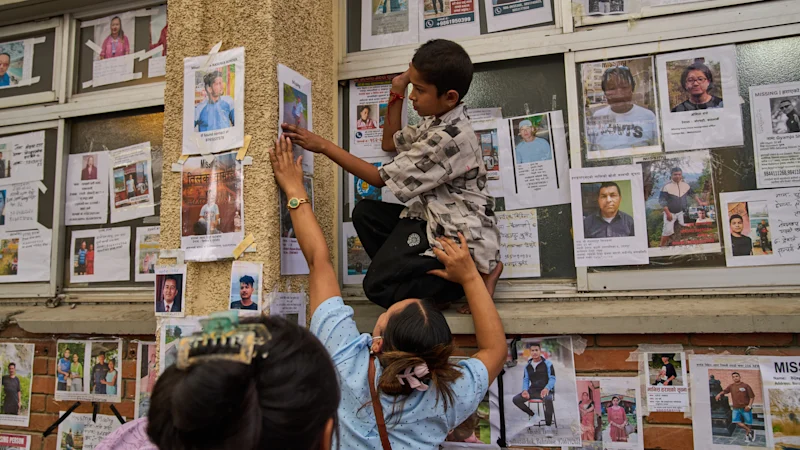
Photographs of missing relatives now cover the walls of Nepal’s largest hospital as families search for loved ones swept away by last week’s catastrophic flooding along the border with Tibet.
At Tribhuvan Teaching Hospital in Kathmandu, visitors scan rows of images and handwritten appeals, hoping a member of staff or another survivor will recognise a face and provide news that a relative is still alive.
Among those searching is Sunita, whose 31-year-old brother Bishal Nepali disappeared after leaving for a morning walk in the border region. His wife, Monita, said the couple last spoke at 7am on Wednesday, roughly two hours before the flood struck.
“My heart is aching and my hope is fading. I feel he will come back but with each passing day I lose hope of his return,” she said.
A photograph of Bishal was added to the hospital wall with an appeal reading: “Urgent request for search and rescue. Our family is worried. After flooding we have no contact with him.”
Nepal’s disaster agency said on Monday that 939 people had died and 3,925 remained missing. A further 900 people were reported missing on the Chinese side of the border, including foreign nationals caught in the disaster.
The flash floods tore through the Bhotekoshi and Trishuli river systems after a collapse in the high Himalayas sent a mass of water, rock, mud and ice downstream. Settlements, bridges, roads and hydropower infrastructure were swept away across northern Nepal and Tibet.
Families have been visiting hospitals and emergency centres to compare official lists with photographs of the dead and missing. Images have also been shown on television screens inside morgues to help relatives identify those who have been recovered.
Families face agonising wait as bodies are buried unidentified
The search for survivors has been complicated by the condition of bodies recovered from mud and floodwater. Officials said morgues had run out of space and humid temperatures were accelerating decomposition, leaving them with little choice but to begin temporary burials before identities could be confirmed.
In and around Bharatpur, three hospital morgues reached capacity. About 200 unidentified bodies were buried in a forest beneath numbered metal markers, with each grave recorded for possible identification and later religious rites.
Rajendra Prasad Dhamala, a government spokesman, said bodies had been sealed in airtight plastic bags and buried about 1.5 metres underground to slow further deterioration.
Nepal’s Foreign Ministry said medical teams had taken DNA samples from every victim before burial. The bodies may be exhumed later if families need to carry out funeral ceremonies, it said. ([mofa.gov.np](https://www.mofa.gov.np/content/1868/press-briefing-by-the-spokesperson-on-bhote/))
More than 900 bodies have been recovered in Nepal, but only about 20 had been identified in the latest figures cited by officials. Many victims had been buried beneath mud or left in floodwater for days, making recognition difficult.
In one case in Pokhara, two families claimed the same body. Police have been using DNA testing, fingerprints and dental records to resolve disputed identifications.
The scale of the tragedy has also raised concerns about the accuracy of the missing-person lists. Families who spoke to reporters said that some relatives believed to have died had not appeared on the official register, suggesting that the eventual death toll could rise.
Rescue teams are separately trying to reach hundreds of workers feared trapped inside tunnels at hydropower projects in Rasuwa and Nuwakot. The Independent Power Producers’ Association of Nepal said about 900 workers were unaccounted for across 12 damaged sites, with around 500 thought to be inside tunnels.
At the Rasuwagadhi hydropower project, the Nepal Army searched a tunnel to its far end but found no one. Three employees reported to have been on duty inside when the flood struck remain missing, while the fate of dozens of other workers at the site is also unclear. ([apnews.com](https://apnews.com/article/744fe6e15ae7751e15efcd6dff70170c))
Army teams have been using excavators, searchlights and controlled explosions to clear water, mud and rock. The operation has become a race against time as rescuers try to establish whether pockets of air remain inside the buried tunnels.
For the families gathered in Kathmandu, however, the hospital wall remains the most immediate focus. Each new photograph offers a slim chance of recognition, while every unidentified body adds to the fear that the search may end without the certainty they are seeking.
