


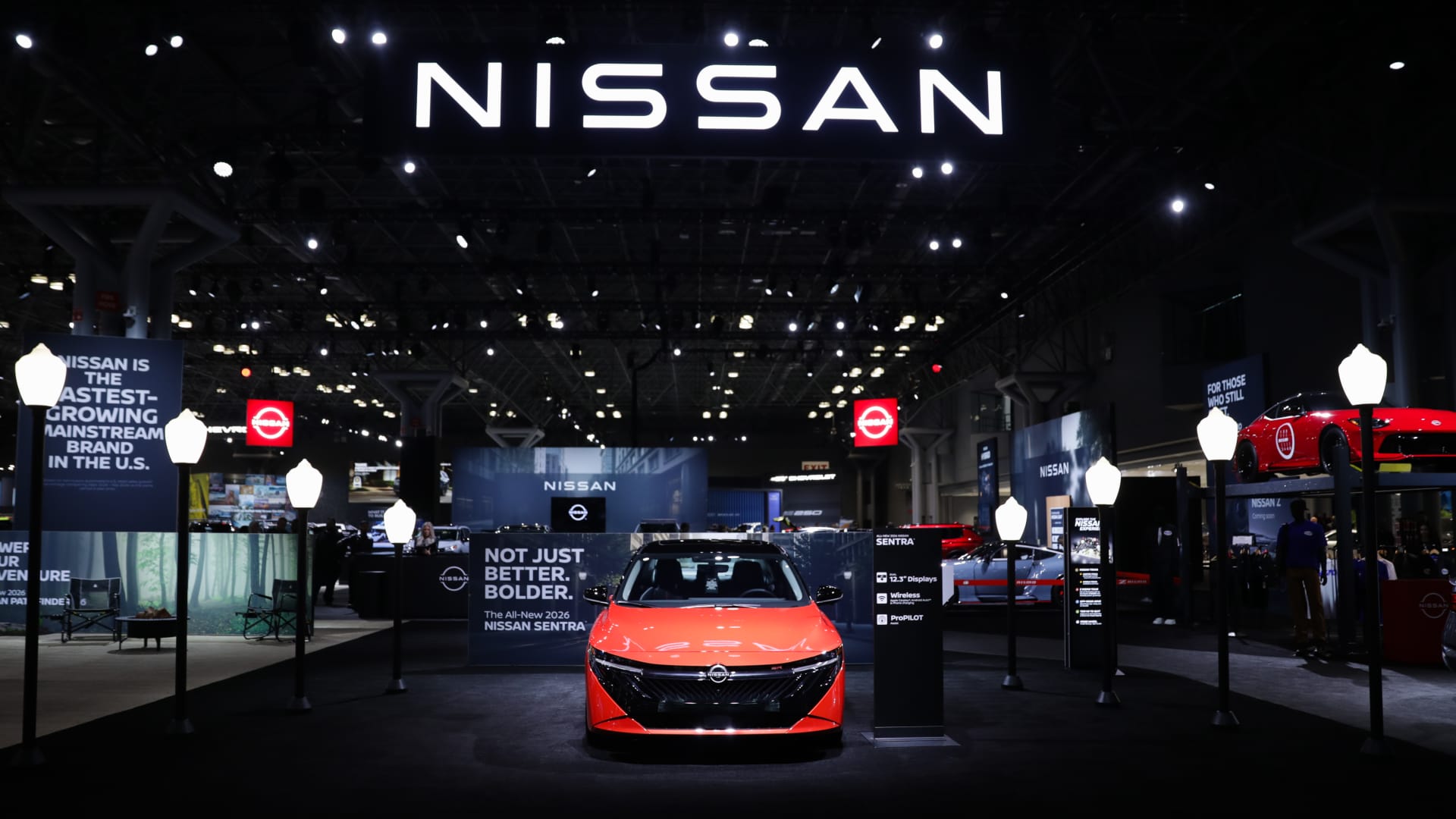
Nissan is preparing to increase production in the United States as it introduces the 2027 Rogue, with a new hybrid model at the centre of its plans for the American market.
Christian Meunier, chairman of Nissan Americas, said the company was operating at full US production capacity and was considering adding a third shift at its factories.
“We’re now maxing out the production capacity in the U.S.,” he said. “The next step is going to be three shifts, and I’m pretty optimistic that with the launch of the new Rogue that is happening in the next couple months, we’ll be able to do that pretty quickly with the launch of the hybrid.”
The Rogue is built alongside Nissan and Infiniti crossovers at the company’s six million-square-foot plant in Smyrna, Tennessee, which currently operates on two production shifts. Nissan also has a factory in Canton, Mississippi, producing the Altima saloon and Frontier pick-up.
If Nissan adds a third shift at its assembly plants, Mr Meunier said US production could rise to roughly one million vehicles a year, compared with nearly 487,000 in 2025.
Production of the conventional petrol-powered 2027 Rogue is due to begin at the Tennessee plant in the spring. US manufacturing of the hybrid is expected to start next year.
Until then, Nissan plans to import the hybrid from Japan to bring it to American customers more quickly, supporting sales as the company pursues a global turnaround.
Nissan aims to produce 80% of the vehicles it sells in the US domestically by 2030. Mr Meunier said the company did not currently plan to build a new factory.
“I think we’re very well equipped to succeed without major investment and a new factory and everything else. Maybe after 2030,” he said. “Over the next four or five years, we’ll see.”
Nissan Rogue hybrid targets Toyota RAV4
Nissan has revealed the 2027 Rogue with its e-Power system, a series hybrid technology being introduced to the US market for the first time.
The petrol engine acts as a generator for the vehicle’s electric motors, which drive the wheels. The system uses a smaller battery than an extended-range electric vehicle and does not need to be plugged in, while the engine does not directly power the wheels.
The hybrid Rogue will cost between 35,490 dollars for the entry-level version and 43,490 dollars for the Platinum model.
The Rogue is one of Nissan’s leading US sellers and competes with the Toyota RAV4 and Honda CR-V, both of which offer established hybrid versions in the small crossover market.
Mr Meunier said the Rogue hybrid had been one of his priorities since returning to Nissan in January 2025 after four and a half years at Jeep. He said its US launch had been brought forward twice.
“The hybrid power that we’re launching on Rogue is going to really be the boost to our performance,” he said. “It’s been quite remarkable to be able to grow without having a hybrid in the U.S. because the hybrids are obviously becoming more and more popular.”
Nissan intends to position the Rogue e-Power against the RAV4. Mr Meunier said the company could even allow prospective buyers to test-drive both vehicles at Nissan dealerships, despite Toyota models not normally being available there.
The Rogue hybrid is expected to deliver 38 miles per gallon in combined fuel economy. Nissan’s figures compare with 43 miles per gallon for the Toyota RAV4 hybrid and 40 miles per gallon for the Honda CR-V.
Nissan’s US turnaround plans
The focus on the Rogue hybrid forms part of Nissan’s wider plan to recover after several years of weak sales. The strategy includes reducing the number of poorly performing models and increasing the use of technologies such as artificial intelligence.
Nissan is targeting one million sales for its brand in both the US and China by the 2030 financial year, while aiming to increase annual sales in Japan to 550,000 vehicles.
US sales rose by about 10% in the first half of the year, while the wider industry recorded a fall of roughly 3% over the same period, according to Cox Automotive.
“I think the next few months are going to be pretty good. Pretty tough, but pretty good,” Mr Meunier said. “We’re going to have a strong close of the calendar year in December.”
