


Donald Trump has played down calls for tighter AI regulation, saying the United States must maintain its lead over China because “whoever wins with AI wins”.
The president said some safeguards could be introduced but offered no details, dismissing warnings that the technology was advancing too quickly and without sufficient oversight as coming from “negative forces”.
“We can put guardrails, we can do this and that, but I think you have a lot of negative forces that are bringing it up that … shouldn’t be bringing it up, and they’re bringing up things that won’t happen,” Mr Trump told reporters during a weekend trip to Ireland.
His comments came a day after Dario Amodei, chief executive of Anthropic, said the industry should slow its rapid development to allow safety measures to catch up. Elon Musk and Sam Altman, the OpenAI chief executive, have also publicly backed the call.
Asked whether AI development should be slowed or regulated, Mr Trump said the US was ahead of China and that he wanted to keep it that way. Chinese President Xi Jinping is due to visit the US later this month for talks with Mr Trump, with AI expected to be among the issues discussed.
Obama urges Democrats to make AI a campaign issue
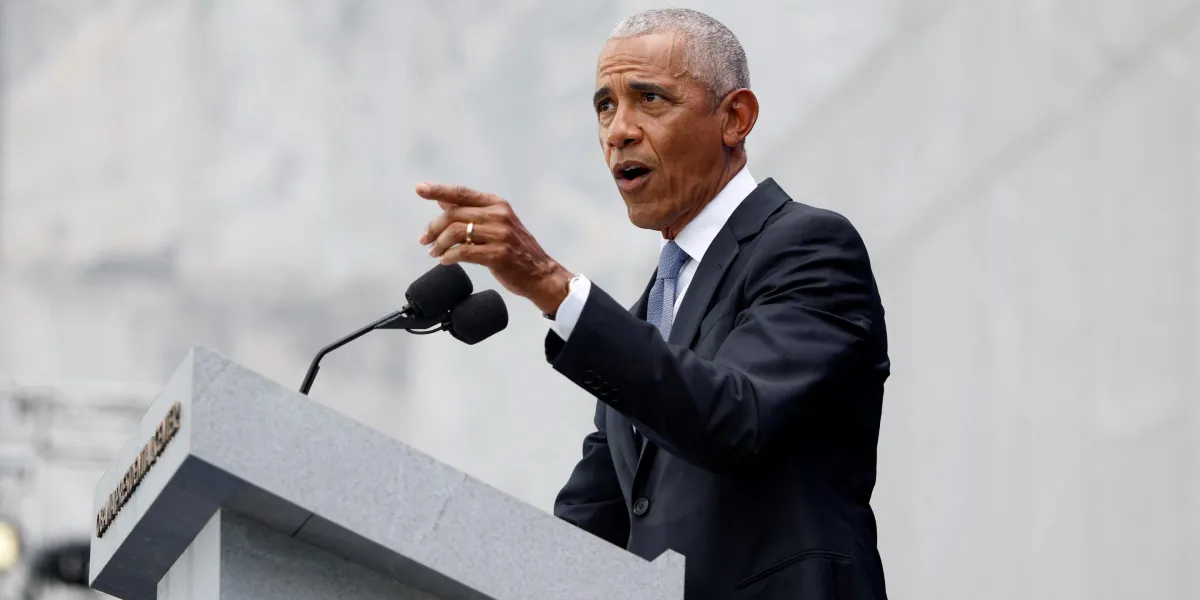
Former president Barack Obama said Democrats should put AI at the centre of their election campaigning, including plans to protect children, address job losses and manage the technology’s economic effects.
“I would talk about this, and I would say, ‘Here’s our plan for safety, here’s our plan for making sure our kids are not corrupted by this.’ … I would be thinking about the economic impacts in very concrete ways and understanding what does it mean if there’s going to be job displacement. Where is that going to hit? How are we going to respond?” he said at an event with Hakeem Jeffries, the top Democrat in the US House.
AI has become a prominent election-year issue as major companies establish computing warehouses in small towns. Communities and politicians from both parties have raised concerns about the effect on farmland and water supplies, as well as potentially higher electricity bills.
Mr Trump has continued to support data centres, even as Republicans and Democrats have sought to distance themselves from them and communities have tried to prevent their construction.
Calls for action in Washington
Kevin Hassett, director of the White House National Economic Council, said administration officials responsible for cyber policy and science and technology were expected to meet this week to discuss the next steps.
He said Mr Trump could also meet members of Congress, adding: “I think the president wants to hear from them as well.”
Mike Johnson, the Republican Speaker of the House, said AI needed “some guardrails, some safety measures” so that it did not “run away”. But he also warned that losing the race with China would pose a national security threat.
Mr Johnson said industry leaders should be brought together for “one big meeting” and said he had discussed the issue with Mr Trump. He described it as a top priority for Congress, while cautioning: “But we don’t need everybody to panic right now.”
Mr Jeffries criticised Republican leaders for allowing lawmakers to return to their districts during the final part of September. He said Congress should act immediately to slow the pace of development and protect the public, with AI expected to be a high priority when House Democrats meet on Tuesday.
Neither Mr Johnson nor Mr Jeffries set out specific measures. Although there is broad agreement that safeguards are needed, previous attempts to impose even limited rules have collapsed.
Jacob Coxon, a former Anthropic employee who resigned over concerns about AI, called for international rules alongside voluntary action by the industry. He said advanced models could soon develop capabilities beyond human control.
“You’re building a human-level or superhuman-level mind, without understanding what it wants, or thinks, or the way it thinks,” Mr Coxon said.
He urged the US and China to co-operate on slowing development, warning that “we risk running the same race with China, which could be equally dangerous”.
David Sacks, a technology investor and co-chairman of a White House advisory council on science and technology, challenged industry leaders who have called for regulation. He argued that they could slow development themselves, writing: “The easiest way not to build superintelligence is for you to agree not to build it.”
