


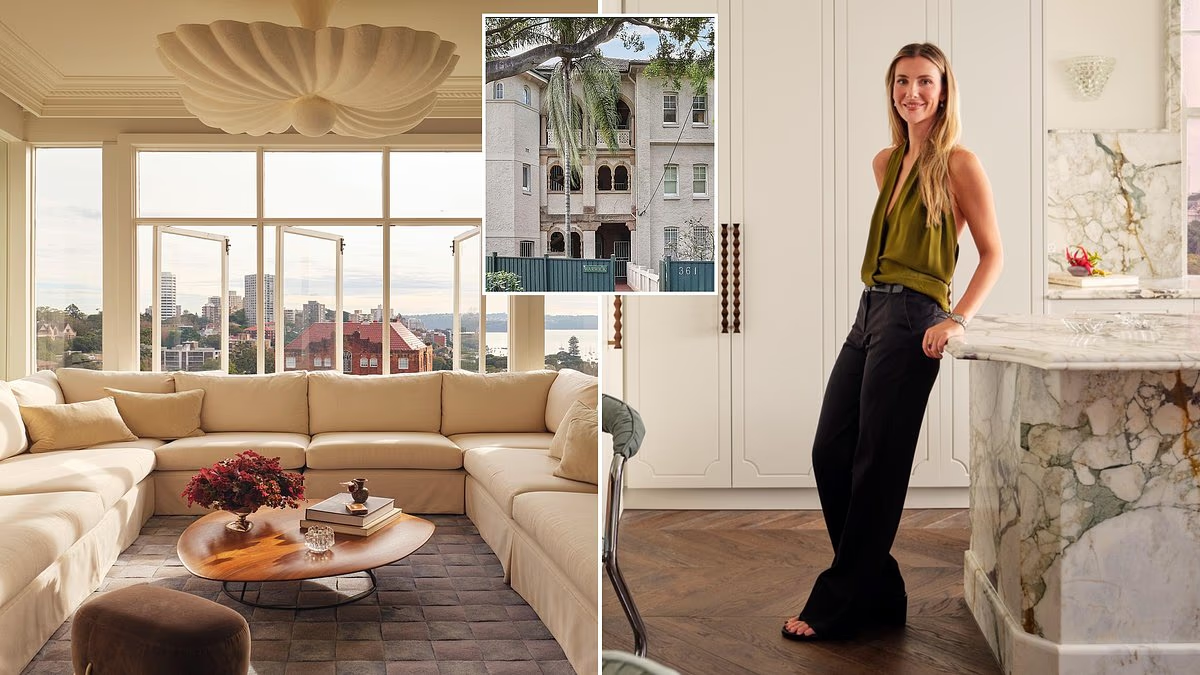
Award-winning interior designer Shona McElroy has spent years creating dream homes for clients across Australia, but when it came to designing one for herself, she knew exactly what she wanted.
The founder of Smac Studio transformed a dated three-bedroom apartment in Sydney’s exclusive eastern suburbs into a light-filled, Parisian-inspired home that blends old-world elegance with contemporary living.
With soaring ceilings, chevron floors, dramatic marble, oversized custom furniture and thoughtful details, Shona has made every room feel both luxurious and effortlessly liveable.
The Australian Interior Design Award nominee said every design decision was intentional, from reimagining the outdated floorplan to maximise entertaining to hiding clever storage in almost every room.
‘I had a pretty clear idea of what I wanted my own home to look like, even though I spend my days designing for everyone else’s needs,’ Shona told Daily Mail.
‘I’ve always been drawn to beautiful European apartments with detailed cornices, chevron flooring and classic architectural features that never really go out of style.’
Along the way, she’s learnt exactly where to splurge, where to save, why beige homes are destined to date, and the styling rules every homeowner should follow.
Award-winning interior designer Shona McElroy (pictured) has spent years creating dream homes for clients across Australia, but when it came to designing one for herself, she knew exactly what she wanted
An dated floorplan with endless potential
When Shona purchased the apartment in 2024, she wasn’t searching for a perfectly renovated home, but rather a property with great bones that she could reimagine with her own unique Parisian-inspired twist.
‘I wanted ceiling height, north-facing light and something I could actually transform,’ she told Daily Mail.
‘Views were always a bit of a pipe dream, but brightness was really important to me, as was finding somewhere that I could completely make my own.’
While the apartment was perfectly liveable, the layout reflected its early 1900s origins rather than the way people live today.
‘The kitchen was tucked away in its own little room, completely separate from the living and dining spaces,’ she said.’
‘This was very typical of homes from that era because the kitchen was considered a private place where food was prepared before being brought out to everyone else.
‘But today the kitchen is really the heart of the home, so I knew straight away that the layout had to change.’

The founder of Smac Studio transformed a dated three-bedroom apartment in Sydney’s exclusive eastern suburbs into a light-filled, Parisian-inspired home that blends old-world elegance with contemporary living

The kitchen required the biggest structural overhaul of Shona’s entire renovation, with the decision to position a statement island at the centre of the space completely transforming how the home is used
Shona decided to completely reworked the layout of the apartment, pushing the bedrooms further back to create a generous open-plan kitchen, living and dining space where people naturally gather.
‘I’ve always been drawn to beautiful European apartments, particularly Parisian interiors.
‘I love detailed cornices, oversized doors, chevron flooring and those classic architectural details that never really go out of style, so I already had a pretty clear vision of what I wanted my own home to become.’
The marble kitchen that transformed the entire home
The kitchen required the biggest structural overhaul of Shona’s entire renovation, with the decision to position a statement island at the centre of the space completely transforming how the home is used.
Rather than selecting a plain slab, she chose a stone featuring soft burgundy, green, rust and gold veining that subtly connects with the colours used throughout the rest of the apartment.

Rather than selecting a plain slab of marble, she chose a stone featuring soft burgundy, green, rust and gold veining that subtly connects with the colours used throughout the rest of the apartment. Pictured: The open plan dining area
‘I wanted something that had all these beautiful colours running through it without feeling overwhelming. It’s still incredibly classic.’
Although natural stone is often avoided because of concerns about staining, Shona believes many homeowners are unnecessarily cautious.
‘I think people are far too scared of marble. I recently returned from Europe where we were walking through buildings made almost entirely from marble, and they’ve been standing for hundreds of years.’
While the marble was a worthwhile investment, she deliberately kept the cabinetry simple to balance the budget.
‘Instead of using expensive timber veneers or highly detailed joinery, we used painted polyurethane cabinetry in the same colour as the walls.
‘One of the easiest ways to make a kitchen feel expensive without blowing the budget is to keep the cabinetry simple and spend your money on beautiful hardware instead.’
Her bronze cabinet handles, created through a collaboration with interiors brand Lo & Co, became statement pieces became statement pieces in their own right.

Shona kept the kitchen cabinetry simple and budget-friendly, opting for painted polyurethane over expensive timber veneers or detailed joinery, then splurging on statement hardware to give the space a more luxurious finish
A living room designed for conversation
Despite the dramatic kitchen renovation, it’s the living room that remains Shona’s favourite space in the apartment.
Bathed in natural light for most of the day, the room centres around an oversized custom U-shaped sofa inspired by the conversation pits of the 1970s.
‘I wanted as much seating as possible because we’re in our early 30s and our home is all about entertaining, but I never wanted the room to revolve around a television.
‘So many living rooms are designed around a screen, whereas I wanted ours to feel like somewhere people naturally gathered to sit, talk and spend time together.’

Despite the dramatic kitchen renovation, it’s the living room that remains Shona’s favourite space in the apartment. Bathed in natural light for most of the day, the room centres around an oversized custom U-shaped sofa inspired by the conversation pits of the 1970s
Unable to find a sofa that fitted the room properly, she designed one herself using one of Smac Studio’s furniture makers.
‘I looked everywhere for something off the shelf, but nothing worked. Sometimes custom furniture really is worth the investment because it fits the room exactly as it should.’
Counterintuitively, she believes many homeowners make the mistake of choosing furniture that’s too small.
‘People often think smaller furniture will make a room feel bigger, but it does the opposite. If you can fit a larger sofa comfortably, the whole room immediately feels more generous.’
The room is layered with oversized books, Murano wall sconces, dramatic lighting and her own bespoke Hali Rugs collaboration inspired by the woven detailing of a Bottega Veneta handbag – worth a staggering $6490.
‘I love weaving fashion into interiors, and that rug was designed around one of my favourite Bottega bags. Once I had that as the foundation, everything else naturally layered around it.’

Unable to find a sofa that fitted the room properly, she designed one herself using one of Smac Studio’s furniture makers. ‘Sometimes custom furniture really is worth the investment because it fits the room exactly as it should,’ she said

The room is layered with oversized books, Murano wall sconces, dramatic lighting and her own bespoke Hali Rugs collaboration inspired by the woven detailing of a Bottega Veneta handbag – worth a staggering $6490

‘So many living rooms are designed around a screen, whereas I wanted ours to feel like somewhere people naturally gathered to sit, talk and spend time together’
Every bedroom has been carefully considered
Storage was one of Shona’s biggest priorities throughout the renovation, particularly in an older apartment where built-in cupboards were almost non-existent.
The primary bedroom features floor-to-ceiling cabinetry on two walls, softened by mirrored panels that reflect natural light back into the room.
‘I needed a huge amount of storage, but I didn’t want it to feel like you were sleeping inside a wardrobe. The mirrors make everything feel lighter and much more spacious.’

Storage was one of Shona’s biggest priorities throughout the renovation, particularly in an older apartment where built-in cupboards were almost non-existent, especially in the bedrooms


The primary bedroom features floor-to-ceiling cabinetry on two walls, softened by mirrored panels that reflect natural light back into the room

Warm mushroom-toned walls, linen Roman blinds and a rich burgundy upholstered bedhead continue the apartment’s sophisticated palette

Even the smallest guest bedroom (pictured) was designed to feel like a boutique hotel suite rather than just somewhere to sleep. ‘We created curtains that separate the sleeping area and make it feel really intimate and dreamy,’ Shone added
Warm mushroom-toned walls, linen Roman blinds and a rich burgundy upholstered bedhead continue the apartment’s sophisticated palette.
Even the smallest guest bedroom was designed to feel like a boutique hotel suite rather than simply somewhere to sleep.
‘Instead of just putting a bed into a tiny room, we created curtains that separate the sleeping area and make it feel really intimate and dreamy. Every single space in the home has a purpose, and I think that’s what makes smaller homes feel much larger.’
Storage can be found almost everywhere, from under the beds to behind bathroom mirrors and even beneath the dining banquette.
‘We have storage everywhere because apartments never seem to have enough. Every opportunity became somewhere to hide things.’
The styling rules Shona swears by
While Shona believes every home should reflect its owner’s personality, there are a handful of design principles she follows every time – and the first is scale.
‘A large rug instantly makes a room feel more expensive, and ideally all of your furniture should sit comfortably on top of it,’ she said.
Her second rule is to layer lighting rather than relying on overhead down lights.

While Shona believes every home should reflect its owner’s personality, there are a handful of design principles she follows every time. One rule she abides by is to layer lighting rather than relying on overhead down lights

She also pushes the notion that every room should be designed with purpose rather than simply filled with furniture. ‘I think every corner needs intention. Whether it’s somewhere to sit with a coffee, read a book or put your keys when you walk in the door, every space should feel like it’s being used properly’
‘If you can light your home without turning on a single downlight, you’re doing something right. We have wall sconces throughout the apartment because every corner deserves its own light source.’
She also pushes the notion that every room should be designed with purpose rather than simply filled with furniture.
‘I think every corner needs intention. Whether it’s somewhere to sit with a coffee, read a book or put your keys when you walk in the door, every space should feel like it’s being used properly.’
How to make your home look expensive for less
Despite working on luxury homes every day, Shona insists creating an expensive-looking home isn’t always about spending more money.
Instead, she recommends investing in the fundamentals before worrying about decorative accessories.
‘Beautiful lighting and quality furniture will always have a much bigger impact than buying lots of styling pieces straight away,’ she said.
One of her favourite money-saving tricks is reducing the amount of wall-to-wall tiling in bathrooms.

One of her favourite money-saving tricks is reducing the amount of wall-to-wall tiling in bathrooms

‘We often paint the walls outside the wet areas instead of tiling everything. It saves a huge amount of money and creates a much more interesting contrast’

Pictured: Her large walk-in shower complete with brass shower head, taps and invisible shelving
‘We often paint the walls outside the wet areas instead of tiling everything. It saves a huge amount of money and creates a much more interesting contrast.’
Artwork, she says, should also be purchased slowly rather than rushed.
‘I loved one particular artist for probably five or six years before I finally bought one of his pieces. I’d rather wait and buy something I know I’ll love forever than spend money filling a wall just for the sake of it.’
The one mistake almost everyone makes
Before buying a single piece of furniture, Shona urges homeowners to carefully measure their space and map everything out on a floor plan to ensure each piece works perfectly within the room.
‘People get excited, purchase something they love online, then realise it’s completely the wrong size once it arrives. Good design starts with planning, not shopping.’
‘Focus on the fundamentals first, and the beautiful layering pieces will come over time, but if you get the bones of a space right, you’ll love your home for years to come.’

Before buying a single piece of furniture, Shona urges homeowners to carefully measure their space and map everything out on a floor plan to ensure each piece works perfectly within the room

When it comes to choosing artwork, Shona has one simple philosophy – bigger is usually better. ‘I think one really large artwork on a big wall almost always looks better than several smaller pieces,’ she said

‘White space is important. Your house shouldn’t be full of things simply because you think every surface needs decorating, so leave space for pieces you genuinely love to find their way into your home over time’
Bigger artwork means fewer regrets
When it comes to choosing artwork, Shona has one simple philosophy – bigger is usually better.
‘I think one really large artwork on a big wall almost always looks better than several smaller pieces,’ she said.
‘The smaller works are lovely in little corners or more intimate spaces, but if you’ve got a wall that can take something oversized, don’t be afraid to go big.’
She also doesn’t believe every wall needs to be filled.
‘White space is important.’
‘Your house shouldn’t be full of things simply because you think every surface needs decorating. Leave space for pieces you genuinely love to find their way into your home over time.’
2026 Design Ins and Outs
Shona reveals the trends taking over in 2026 and the tired aesthetic she says is finally on its way out.

Shona believes colour is needed to add character to a home
IN: Rich, warm browns
Cool, muted palettes are making way for warmer, richer brown tones that bring depth and character to a room.
STILL IN: Velvet
Forget claims it’s dated. Shona says the luxurious fabric has never really gone out of style.
HERE TO STAY: Arches
‘People keep saying arches are out, but I completely disagree,’ Shona says.
While they may have been overused in contemporary homes, she believes they’ll always look beautiful in the right setting.
OUT: Everything beige
The all-beige aesthetic is the trend Shona believes homeowners are most likely to regret.
From beige walls and furniture to bathrooms, she says monochromatic neutral homes can feel ‘completely devoid of personality’.
ONE TO WATCH: More colour
Homeowners are becoming braver with colour, and Shona believes it’s a far better direction for interiors to add character into a home.
