


The Coalition has unveiled plans to dismantle key Australian climate policies as part of a proposed $31 billion spending reduction aimed at easing inflation, putting the country’s green transition at the centre of its economic attack on the Labor government.
Opposition Leader Angus Taylor released early budget costings on Monday, arguing that the savings would fund tax cuts while accusing Prime Minister Anthony Albanese and Treasurer Jim Chalmers of having “run out of ideas”.
The proposals include abolishing or reducing agencies responsible for emissions reductions, scrapping home battery programmes and ending tax breaks for electric vehicle purchases. The Coalition also wants to abolish the safeguard mechanism, the main policy governing emissions reductions, while retaining only the Clean Energy Finance Corporation.
The opposition abandoned its commitment to net zero emissions last year. Its latest proposals are based on the assumption that voters are becoming less concerned about climate policy, although the plans have already prompted criticism within Liberal ranks.
Liberal senator Andrew McLachlan said the party was aligning itself with polluters and abandoning Australia’s transition to cleaner energy, rather than simply changing the pace of Labor’s programme.
“It is a sad day for the Liberal Party that [it] has now repudiated its once proud policy tradition of a commitment to a healthy environment,” he said, adding that Australia’s Pacific allies had a strong interest in climate change.
“The Coalition policy suite is now solely focused on encouraging pollution,” Mr McLachlan said.
Coalition spending cuts challenged
The largest proposed saving is the $9.4 billion climate-related reduction. Other measures include $7.3 billion from ending subsidies for companies and tax credits for critical minerals, $4.7 billion from scrapping Labor’s housing schemes, and $2 billion from blocking National Disability Insurance Scheme and welfare payments for permanent residents.
The Coalition also plans to relaunch its so-called tax back guarantee, which would index tax brackets to inflation to reduce bracket creep. The measure is estimated to cost about $20 billion over four years, with substantially higher costs thereafter.
The government said the opposition remained $110 billion in deficit when the cost of its unfunded commitments was included. These were said to include increased defence spending, reversing changes to negative gearing and capital gains tax, and deep cuts to migration.
Finance Minister Katy Gallagher rejected demands for broad spending reductions, saying they failed to recognise the services now funded by the Commonwealth budget.
She said more than 80 per cent of spending went towards social security and welfare, defence, payments to states and Medicare. Disability spending had increased by two percentage points of gross domestic product since former prime minister John Howard left office, as the NDIS was introduced.
“Many of these program areas are demand-driven and increases (or decreases) occur without a decision of government,” Ms Gallagher said.
She added that, excluding disability assistance, government spending as a share of GDP in the current financial year would be lower than under the Howard, Abbott and Morrison governments.
Inflation pressure intensifies
The dispute comes as markets price in a fifth interest rate rise this year after Sarah Hunter, the Reserve Bank of Australia’s chief economist, said the bank was “not quite” finished tackling inflation.
Dr Hunter also said government spending was “definitely” contributing to inflationary pressure, alongside the war in Iran and higher oil prices.
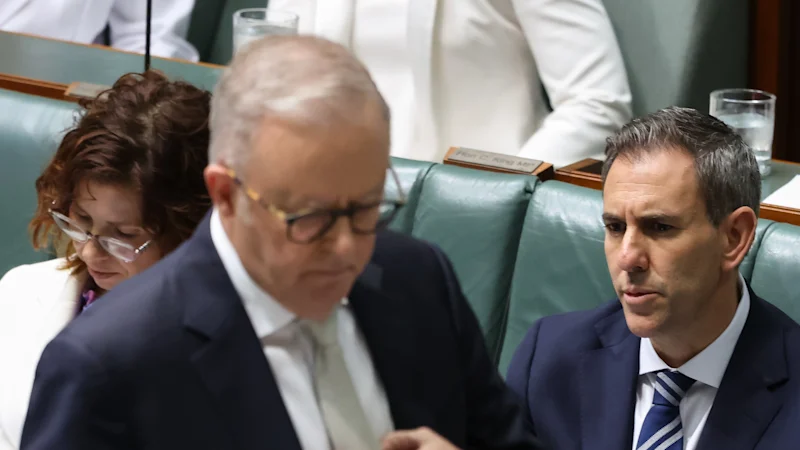
Mr Taylor seized on Mr Chalmers’s argument, made during an Inside Politics podcast, that he would not give in to calls to cap spending. The Treasurer has challenged opponents to identify the areas they would cut.
Prime Minister Anthony Albanese said during question time that Australia’s budget deficit was smaller than that of any other G7 nation, and suggested Labor had avoided cutting spending too sharply in order to protect jobs.
Mr Chalmers said volatility from the Middle East was making Australia’s domestic economic challenges more difficult.
Economists said the government nevertheless had a responsibility to identify appropriate reductions. Richard Holden, an economist at the University of New South Wales, said the government needed to set out its plan if it wanted to be seen as the natural party of government.
Independent economist Chris Richardson proposed reducing the Commonwealth’s share of federal-state infrastructure projects, including major schemes such as Victoria’s Suburban Rail Loop. He also said cutting grants for community projects would have limited financial impact but could demonstrate a willingness to make difficult decisions.
Brendan Rynne, KPMG’s chief economist, said successive governments had allowed public programmes and activities to expand without routinely assessing whether they continued to meet a basic test of value.
