


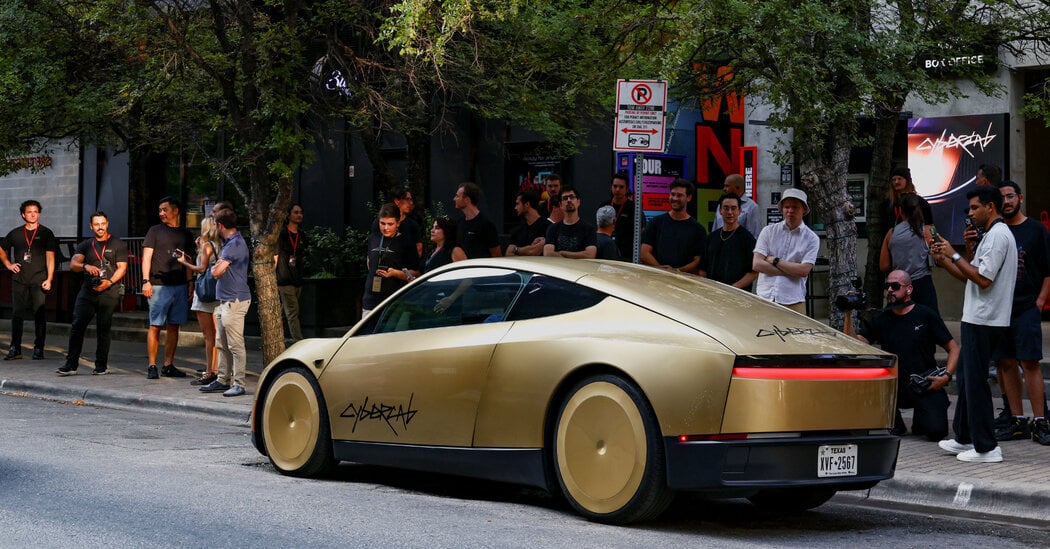
US federal regulators have opened an investigation into whether Tesla’s new Cybercab complies with vehicle safety rules, threatening to disrupt Elon Musk’s plans to expand a paid driverless taxi service.
The National Highway Traffic Safety Administration said on Friday, September 4, that it had launched an audit into Tesla’s certification of the two-seater vehicle, shortly after the company began commercial deployment in Austin, Texas.
The Cybercab has no steering wheel, accelerator or brake pedals, and lacks conventional side and rear-view mirrors. NHTSA said it would examine the technical data and processes Tesla used to declare that the vehicle met all applicable Federal Motor Vehicle Safety Standards. ([nhtsa.gov](https://www.nhtsa.gov/press-releases/investigation-tesla-cybercab-self-certification))
The regulator will also consider whether Tesla decided that certain safety requirements did not apply to an automated vehicle. Existing standards remain in force while the agency considers changes intended to accommodate autonomous vehicles, NHTSA said.
“NHTSA fully supports the safe development and deployment of automated vehicles. But as the federal regulator, we need to ensure that all of our laws are followed,” Jonathan Morrison, the agency’s administrator, said.
Automakers in the United States generally certify for themselves that their vehicles comply with federal safety standards, subject to regulatory oversight. NHTSA has authority to permit limited numbers of vehicles without conventional controls, but Tesla has not obtained such an exemption, according to the agency. ([nhtsa.gov](https://www.nhtsa.gov/press-releases/investigation-tesla-cybercab-self-certification))
The investigation follows a launch event in Austin on Thursday, when Tesla displayed dozens of gold-painted Cybercabs near its Texas factory and began offering rides. The company has permission from the Texas Department of Motor Vehicles to operate 45 of the vehicles for paid journeys.
Reuters reported that Tesla had 45 Cybercabs among 420 autonomous vehicles registered in Texas on Friday morning. The company has said it intends to expand the service to more vehicles and other locations, while also inviting enquiries from potential fleet buyers. ([investing.com](https://www.investing.com/news/stock-market-news/us-auto-safety-regulator-opens-probe-into-nearly-1000-tesla-cybercabs-4889162))
Tesla did not immediately respond to requests for comment. Its shares fell by more than 5 per cent in early trading on Friday after the investigation was announced, reversing gains made following the Austin launch. ([apnews.com](https://apnews.com/article/2228b6499d46c79169672f874e67eef1))
The company has presented the Cybercab as central to Mr Musk’s ambition to transform transport through autonomous vehicles. The model is not yet available for individual purchase, and its future commercial rollout now depends in part on whether Tesla’s interpretation of federal safety rules withstands regulatory scrutiny.
NHTSA has been developing proposals to revise requirements for autonomous vehicles, including rules covering brake pedals and mirrors. In the meantime, the agency said, manufacturers must comply with the regulations currently in effect. ([nhtsa.gov](https://www.nhtsa.gov/press-releases/investigation-tesla-cybercab-self-certification))
