


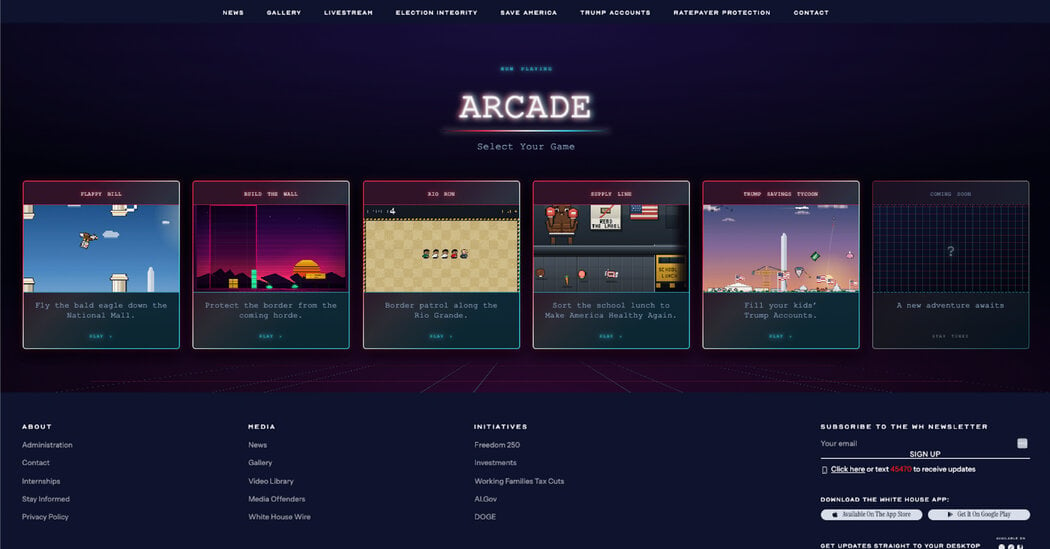
The Trump administration has provoked a backlash from The Tetris Company after launching a White House video game that uses the familiar block-stacking format to promote a border wall and depict migrants as an invading horde.
Called Build the Wall: Zombie Border Siege, the game instructs players to stack bricks and “protect the border from the incoming horde”. Figures described in the game as aliens and zombies explode when they collide with the wall.
The game appeared on an official White House online arcade launched on Thursday, featuring five retro-style titles based on policies associated with President Donald Trump. The administration promoted the site with the message: “Can’t stop winning. Build the wall. Deport. Fill a Trump Account.”
The Tetris Company said it had no involvement in the game and issued a pointed warning over its use of the brand’s distinctive gameplay.
“At Tetris we believe in the power of connection and bringing people together, not dividing them,” the company said in a statement posted on social media. “To our fans everywhere: we love you, we see you, and we’re grateful to have you in our community.”
It added: “The Tetris Company was not involved in the creation of ‘Build the Wall’,” followed by the warning: “We take copyright infringement very seriously.”
The White House arcade also includes Rio Run, a version of the classic game Snake in which players patrol the Rio Grande, intercept people attempting to cross the border and build up a line of deportees.
Other games ask players to collect money for so-called Trump Accounts, sort school lunches under the administration’s “Make America Healthy Again” initiative, and guide a bald eagle through obstacles around the National Mall.
The Tetris game is based on the puzzle created by Soviet software engineer Alexey Pajitnov in 1984, in which falling geometric shapes are arranged to complete lines. The Tetris Company continues to license official versions of the game, including editions featuring characters from Nintendo franchises.
The company successfully sued a maker of a Tetris clone in 2012, in a case that strengthened protection for the visual appearance and overall “look and feel” of a video game under US copyright law.
The White House has increasingly used gaming imagery and online culture to appeal to younger male voters. In a separate post, the Department of Homeland Security previously compared migrants with the flesh-eating Flood aliens from Microsoft’s Halo series, prompting Microsoft to say it had no comment.
