


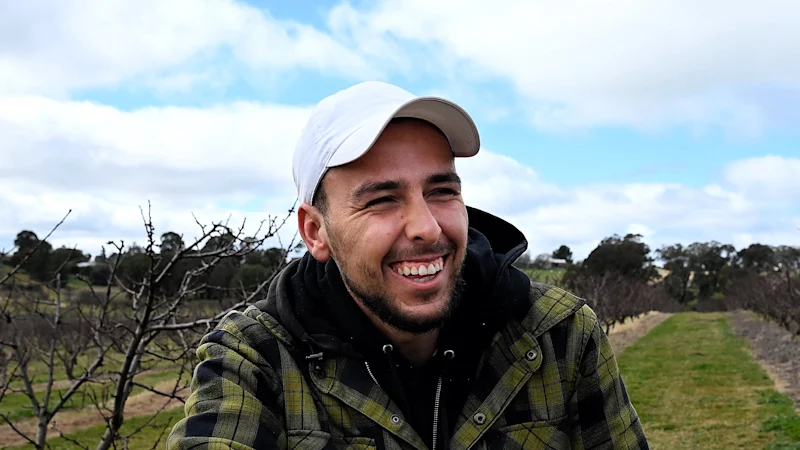
For three generations, the Ali family has found a life far from Sydney among the cherry orchards of Young, a small town in New South Wales where a growing Lebanese community has put down deep roots.
Mostapha Ali arrived in Australia in 1977 after civil war erupted in Lebanon. He initially settled in Sydney, where his seven children grew up, but repeated trips to regional areas for seasonal fruit-picking eventually drew him back towards the farming life he had known in northern Lebanon.
In 1990, he bought a cherry farm on the outskirts of Young and set about rebuilding the family’s connection with the land. His son Bassam, now 52, followed him into the orchard, while his grandson Mohammed, 25, is continuing the family business.
“Dad was an old-school farmer. He used to grow pomegranates and olives in his village. So when he came to Young, he picked farming back up,” Bassam said.
“And we have laid roots here. Young is a special place.”
Young’s Lebanese cherry farmers
The Ali family brought more than labour to the orchard. Traditional Lebanese methods were adapted to the Australian soil, including hand-dug trenches around trees to retain water, a technique used in rural Lebanon for generations.
“We’d dig the trenches by hand. It’s an old technique, but a good one,” Bassam said. “It was more natural, no chemicals. My father was a simple but dedicated farmer.”
Mohammed remembers being put to work among the trees from an early age, alongside his uncles and aunties. He now rides through the orchard on a dirt bike, checking the rows of cherry trees established by his grandfather.
“He was a straight shooter,” Mohammed said of Mostapha. “He was a well-respected, hard-working farmer who you’d never want to cross.”
The Ali family is part of a wider migration from Sydney to Young by Lebanese families whose roots lie in rural villages rather than the large cities of Lebanon. Many first settled in western Sydney after arriving in Australia, following relatives and relying on established family networks.
For some, however, the crowded pace of city life never replaced the farming traditions they had left behind. Young, known as the Cherry Capital of Australia, offered a way to return to agriculture while remaining in Australia and building a future for their children.
Mahmoud Khodr moved his family to the town 17 years ago after visiting with his in-laws. He bought a neglected orchard and gradually restored it, working alongside his son among the trees.
“I came here for the first time with my in-laws and I fell in love with it. It smelt like the village from back home,” Khodr said.
“If you gave me a house worth $2 million in Sydney, I’d still stay here. It’s the calm I was looking for.”
Young’s cherry industry has long been central to the town’s identity, with orchards spread across the surrounding Hilltops region and the harvest attracting visitors during the warmer months. New South Wales’ primary industries department identifies Young, alongside Orange, as one of the state’s main cherry-growing centres.
The Lebanese community has grown alongside the orchards, establishing social, religious and educational institutions in a town far removed from the migrant hubs of western Sydney. A new mosque in Young was officially opened on 14 August, with the local Muslim population estimated to account for about a tenth of the town’s residents. ([youngwitness.com.au](https://www.youngwitness.com.au/news/young-mosque-officially-opened-uoamns3t?utm_source=openai))
For families such as the Alis and Khodrs, the move was not simply an economic decision. It was a chance to recover a rural way of life, preserve knowledge inherited from Lebanon and pass it on to another generation.
“There are no headaches or rushing here,” Khodr said. “I love it.”
