


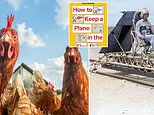
Aircraft safety has been tested in ways far removed from the polished cabins and smooth take-offs passengers see, according to a new book exploring the hidden world of test engineering.
In How to Keep a Plane in the Sky, author Alex Davies examines the extraordinary methods used to discover how aircraft and everyday products might fail — from firing dead chickens at planes to using human crash-test dummies to measure the limits of the body.
The book, due to be published on September 10, reveals how engineers subject aircraft to punishing experiments before they are allowed into service. Wings are bent towards breaking point, tyres are repeatedly slammed into the ground and planes are exposed to artificial lightning.
Bird-strike testing is carried out using so-called chicken cannons, which launch carcasses at aircraft components to recreate the impact of birds in flight. The gruesome experiment is designed to show whether windscreens, cockpit structures and other parts can withstand a collision at speed.
Davies also describes the use of rocket sleds and other equipment intended to reproduce the violent forces experienced during accidents. Human crash-test dummies, meanwhile, have helped researchers establish how much force different parts of the body can endure — information that can then be used to assess the protection provided by vehicles and safety systems.
The hidden work behind safer products
The investigation reaches beyond aviation, looking at the engineers who test cars, bridges and apparently simple household items. Their work includes checking whether childproof bottle caps can withstand determined attempts to open them and whether structures can endure forces far beyond those expected in normal use.
Davies argues that this largely unseen discipline is essential because inventing a product is only the beginning. Test engineers must anticipate the unlikely, expose weaknesses and identify the circumstances in which something could crack, collapse, catch fire or otherwise fail.
Published by Elliott & Thompson, the 272-page book presents test engineering as a methodical search for danger, carried out so that products can be trusted when they are eventually put into the hands of the public.
