


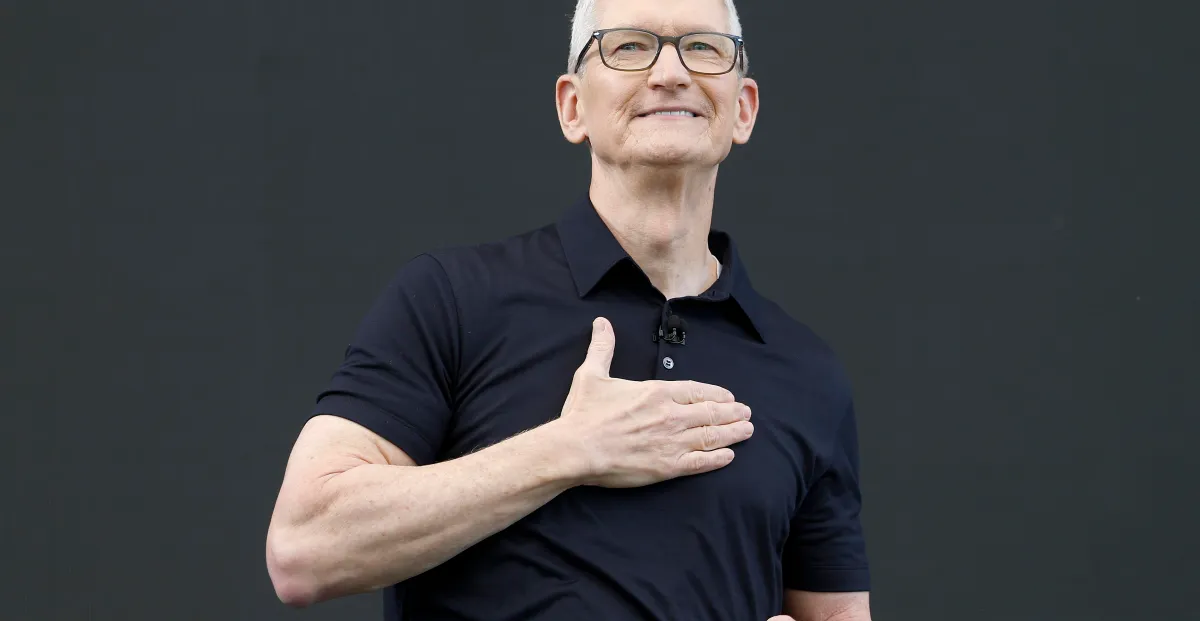
Tim Cook is stepping down as Apple chief executive after 15 years at the helm, handing responsibility for the world’s most valuable technology company to hardware chief John Ternus.
Cook inherited Apple in 2011 at the height of the iPhone’s rise, following Steve Jobs’s return to the company and the launch of products including the iPod, Mac innovations and the iPhone. His tenure has been defined less by a single breakthrough than by the expansion and consolidation of the business Jobs left behind.
As executive chairman, Cook will remain involved in Apple’s relationship with US president Donald Trump. Ternus, who has led the company’s hardware operations, takes over as Apple faces pressure to deliver its next major product success while maintaining the enormous profits built during Cook’s leadership.
Services become Apple’s second engine
One of Cook’s most significant achievements was reducing Apple’s reliance on the iPhone. When he became chief executive, the handset accounted for roughly half of the company’s revenue. Apple’s services division has since grown into its second-largest source of sales.
The division has been built around the App Store and expanded through iCloud, Apple Pay, Apple Music, Apple TV Plus, Apple Arcade, Apple News Plus and Fitness Plus. Apple has also introduced Apple One, a subscription bundle, and its own credit card.
The company reported services revenue of $100 billion last year, underlining the importance of recurring payments alongside hardware sales. The strategy has helped Apple generate more predictable income as the smartphone market has matured.
The Apple silicon gamble
Cook also oversaw one of Apple’s biggest technical changes: replacing Intel processors in Mac computers with chips designed in-house.
The transition began in 2020 with the M1 processor, used in the MacBook Air, MacBook Pro and Mac mini. Rather than causing the compatibility and performance problems that have dogged some other moves to Arm-based computing, Apple’s chips quickly became a selling point for its computers.
Apple completed the move away from Intel in 2023. The company has continued developing its M-series processors and has also produced its own 5G modem, first used in the iPhone 16e.
Apple Watch and AirPods broaden the empire
Under Cook, Apple moved decisively into wearables. The Apple Watch, launched in 2015, developed from an iPhone accessory into a health-focused device capable of recording an ECG, identifying irregular heart rhythms and detecting sleep apnoea.
AirPods followed in 2016 and helped turn wireless earbuds into a mass-market product category. More recent models have included hearing-protection tools and a hearing-aid function authorised by the US Food and Drug Administration.
Cook said in a 2019 interview that he believed Apple’s greatest contribution to humanity could ultimately be in healthcare. The company’s wearables strategy remains one of the clearest examples of Apple creating a substantial new business during his tenure.
Financially, the results have been extraordinary. Apple became the first US company to pass a market capitalisation of $1 trillion in 2018, and subsequently crossed the $2 trillion, $3 trillion and $4 trillion thresholds.
Privacy became a defining cause
Cook made privacy a central part of Apple’s public identity. In 2015, he opposed a US government request for access to the iPhone used by one of the San Bernardino attackers, warning that creating a back door could weaken security for other customers.
Apple has since promoted features including Private Relay, Advanced Data Protection and Private Cloud Compute, designed to limit access to personal information and protect certain artificial-intelligence requests.
That stance has been tested in Britain, where Apple is challenging demands to provide access to encrypted iCloud data. The dispute has placed the company’s commercial interests and its claims about privacy in direct tension with government demands for access to information.
Vision Pro and the Apple Car expose the risks
Not every expansion under Cook has delivered. The Vision Pro headset, released in 2024, was Apple’s most ambitious attempt to create a new computing platform since the iPhone and Apple Watch.
But its $3,499 price and limited practical applications restricted its appeal. The Financial Times reported in December 2025 that Apple had reduced production and marketing because of weak sales, while Bloomberg reported cuts to the headset’s development and gaming teams.
Project Titan, Apple’s secretive attempt to develop an autonomous vehicle, ended more decisively. The project is reported to have consumed more than $10 billion before Apple abandoned it and disbanded a team of about 2,000 people.
Cook had publicly acknowledged in 2017 that Apple was concentrating on autonomous systems, but the company never turned the long-running project into a product.
Siri, regulation and the unfinished work
Apple’s difficulties in artificial intelligence may prove to be the most important issue inherited by Ternus. Siri has received incremental improvements since the start of Cook’s tenure, but it has struggled to match rival voice assistants in answering questions and carrying out complex tasks.
A promised overhaul, announced in 2024, was delayed after Apple failed to deliver features intended to let Siri perform actions across applications. The company later changed its artificial-intelligence leadership and agreed to pay $250 million over allegations that customers had been misled about the upgraded assistant. Apple has said the new Siri is expected to launch in the autumn, more than two years after it was first shown.
The App Store has also become a source of legal and regulatory trouble. Epic Games sued Apple in 2020 after Fortnite was removed for using Epic’s payment system, bringing renewed scrutiny of Apple’s commission and control over software distribution.
In the European Union, Apple has faced pressure to allow alternative app stores and payment arrangements. Its efforts to comply have been criticised by developers and regulators, highlighting how heavily the company depends on the App Store and its associated revenues.
Apple Maps provided an earlier warning about the cost of releasing an unfinished product. Its 2012 launch was marred by missing information, misplaced landmarks and blank areas in cities including London, Beijing and Tokyo. Cook apologised publicly, while the service was gradually rebuilt into a far more capable part of the iPhone.
Cook leaves behind an Apple that is substantially richer, more diversified and more influential than the company he took over. His successor’s challenge will be to find the next defining product without sacrificing the operational discipline that turned Cook’s Apple into a technology powerhouse.
