


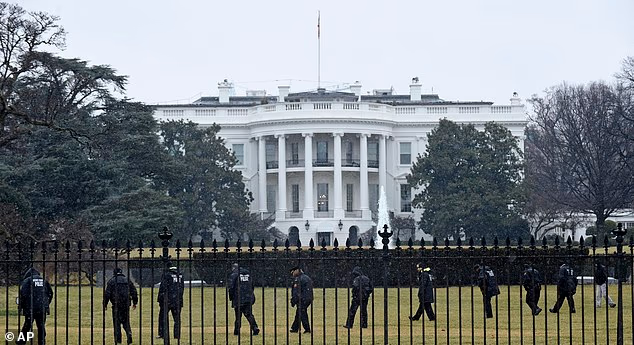
The Trump administration is pressing ahead with plans for a permanent security fence around Lafayette Square, the historic public park directly opposite the White House in Washington DC.
The proposed black metal barrier would stand between eight and 10 feet high and enclose the entire eight-acre park. It is due to be discussed by the National Capital Planning Commission on Thursday, although the panel is considering the fence’s design and positioning rather than granting final approval for construction.
The scheme would replace the temporary fencing, bollards, bicycle racks and other improvised barriers repeatedly deployed around the presidential residence during major security operations.
Large gates at the park’s main entrances would allow officials to close Lafayette Square quickly when necessary, while keeping it open during normal conditions, according to the administration’s proposal.
The National Capital Planning Commission’s published agenda confirms that the meeting will take place on September 3, 2026, and is open to the public. No vote on the fence is expected.
Permanent Lafayette Square fence would alter historic public space
The White House and the US Secret Service have argued that permanent infrastructure would make it easier to protect the president and manage access during periods of heightened risk.
The proposal follows a series of threats to Donald Trump, including two incidents during the 2024 presidential campaign and a further incident in April, when a gunman opened fire near a White House correspondents’ dinner attended by the president.
Security concerns intensified again in May, when Secret Service officers fatally shot a man who opened fire near a White House security checkpoint.
Trump has backed the wider effort to strengthen security around the 18-acre White House complex, although he has said decisions should be left to the Secret Service.
“It’s only up to Secret Service. I just follow what they’d like to do,” he said last month when asked about the agency’s security projects.
White House officials have said the changes would improve both the safety and appearance of the area. Secret Service representatives have also described the proposed fence, alongside a planned visitors’ screening centre, as a way to enhance protection while preserving public access.
Lafayette Square has already been closed and surrounded by temporary fencing for almost eight months during a renovation project overseen by the National Park Service. The work included repairs to the park’s fountains, but the barriers remained in place after the improvements were reportedly completed.
In July, the US Commission of Fine Arts reviewed the concept and expressed support for a permanent solution to public safety concerns, while taking no formal action on the proposal.
The commission said the park should remain as open as possible for peaceful gatherings and recognised its historic role as a site of First Amendment activity. It described the proposal as an enclosure rather than a closure, but called for further work on its design.
Officials are considering whether monuments at the four corners of Lafayette Square should sit inside or outside the perimeter. The commission has also suggested a simpler alignment, gates flanked by masonry piers and fencing modelled on the existing White House barrier.
The administration is separately pursuing an underground White House Visitor Screening Facility, intended to replace temporary tents used to screen tourists, staff, contractors and guests. The 33,000-square-foot centre is planned for completion by July 2028 and has been moved to the western edge of the site following consultations over underground utilities.
Preservationists and civil liberties advocates fear that the Lafayette Square fence could make it easier for authorities to restrict access to one of Washington’s most prominent venues for demonstrations.
The park has long attracted protesters, tourists and campaigners seeking a close view of the White House. Critics say a permanent barrier could weaken the symbolic connection between the public and the seat of the US presidency, even if its gates remained open most of the time.
Eleanor Holmes Norton, Washington DC’s non-voting representative in Congress, has said she plans to introduce legislation opposing permanent fencing around Lafayette Square, Pennsylvania Avenue and other areas near the White House.
“More fencing around the President’s Park would send the wrong message to the nation and the world by continuing to transform our democracy from one that is accessible and of the people to one that is exclusive and fearful of its own citizens,” she said in a statement.
The dispute echoes earlier arguments over White House security. Lafayette Square was fenced during protests after George Floyd’s death in 2020, when federal law enforcement cleared demonstrators from the area shortly before Trump walked to St John’s Episcopal Church.
The park had permanent fencing in the 19th century, including an iron perimeter installed in 1853, but it was removed in 1888 and 1889. Since then, successive administrations have resisted making the security boundary permanent because of concerns over public access.
The latest proposal would therefore mark a significant change to the appearance and use of the historic square, placing the future of one of Washington’s best-known public gathering spaces at the centre of the White House security debate.
