


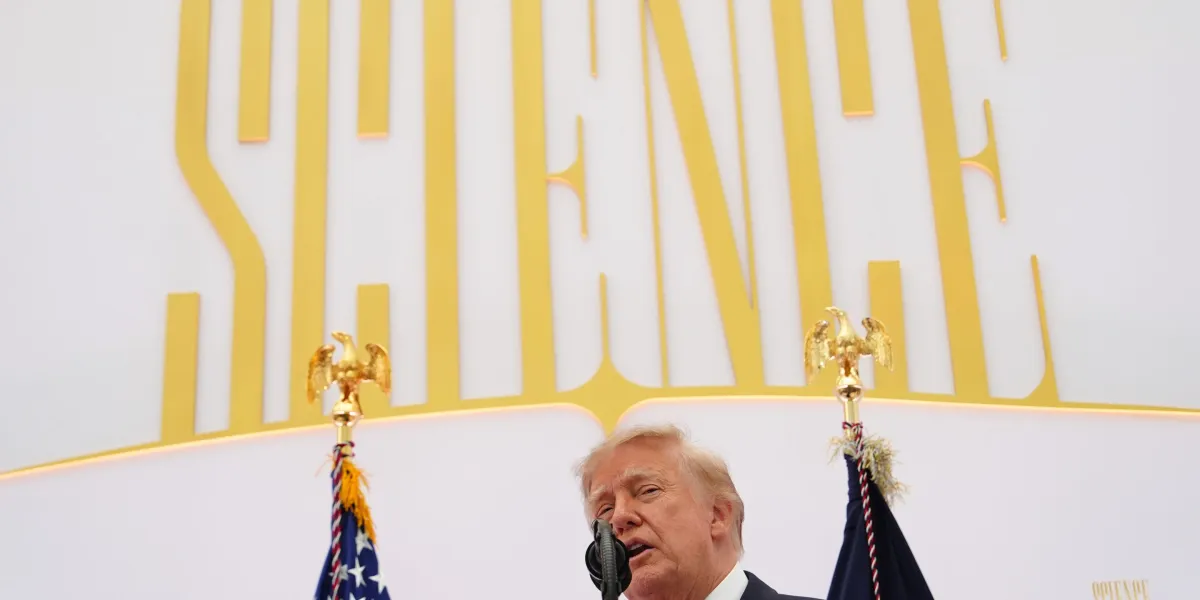
Donald Trump honoured six leading technology executives at the White House on Thursday, including Microsoft chief executive Satya Nadella, hours after his vice-president accused the company of abusing the visa system to recruit foreign workers.
The awards highlighted a tension at the heart of the administration’s approach to immigration: its criticism of companies hiring overseas talent alongside its support for immigrant entrepreneurs credited with driving American innovation.
JD Vance announced before the ceremony that Microsoft had been suspended from a programme allowing companies to apply for green cards for skilled foreign workers holding H-1B visas.
“Our message to Microsoft is: You’re a great American company, but you’ve got to hire great American workers,” Mr Vance told reporters. “You cannot lay off American workers and then replace them with foreign indentured servants.”
He said Microsoft had dismissed 6,000 US workers last year while obtaining 6,300 H-1B visas and almost 3,000 green cards.
Microsoft, which is based in Redmond, Washington, said most of its H-1B applications during the last financial year were “to extend or change the status of existing Microsoft employees”. The company has 223,000 employees worldwide.
Despite the criticism, Mr Trump praised Mr Nadella as he presented him with the National Medal of Technology and Innovation, making no reference to the visa dispute.
“For more than three decades, Satya Nadella has been a key figure in the transformation of Microsoft, revolutionizing the company and empowering businesses, students and consumers from all over the world with some of the most capable software ever built,” the president said.
Asked about the apparent contradiction, Mr Vance said: “We’re going to continue to support Microsoft and have a great relationship with Microsoft.”
Trump honours tech leaders as ‘national treasures’
Five of the six executives receiving awards were born outside the US. Mr Nadella immigrated from India, while Elon Musk was born in South Africa, Google co-founder Sergey Brin in Russia, and Nvidia chief executive Jensen Huang and AMD chief executive Lisa Su in Taiwan.
Mr Trump presented the National Medal of Science to Mr Musk, Mr Brin, Mr Huang and Ms Su. He awarded the National Medal of Technology and Innovation to Mr Nadella and Dell Technologies chief executive Michael Dell, who was born in Texas.
Mr Dell has supported the government’s special investment accounts for children, known as Trump Accounts. Mr Nadella later thanked the president on social media, saying he was “humbled to stand alongside so many giants of American innovation”.
Mr Trump described the recipients as “national treasures”, comparing them with his uncle, John Trump, an electrical engineer and Massachusetts Institute of Technology professor who received the National Medal of Science in 1983.
“Such a big day in the world of science and the world of technology — this is the biggest day there is,” Mr Trump said. “You’re going to go down in the annals of history as being great.”
The ceremony formed part of a summit promoting a new “golden age” of science. Mr Trump has increasingly relied on technology companies and artificial intelligence to advance his economic agenda, calling for the US to lead its development while opposing safeguards he believes could restrict growth.
The White House said the recipients were helping to preserve America’s position in global innovation. Liz Huston, a White House spokesperson, said: “These recipients are helping ensure America keeps leading the world in innovation.”
The honourees have made frequent visits to the White House in recent weeks. Mr Musk, Mr Huang and Ms Su attended a state dinner for China’s leader, Xi Jinping, while Mr Brin, Mr Nadella and Mr Dell were also present. Mr Huang and Mr Musk were among technology executives who last week signed a voluntary agreement on AI development.
Mr Vance also said universities including Stanford and MIT should be investigated for visa fraud. Mr Huang and Mr Brin studied at Stanford, while Ms Su has several degrees from MIT.
The awards came less than a month before November’s midterm elections, as Mr Trump seeks to emphasise the impact of AI investment on the stock market and the wealth of richer Americans. Polling cited at the event indicated continuing concern across party lines about the pace of AI development, while high prices for essentials were weighing on the wider economic outlook.
