


The US has announced a new task force aimed at disrupting Iran’s land and sea supply routes for advanced weapons, as Washington expands efforts to restrict Tehran’s military networks.
Task Force Iron Gate will operate from Tampa, Florida, and coordinate with other US government agencies to target the movement of weapons systems, dual-use technology, sanctioned materials and alleged illegal revenue streams across Iran’s land borders and the Caspian Sea.
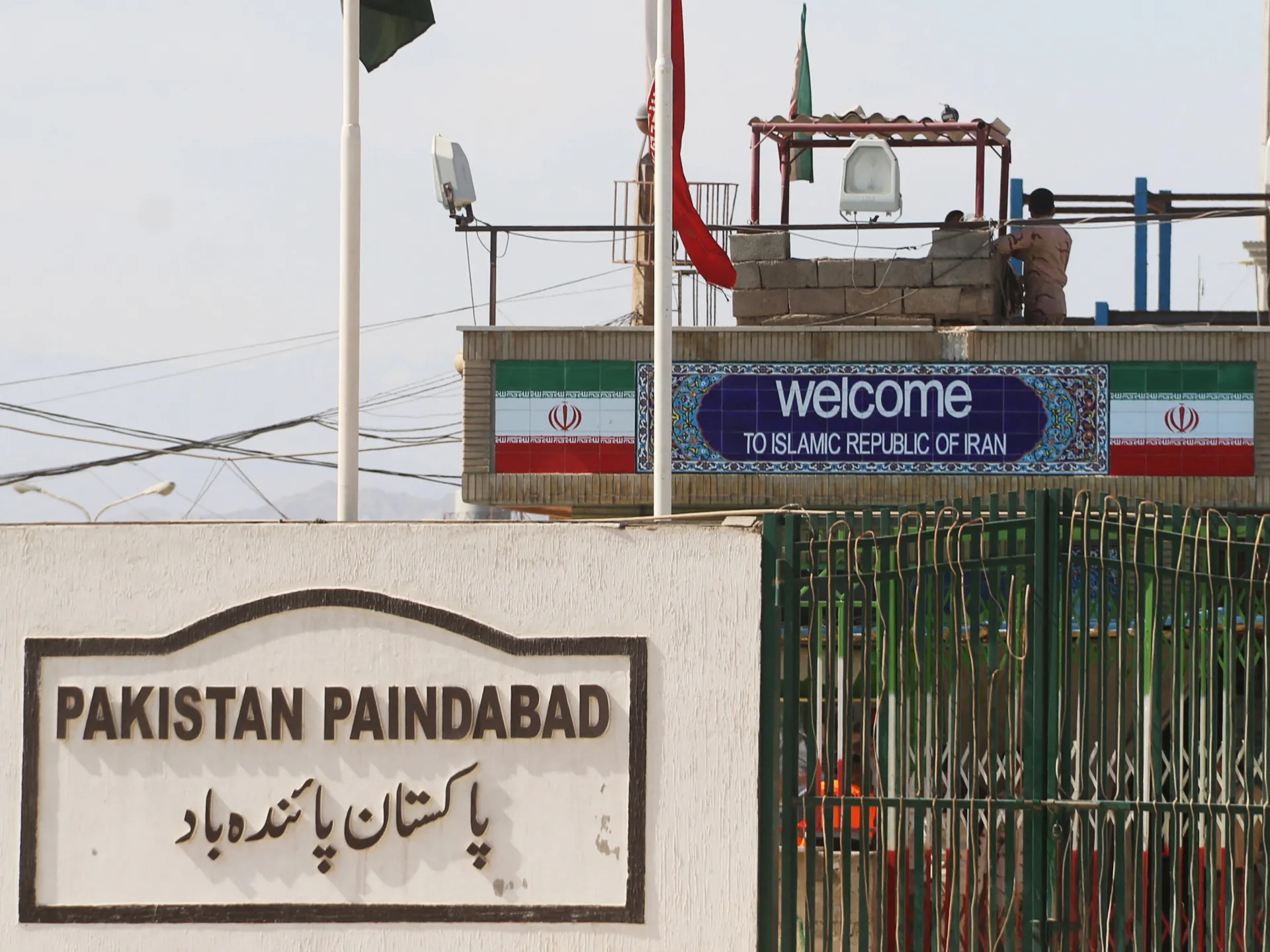
The unit is expected to comprise about 20 civilian and military personnel. It will build on the US blockade of Iranian ports by focusing on routes through Iran’s borders with Afghanistan, Armenia, Azerbaijan, Iraq, Pakistan, Türkiye and Turkmenistan.
What the US task force will target
US Central Command said the task force would reinforce what its commander, Admiral Brad Cooper, called the “ironclad blockade” at sea. Michael Mulroy, a former US deputy assistant defence secretary for the Middle East, said its role would be to establish where weapons systems were entering Iran and how those routes might be cut off.
Mulroy said the initiative was primarily a co-ordinating body intended to strengthen Washington’s economic pressure on Tehran by targeting ground routes after much of Iran’s maritime access had been covered.
He said that, if Donald Trump ordered an escalation of the war, the task force could help identify economic and infrastructure targets. Unlike Operation Epic Fury, which he said had focused mainly on military targets, the new effort would seek to weaken Iran’s ability to fight and fund itself.
The Islamic Revolutionary Guard Corps dismissed the announcement as “just a play on words”. Its spokesman, Sardar Mohebi, said the US could not use the plan to force an economic collapse in Iran, adding that earlier claims Tehran would suffer such a collapse within two weeks had not materialised.
Possible links to Russia
The US announcement did not explicitly refer to Iran’s military trade with Russia, but analysts said the task force could disrupt supply networks involving Moscow.
US media have reported claims that Russia has sent drone components and explosives to Iran through the Caspian Sea. There have also been allegations that Russian technology is assisting Iran’s development of advanced supersonic cruise missiles.
Mahjoob Zweiri, a professor of contemporary history and politics at Qatar University, described the reported military equipment transfers as a serious concern for Washington and warned that the task force could create a confrontation with Russia.
Rami Khouri, a public policy fellow at the American University of Beirut and a non-resident senior fellow at the Arab Center in Washington, said the US appeared to be acting without a clear strategy towards Iran, a method he argued had produced little success.
Questions over whether Iran’s supply lines can be sealed
Khouri said Iran’s long history as a trading nation made it almost impossible for the US to close every route into the country. He said Tehran had extensive commercial and political links across Asia and the wider region, involving countries including Russia, China and the United Arab Emirates.
He added that materials used in Iran’s weapons systems could be purchased from a range of countries, including the US or European states, before being channelled through companies in Asia.
Zweiri also questioned how effective the operation could be in the Caspian Sea, where the US has no military presence. Any access would depend on co-operation from neighbouring countries such as Azerbaijan or Armenia, which he said were unlikely to act in a way that might upset Russia.
He said the task force could ultimately require troops on the ground, which he regarded as unlikely. The Caspian Sea’s contribution to Iran’s economy was also estimated at 11 per cent, although the figure could not be independently verified; the sea accounts for only a fraction of Iran’s overall maritime trade.
Joe Kent, a former Trump aide and senior counter-terrorism official who resigned in March over the US war on Iran, accused Central Command of undermining diplomatic efforts. He said the announcement risked inviting escalation while the vice-president was attempting to negotiate with Tehran.
