


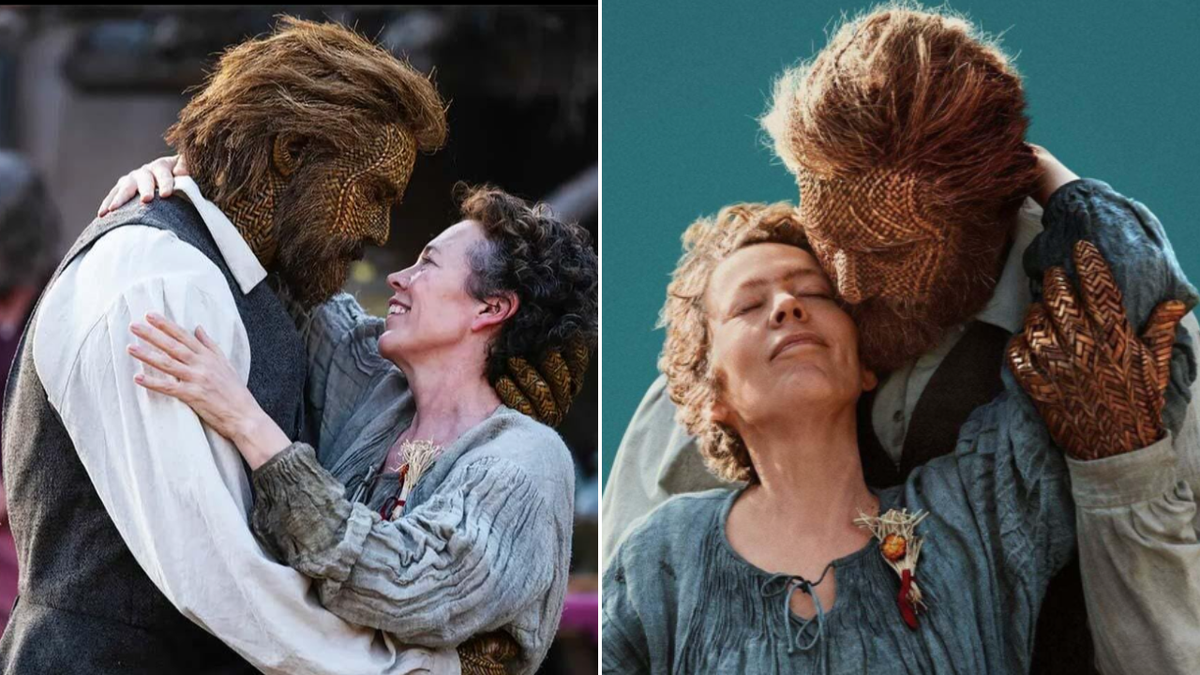
A bizarre new romantic comedy-drama starring Olivia Colman and Alexander Skarsgard has prompted widespread online fascination with its unlikely central couple: a lonely fisherwoman and a husband made entirely from wicker.
Set in a traditional coastal village inspired by the 19th century, Wicker follows Colman’s unnamed Fisherwoman as she turns to the local Basket Weaver, played by Peter Dinklage, with a request to create her a husband.
The resulting Wicker Husband, portrayed by Skarsgard, is brought to life and appears to offer the companionship she has been missing. He is affectionate, attentive and willing to help around the home.
But the relationship soon causes tension in the village. The couple’s unconventional marriage provokes jealousy and outrage, while the film’s premise has fuelled an online debate about intimacy, relationships and what women expect from their partners.
Wicker film sparks debate over the ideal partner
Much of the attention has focused on Skarsgard’s full-body wicker costume and a bedroom scene in which an intimate encounter ends with the couple’s bed breaking.
Skarsgard said the scene was filmed at the very start of production. “It was like a rollercoaster,” he said, describing the anticipation before filming began.
Colman recalled that the cast responded with “proper full on” laughter when the bed finally collapsed.
The film’s suggestive marketing has also inspired jokes about the practicalities of being intimate with a man made of woven branches, including concerns about splinters.
Elizabeth Debicki, who plays the tailor’s wife, said the Wicker Husband’s appeal lies in qualities that extend beyond his appearance. “He is a really good listener,” she said.
Debicki added that he listens to the Fisherwoman, responds to her cues, acts without being asked and makes suggestions. Those qualities, she said, are what women like.
Some viewers have described the film as “anti-male”, while others have joked that women are ready to “trade men for baskets”. One social media comment said insecure men believed women wanted muscles, while audiences were instead responding to “a guy made out of a basket”.
Within the story, the Fisherwoman’s marriage prompts other wives in the village to question why their own husbands do not show them the same level of affection or share household responsibilities. Rather than follow his example, the village men become increasingly resentful.
The social themes behind the unusual romance
The film was adapted from a short story by fantasy writer Ursula Wills-Jones, but its creators say the surreal premise is intended to explore modern relationships.
Filmmaking team Alex Huston Fischer and Eleanor Wilson have pointed to the Wicker Husband’s habit of fixing problems without seeking praise as a key part of his appeal. The story uses that behaviour to examine unequal expectations in heterosexual relationships, particularly around domestic work and childcare.
Colman has described the film as an exploration of equality, feminism and the traditional position of women, while Skarsgard has said it addresses marriage, patriarchy, jealousy and social hierarchy.
For all its jokes about wicker and bedroom mishaps, the film presents the Fisherwoman’s choice as a challenge to the established order of the village. Her relationship unsettles the men around her because it exposes a different model of marriage and companionship.
