


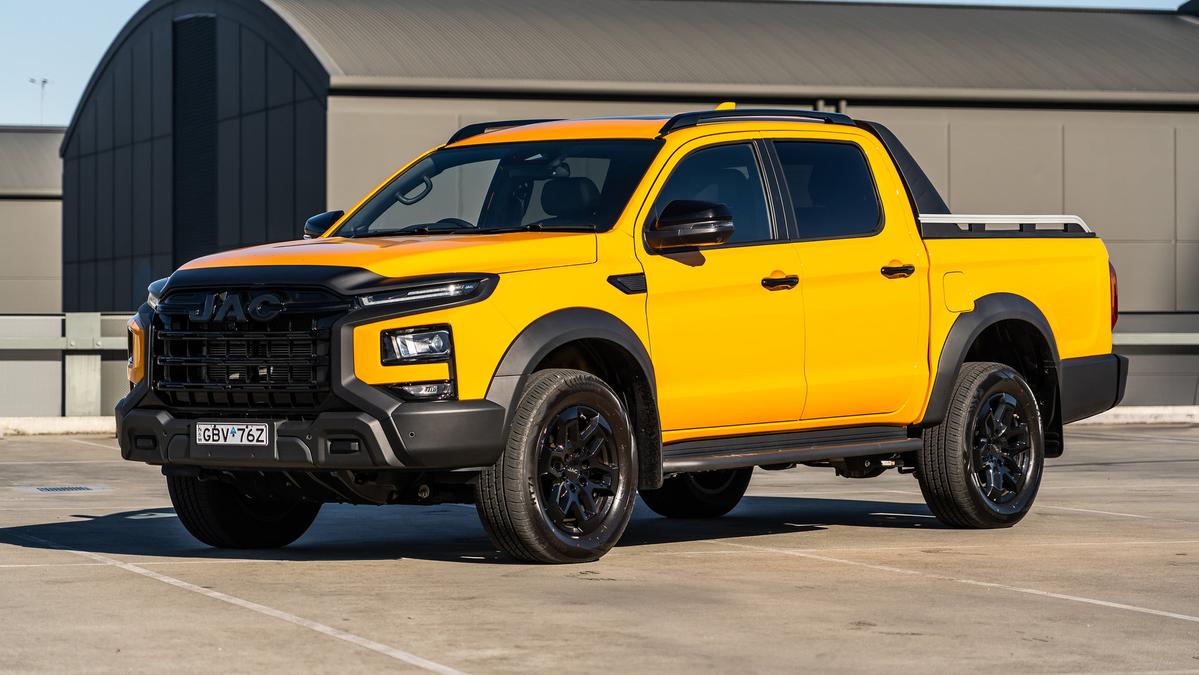
The JAC Hunter has arrived in Australia as the country’s cheapest plug-in hybrid ute, with a starting price below A$50,000 — but a first review suggests its impressive specification is let down by dated technology and an uneven ownership proposition.
The Chinese manufacturer’s new dual-cab, badged for the 2027 model year, is available in Pro and X variants. Prices begin at A$49,988 before on-road costs for the Hunter Pro, while the better-equipped Hunter X starts at A$54,844.
That places the Hunter below key plug-in hybrid rivals including the BYD Shark 6, GWM Cannon Alpha and Ford Ranger PHEV. JAC is also offering the first 1,000 reservation holders a choice of a home electric vehicle charger or a A$500 accessories voucher.
JAC Hunter PHEV promises serious capability
Under the bonnet is a 2.0-litre turbocharged petrol engine supported by two electric motors, one on each axle. JAC claims combined outputs of 360kW and 1,010Nm, figures which put the Hunter ahead of several more expensive competitors.
The four-wheel-drive ute uses a 31.2kWh lithium iron phosphate battery and is claimed to travel up to 100km on electric power. Its official combined range is 1,005km, although both figures are based on laboratory testing and may not reflect everyday driving.
It is not merely a lifestyle vehicle on paper. The Hunter has a 915kg payload and a 3,500kg braked towing capacity, while the higher-specification version comes with front and rear differential locks. JAC has also included several off-road driving modes and vehicle-to-load capability.
The company says the model has completed more than 100,000km of Australian testing, covering towing, load carrying, hot-weather evaluation and on- and off-road driving. The local chassis programme was led by former Holden engineer Michael Barber, whose suspension and steering recommendations were incorporated into production vehicles.
That work appears to have paid dividends on the road. The Hunter’s body control and cornering composure are among its strongest qualities, with the ute remaining settled during hard braking and acceleration. Its ride is firm and transmits bumps into the cabin, but the overall handling is considered competent and well balanced.
The review found the driving position comfortable, visibility good and the adaptive cruise control generally effective. However, the lane-keeping system could intervene unnecessarily, while the vehicle’s steering was slow and required relatively large inputs.
There is also unfinished business away from the tarmac. Although the Hunter showed promise during early off-road testing, a full assessment with a trailer and a loaded tray is still needed to establish whether it can match its claimed towing and load-carrying ability in tougher conditions.
The cabin makes a positive first impression, with quilted leather-style upholstery, a digital instrument display, a 10.4-inch touchscreen and a 360-degree camera available. Rear passengers receive air vents, charging points and a reasonably spacious bench, while the tub has a standard liner.
But the infotainment system is where the Hunter struggles most. The graphics look dated, the touchscreen is slow to respond and common functions require too many steps. Smartphone connection can be inconsistent, digital radio does not always resume automatically and the system lacks built-in satellite navigation.
Physical controls for the air conditioning are welcome, but they do not entirely solve the problem. Delays between pressing a button and the system responding can make simple adjustments frustrating, while demisting and maintaining a comfortable cabin temperature proved difficult during testing.
The value equation also changes significantly between the two versions. The entry-level Hunter Pro retains the core towing, payload and off-road hardware at its sub-A$50,000 price, making it the more persuasive proposition. The Hunter X, particularly with options fitted, moves close to rivals that offer more polished technology and longer-established dealer networks.
The verdict is therefore mixed. The JAC Hunter delivers strong headline figures, a capable chassis and substantial standard equipment, but its clumsy software and relatively immature presentation prevent it from becoming an unqualified bargain.
For buyers prepared to trade brand familiarity and digital polish for power, towing ability and a low entry price, the Hunter remains an intriguing new arrival. For everyone else, the cheaper showroom sticker may not be enough to outweigh the compromises.
