


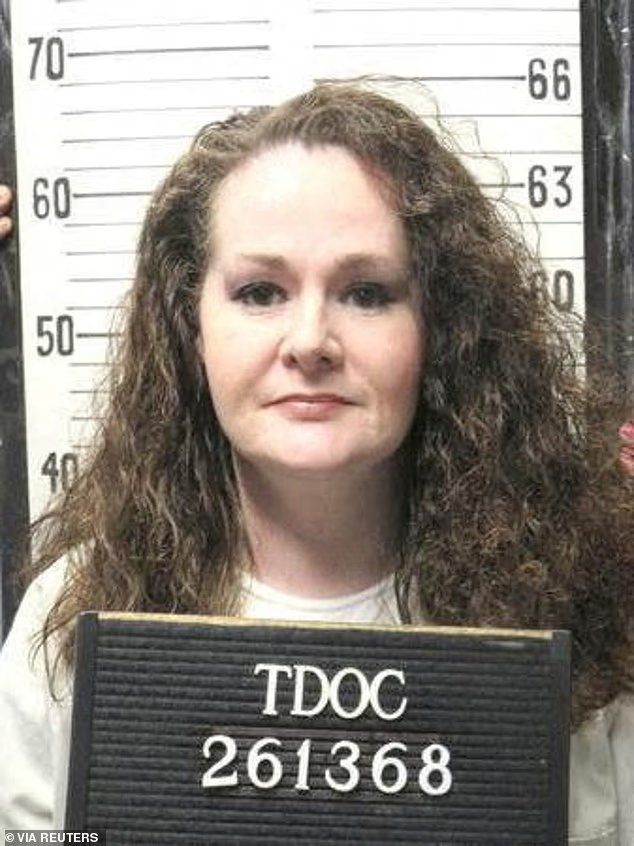
Christa Pike is conscious and speaking after surviving two doses of a lethal injection during a botched execution in Tennessee, although her prognosis remains unclear.
The 50-year-old woke in hospital on Tuesday and has no memory of the execution attempt, according to Dr Joel Zivot, an anaesthesiologist and intensive care physician advising her legal team.
She was able to say who she was and where she was, but incorrectly believed it was still September. Pike’s execution took place on September 30.
Her aunt, Carrie Ross, said the family had been told that Pike was brain dead shortly before she regained consciousness. Relatives were informed that doctors were preparing to remove her from a ventilator after efforts to wake her from a coma had failed.
“We got word that she was brain dead and they were taking her off the ventilator,” Ross said. “They were going to let her go – let her die.”
Family members have not yet spoken to Pike directly. They have instead received updates from her lawyers, who said she was now conscious and communicating.
Pike’s legal team said she was receiving critical medical care and that, “against all odds”, she had regained consciousness. “Her prognosis remains unclear but, at a minimum, we expect a long recovery,” her lawyers said.
The lawyers were due to appear in court to seek an order requiring the Tennessee Department of Correction to preserve evidence relating to the failed execution.
Pike was given two doses of pentobarbital at the Riverbend Maximum Security Institution in Nashville. She remained alive after the procedure and was heard snoring before being taken to hospital in a critical condition.
Execution witnesses reported that Pike remained awake and at one point raised her head to ask prison officials whether her arm was supposed to feel the way it did. Her lawyers said her arms turned purple and that she described a burning sensation.
Dr Zivot has suggested that the intravenous lines may have failed, allowing some of the drug to enter the tissue in her arms rather than her bloodstream. He has also raised the possibility that the pentobarbital had degraded, although state officials have not released details about the drug’s origin or preparation.
He said it was too early to conclude that Pike was out of danger. “I would not, in any way, say at this point that all the big risks are behind her,” he said.
The Tennessee Department of Correction said after the execution that officials had followed every step of the state’s “lawful, established execution protocol”. The procedure allows a second set of drug syringes to be administered if an inmate has not died after the first, but does not specify what should happen if the prisoner remains alive after both doses.
Pike’s lawyers are calling on Governor Bill Lee to commute her sentence to life in prison. They have cited her age at the time of the crime, childhood sexual abuse and mental health conditions including post-traumatic stress disorder.
She was 18 when she and her then-boyfriend, Tadaryl Shipp, killed their 19-year-old classmate, Colleen Slemmer, at a job training facility in Knoxville in 1995. Prosecutors said Pike lured Slemmer to a wooded area because she feared the teenager was trying to steal her boyfriend.
Pike cut Slemmer with a box cutter and beat her with a piece of asphalt. Shipp, who was 17 at the time, admitted carving a pentagram into the victim’s body. He was sentenced to life in prison with the possibility of parole, while Pike received the death penalty.
The failed execution was the second time this year that Tennessee officials have been unable to carry out a lethal injection. In May, the execution of Tony Carruthers was abandoned after officials spent more than an hour trying unsuccessfully to establish an intravenous line.
