


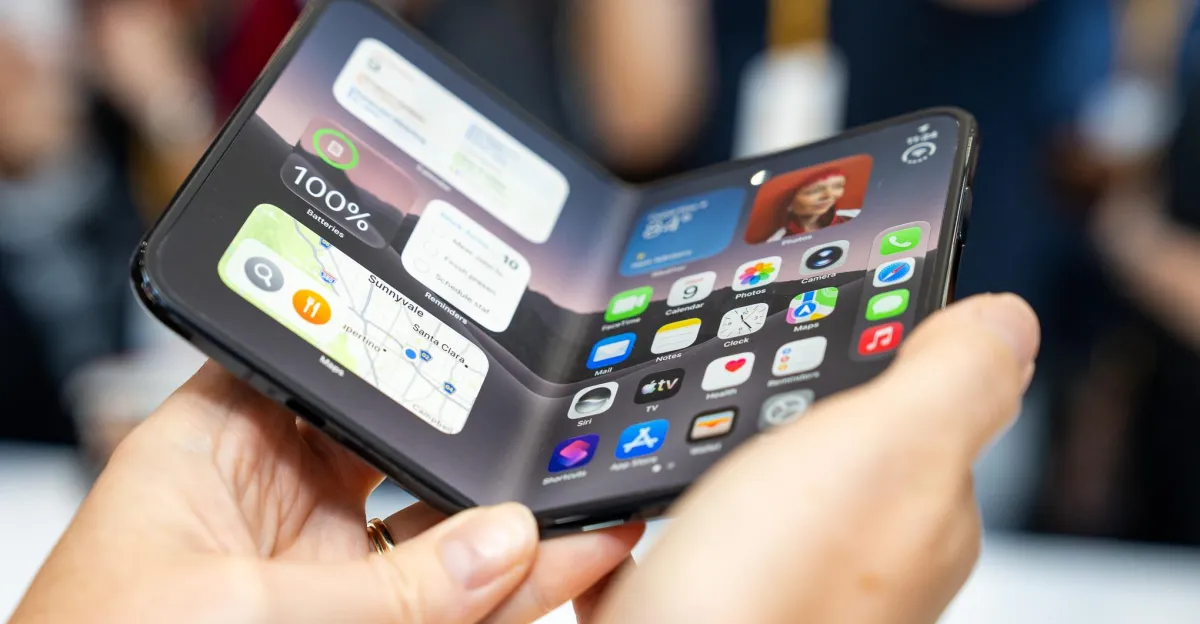
Apple’s first foldable, the iPhone Duo, is set to arrive next month with software designed specifically for its two-screen design, but early impressions suggest the company has not overtaken Android rivals on hardware.
The £? No—Apple has priced the device at $1,999, placing it firmly in the premium foldable market dominated by Samsung, Huawei, Xiaomi, Oppo and Honor. Its main selling point may be the way iOS 27 adapts between the outer and inner displays, rather than any individual component.
When opened, the Duo measures 5.2mm thick. It has a wide, passport-like shape that initially appeared distinctive, but similar designs have already reached the market from several Android manufacturers.
Apple has also made a major effort to reduce the visible crease running across the folding screen. The company says the result is achieved through a hinge made up of 100 components, specialised adhesives that allow the display layers to move over one another, and a matte finish intended to reduce reflections.
Early hands-on testing found that the crease is difficult to see, although it remains detectable by touch. Samsung and Oppo have pursued similar improvements in recent foldable models, meaning Apple’s screen may be competitive without being clearly superior.
Other headline features are familiar from Android phones. The iPhone Duo has an IP68 water and dust-resistance rating, stylus support and an under-display front camera. Google introduced IP68 protection to the foldable category, while Honor now offers an IP69-rated model. Samsung, Oppo and Honor have also produced phones with stylus compatibility.
In some respects, the Duo falls behind. At 254g, it is considerably heavier than Samsung’s Z Fold 8, with a difference of 53g. It is also the thickest among the latest wide-format foldables, although its open profile remains thinner than Apple’s iPhone Air.
Apple has not indicated that it is using silicon-carbon battery technology, which has helped Android manufacturers increase battery capacity within the restricted space of a folding handset. The company promises up to 24 hours of ordinary use, while Honor says its Magic V6 can last for two days.
The camera system is similarly conservative: two 48-megapixel rear cameras, with no telephoto lens. That broadly matches Samsung’s approach, but Google, Motorola, Xiaomi and other rivals have begun offering three-camera systems on their foldable ranges.
iPhone Duo foldable software
Apple’s strongest advantage is its control over both the operating system and the wider app ecosystem. The Duo runs a version of iOS 27 that has been substantially redesigned, rather than simply enlarging the software used on conventional iPhones or borrowing the layout of an iPad.
The dock moves from the bottom of the screen to a vertical rail on the right. The Dynamic Island is incorporated into the same area, while the status bar is reduced to a small circular symbol in the top-right corner. Animations and blurring effects change as the phone opens, helping the transition between the two displays feel continuous.
Apple says the home-screen arrangement will remain broadly consistent when the Duo is opened, allowing users to move between the outer and inner screens without losing their place. The fixed right-hand interface could prove less convenient for left-handed users, however, unless the company provides an option to reverse its position.
StandBy has also been adapted for the folding format. With the handset partly open and resting on a surface, it can display photographs, widgets or a clock, turning the Duo into a small smart display.
The software is not without limitations. Multitasking currently appears to be restricted to two applications at once, including two windows from the same app. Android foldables can often display three apps simultaneously, alongside adjustable floating windows.
Apple is relying on its influence over developers to close that gap. Netflix, Slack and Zoom were shown running versions designed for the Duo, with some features responding to the angle of the hinge. Most Android foldable applications still simply resize to fit the available screen, and some can behave awkwardly on smaller outer displays.
Whether that advantage lasts will depend on how widely developers adopt Apple’s foldable-specific tools. Those features could eventually make their way to Android, but Apple’s tightly controlled hardware and software environment may give the Duo a smoother start.
The iPhone Duo therefore enters the market as a polished but heavily compromised foldable. Its weight, cameras, battery technology and screen design do not clearly surpass the latest Android models, yet its purpose-built software could make the device feel more coherent in everyday use.
