


Renewed Kīlauea volcano activity has prompted the temporary closure of two trails at Hawaiʻi Volcanoes National Park after more than 200 shallow earthquakes were recorded beneath the summit and officials warned of further rockfalls.
Halemaʻumaʻu Trail and part of Byron Ledge Trail were closed on Wednesday, 7 October, removing a combined 1.3 miles of routes from public access. Both trails descend from the caldera rim to the floor, where rockfalls have occurred previously. ([nps.gov](https://www.nps.gov/havo/learn/news/20261007-nr-trail-closures.htm))
The National Park Service said the decision was taken because of continued inflation and increased seismic activity at the summit of Kīlauea, one of the world’s most active volcanoes.
The Hawaiian Volcano Observatory recorded more than 200 shallow earthquakes during the week to 7 October, with six additional tremors detected in the previous 24 hours. A magnitude 3.4 earthquake on 30 September caused small rockfalls along the caldera’s north wall. ([nps.gov](https://www.nps.gov/havo/learn/news/20261007-nr-trail-closures.htm))
Scientists believe a shallow intrusion of magma between 30 September and 1 October opened new cracks across the summit caldera. The US Geological Survey said the magma moved through existing fracture systems formed during the 2018 collapse of Halemaʻumaʻu.
Satellite analysis indicated that the intrusion travelled close to the surface, creating a narrow band of ground deformation and additional small cracks. About 130 earthquakes were recorded during the main phase of the event, according to the USGS. ([volcanoes.usgs.gov](https://volcanoes.usgs.gov/hans-public/notice/DOI-USGS-HVO-2026-10-08T01%3A00%3A28%2B00%3A00))
Kīlauea volcano activity remains difficult to predict
Kīlauea remains at the USGS’s ‘watch’ alert level and under an orange aviation colour code, the second-highest category. The designation reflects heightened volcanic activity and the possibility of an eruption or an eruption under way with limited aviation hazards. ([volcanoes.usgs.gov](https://volcanoes.usgs.gov/hans-public/notice/DOI-USGS-HVO-2026-10-06T18%3A56%3A12%2B00%3A00?utm_source=openai))
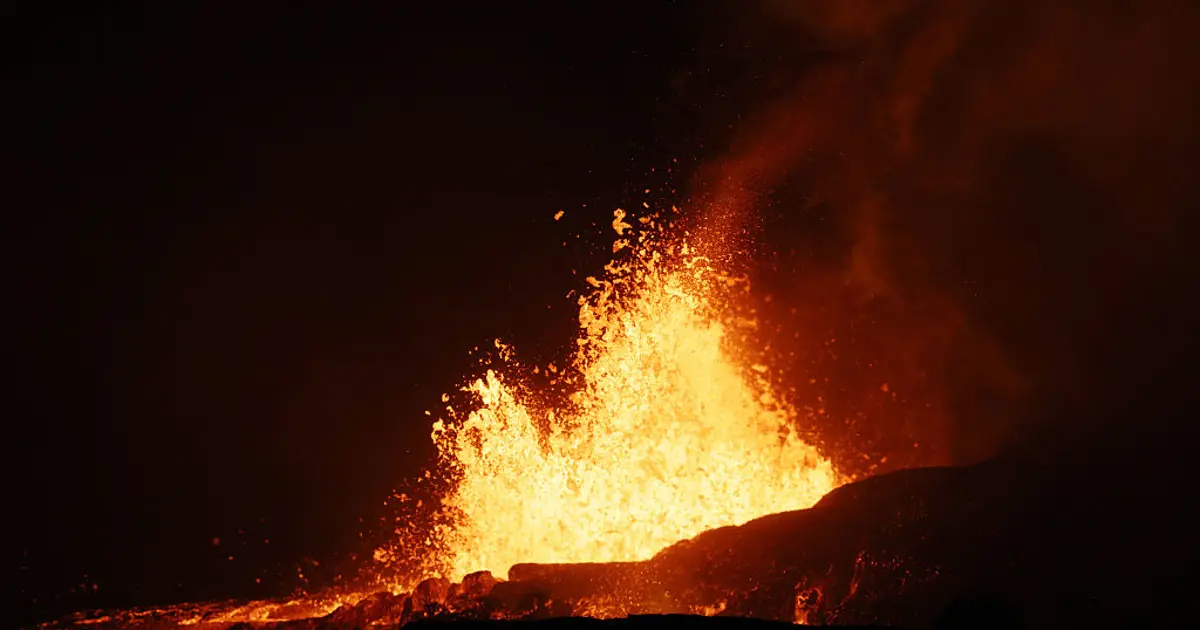
Minor spattering was observed from the volcano’s north vent overnight on Thursday, while strong glow and flames were visible at both the north and south vents. The USGS said the summit remained highly pressurised and that lava fountains, further intrusions or an eruption in a new location could occur.
Scientists said they could no longer model when the volcano’s next major lava-fountaining episode might begin. The previous episode ended on 25 August, and the 43-day pause that followed was the longest since the current eruptive cycle began in December 2024. ([volcanoes.usgs.gov](https://volcanoes.usgs.gov/hans-public/api/notice/getNoticesLastDayHTML))
Visitors have also been warned about volcanic gases and small, glass-like fragments produced by recent eruptions. The particles can be moved by strong winds and may irritate the skin, eyes and respiratory system.
Park officials urged visitors to keep out of closed areas and remain away from unstable cliff edges, which can collapse without warning. Further changes in conditions at the summit could happen quickly, the National Park Service said. ([nps.gov](https://www.nps.gov/havo/learn/news/20261007-nr-trail-closures.htm))
