


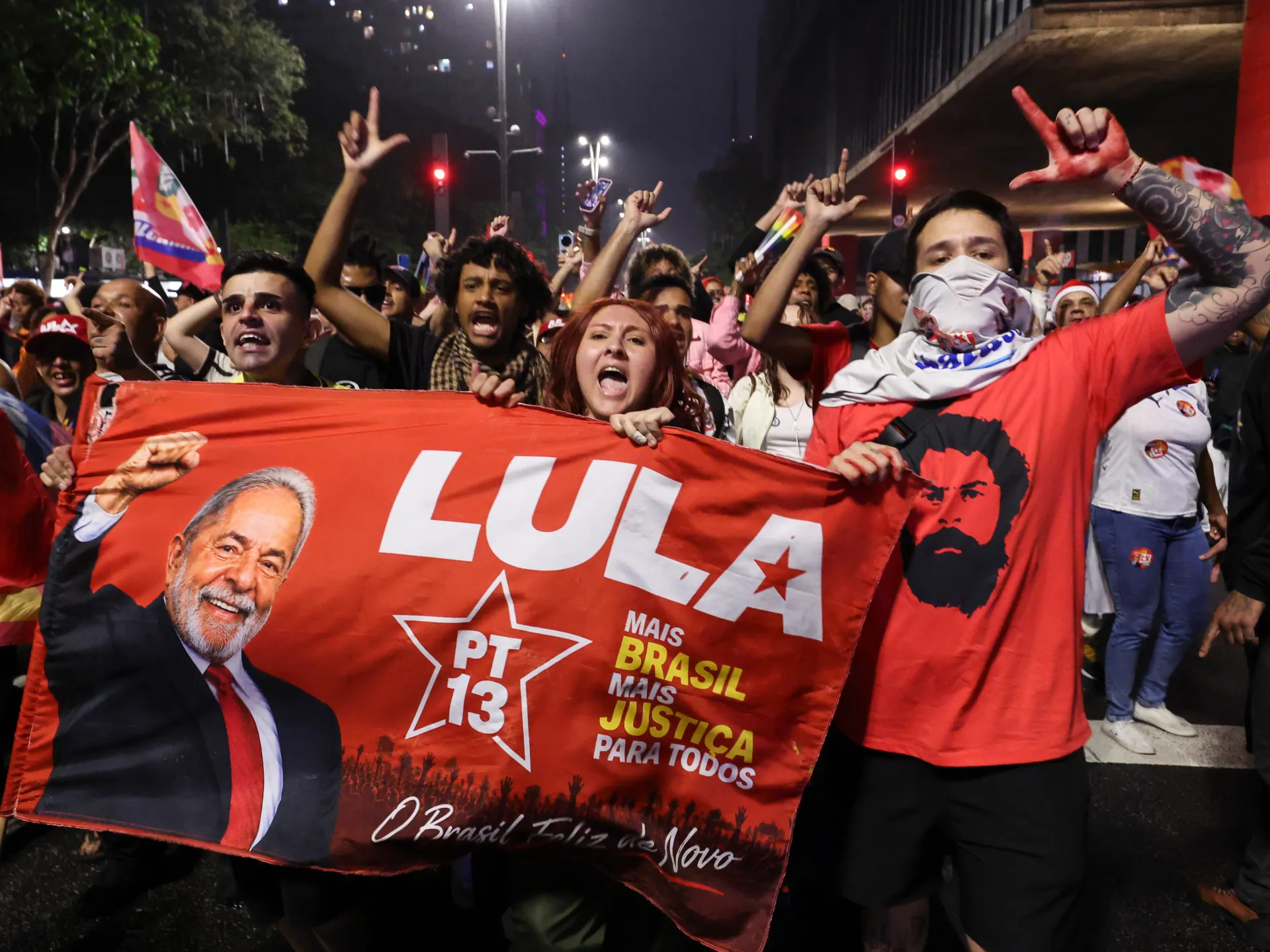
Lula’s victory in Brazil has halted the country’s far-right advance and dealt a significant setback to Donald Trump’s increasingly interventionist agenda in Latin America. The 80-year-old president won 51.8 per cent of the vote in the second round against Flavio Bolsonaro, who secured 48.2 per cent.
The result followed a first-round defeat in which Mr Bolsonaro, the son of former president Jair Bolsonaro, took 47 per cent compared with Lula’s 45 per cent. The turnaround defied pre-election polling and capped an unexpectedly strong revival by Lula’s Workers’ Party during a tense three-week campaign.
The vote was fought over more than the performance of Lula’s government. It became a contest over Brazil’s democratic institutions, its national sovereignty and whether the country would align itself more closely with Washington’s geopolitical agenda.
Lula’s administration could point to a strong economic record. Brazil’s economy grew by a cumulative 9.2 per cent between 2023 and 2025, compared with an average of 5.6 per cent among its South American neighbours. Unemployment fell from 9.3 per cent in 2022 to a historic low of 5.4 per cent in 2026.
Brazil also left the United Nations Hunger Map in 2025, after returning to it under Jair Bolsonaro’s presidency. Deforestation in the Amazon fell to its lowest level in decades, reversing the direction of travel under Lula’s predecessor.
But those achievements did not eliminate widespread economic anxiety. Millions of Brazilians remained burdened by credit-card debt and high interest rates, while the rapid growth of online gambling damaged family finances. The first-round result exposed the depth of that discontent.
In response, Lula’s campaign highlighted debt relief, restrictions on online betting, wider social benefits and fuel subsidies. It also backed a move from a six-day to a five-day working week, seeking to connect the government’s economic figures with the pressures felt in everyday life.
Mr Bolsonaro offered a sharply different programme, centred on spending cuts, privatisation, lower taxes and a tougher response to crime. His proposals included five maximum-security prisons modelled on El Salvador’s penitentiary system and permission for security forces to use lethal force against heavily armed criminals.
He also promised to pardon his father, who was sentenced to 27 years for plotting to overturn the 2022 election, and to grant clemency to those convicted over the assault on Brazil’s democratic institutions on January 8 2023.
Supporters regarded those proposals as a way to end what they saw as judicial persecution. Opponents warned that they would rehabilitate an attempted coup and weaken the independence of the judiciary.
Lula’s victory and the fight over Brazil’s sovereignty
The campaign gathered momentum among younger voters, with grassroots organising helping Lula recover from the first-round setback. It also overcame what the source material describes as algorithmic bias on social media platforms, including Meta, which favoured Mr Bolsonaro.
The international dimension became increasingly prominent. Throughout Lula’s term, the Trump administration imposed punitive tariffs on Brazil, sanctioned a Supreme Court justice involved in Jair Bolsonaro’s prosecution and openly supported his son’s candidacy.
In May, Mr Trump received Flavio Bolsonaro in the Oval Office. Two days later, Secretary of State Marco Rubio designated Brazil’s two largest criminal organisations as foreign terrorist organisations, a step Mr Bolsonaro had publicly requested.
The designations could have consequences beyond the election, including potentially opening the way for US military operations on Brazilian territory under Washington’s expanding campaign against so-called narcoterrorism. Lula has instead argued that co-operation against organised crime must respect Brazil’s sovereignty and strategic autonomy.
His victory interrupts a run of right-wing electoral successes across the region, including in Honduras, Chile and Bolivia since Mr Trump returned to the White House. It also comes before the US midterm elections and could weaken the influence of the Trump administration in the Americas.
In Argentina, President Javier Milei, a frequent critic of Lula who strongly backed Mr Bolsonaro, has been losing support ahead of next year’s presidential election. Chilean president Jose Antonio Kast has faced an even sharper decline in public backing.
Mexico’s Claudia Sheinbaum is also likely to benefit from the result. A Lula defeat would have left her increasingly isolated in a region moving towards the United States, whereas Brazil and Mexico, Latin America’s two most populous countries and largest economies, will remain on the left for the foreseeable future.
The result does not conclusively end the region’s rightward shift. But it suggests that the momentum behind it may have reached its peak, leaving Brazil outside Mr Trump’s proposed Shield of the Americas and preserving Lula’s challenge to Washington’s expanding influence in the hemisphere.
