


Republican redistricting efforts intended to protect the party from heavy losses in the US midterm elections are instead producing a series of unexpectedly competitive House races, forcing the party to spend millions of dollars in districts designed to be safe.
Republican-led states redrew congressional boundaries under pressure from Donald Trump and his political team, with the aim of creating a defensive firewall. But several of the new districts have shifted towards Democrats, while incumbents who were expected to be defeated have remained in the fight.
“It just has not turned out that way,” said Nathan Gonzales, editor of Inside Elections.
North Carolina’s 1st Congressional District has become one of the clearest examples. The state legislature redrew it late last year to favour Republicans, and the new boundaries would have given Mr Trump a margin of more than 11 percentage points in the 2024 election.
Instead, the seat is now widely regarded as a toss-up between Republican nominee Laurie Buckhout and Democratic Representative Don Davis.
The contest has become one of the most expensive House races in the country, with more than $42 million spent on advertising between 1 September and election day, according to an analysis of AdImpact data.
Redrawn North Carolina district remains competitive
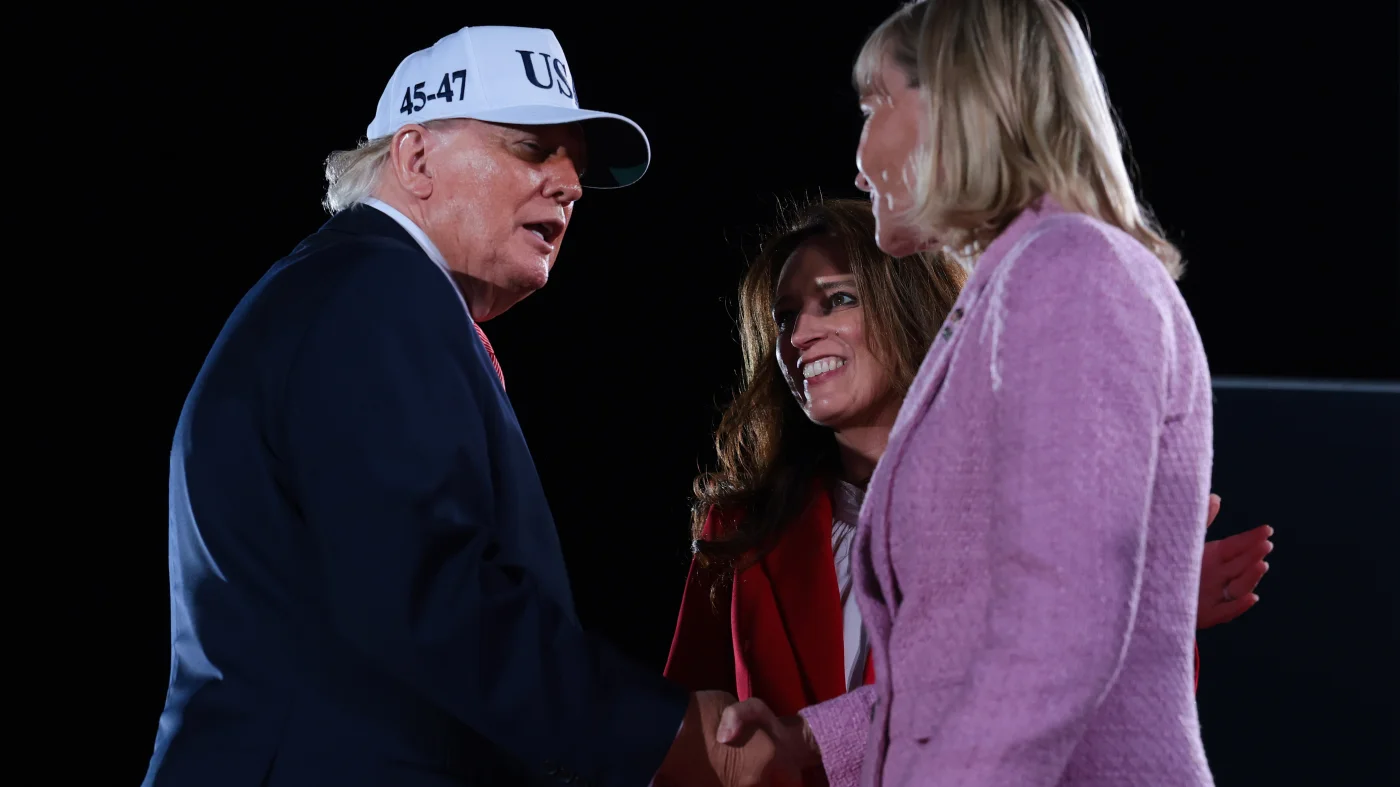
Mr Trump recently appeared at a rally in eastern North Carolina, where he urged voters to support Ms Buckhout and Jennifer Balkcom, the Republican candidate in the state’s 11th District.
He told the crowd that House Speaker Mike Johnson had asked him to give the candidates a special mention because their races were close.
“Come up. The two of you, we have to get them in,” Mr Trump said as he called the candidates on stage. “We have to vote for them. These are two special people.”
Ms Buckhout, a retired Army colonel who ran unsuccessfully in the district two years ago, said Republicans held a straightforward numerical advantage.
“There are more of us,” she said. “All you’ve got to do is get out the vote.”
Yet the need for Mr Trump to make a direct appeal underlined the concerns over turnout. The Republican candidate’s campaign did not respond to requests to take part in the report.
Mr Davis, meanwhile, has had to campaign across a district that has repeatedly been altered. His home county was removed from the latest map, while all or part of six new counties were added.
At an early voting location in Swansboro, in the south-eastern part of the district, one voter told Mr Davis that he was not in their constituency. The congressman laughed and explained that the same thing had happened to him repeatedly.
“This is my third run on a third new map,” he said.
Mr Davis said voters across eastern North Carolina were focused on the cost of living, including the effect of high fuel prices on farmers, lorry drivers and fishermen.
“You hear so much about affordability, inflation and costs but I believe this is becoming for many about survivability,” he said. “Just how they’re able to make it and survive during these tough times.”
Republicans and Democrats acknowledge that Mr Davis is a strong campaigner, helping to make the race more competitive than the boundaries alone might suggest.
“I think they believed that they had beaten Don Davis with the redistricting pen,” said Morgan Jackson, a North Carolina political consultant who is running Roy Cooper’s Democratic Senate campaign. “As it turns out, Don Davis has always been a tough out. He’s a local politician who runs really strong.”
Republicans forced to defend intended gains
Gonzales said Republicans had gained an advantage in 15 congressional districts nationwide through redistricting. But he said some seats that were expected to deliver easy victories had instead become expensive battles.
“What we are seeing this close to Election Day is that some of those that were supposed to be easy victories are not turning out that way and the party is having to pour in millions of dollars to win districts that were supposed to be easy victories,” he said.
In Florida, two districts redrawn to remove Democratic incumbents are approaching a combined $90 million in advertising spending.
Texas has also produced setbacks for Republicans. Districts drawn with a 10-point advantage for Mr Trump have moved towards Democrats, while a previously safe Republican seat that was given additional Democratic voters is now considered at risk.
A Republican strategist involved in midterm races rejected the suggestion that the redistricting campaign had failed, arguing that new boundaries created opportunities rather than guaranteed results.
“Redistricting creates new battlefields, it doesn’t create outcomes,” the strategist said.
Democratic incumbents in a number of redrawn districts chose to remain and campaign rather than withdraw. Gonzales said several now appeared well placed to win.
In North Carolina, Mr Davis has treated the latest changes with humour, joking that there were few remaining ways to redraw his seat other than extending it into Virginia or the Atlantic Ocean.
“I’ll just swim and talk to the fish,” he said.
Mr Jackson described the Republican strategy as a possible “dummymander rather than a gerrymander” – a reference to the redrawing of electoral boundaries in a way that ultimately fails to deliver the intended political advantage.
