


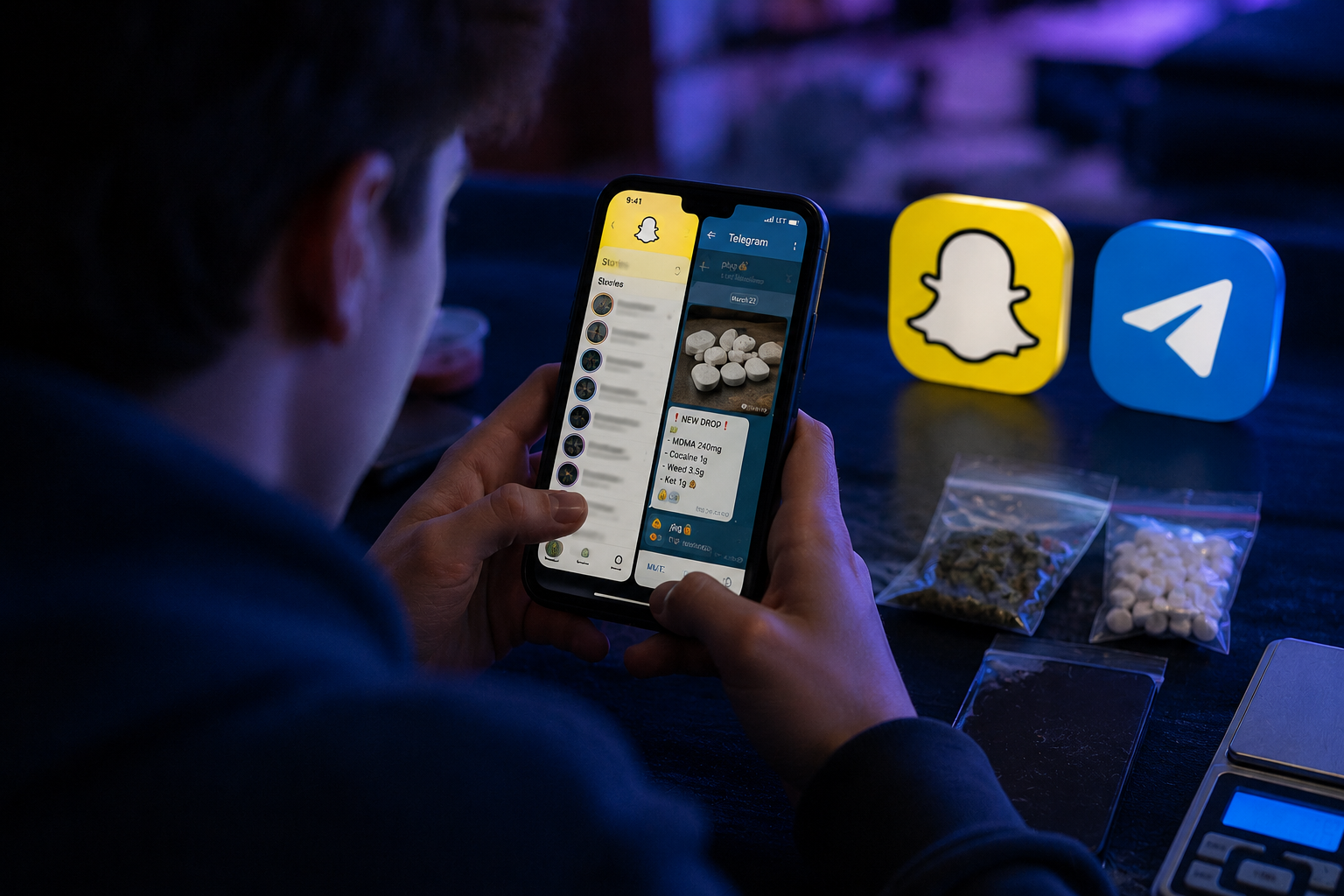
An investigation into the digital marketplaces where UK and US teenagers buy cannabis, MDMA, Xanax — and, increasingly, fake pills laced with lethal doses of fentanyl.
E
In the years since youth charities first flagged the rise of “Insta-dealers,” the marketplace for illicit drugs has migrated almost entirely onto the phones in teenagers’ pockets. The dark web — once the focus of policing concern — has been quietly displaced. Fewer than 2% of teenagers now report using the dark web to obtain drugs, according to research compiled by addiction-services providers. Why bother with Tor browsers and cryptocurrency wallets when a 14-year-old can scroll through Snapchat, tap a story, and be inside a Telegram dealer chat within ninety seconds?
This is the new architecture of teen drug supply, and it has produced a public-health emergency. In the United States, fentanyl now drives the overwhelming majority of teen drug-overdose deaths: KFF’s analysis of CDC data shows that 76% of all adolescent drug fatalities in 2023 involved fentanyl — a higher share than for any adult age group. In the United Kingdom, the National Crime Agency’s “county lines” model has been retooled around Snapchat recruitment, with one Kent teenager describing how he was groomed by a gang within eighty minutes of replying to a single post. The platforms — Snap Inc., Meta, Telegram FZ-LLC — insist they are working hard to remove dealers. The DEA, the FBI, and a growing list of bereaved families say the platforms’ core product features are the problem.
This is how the system actually works.
The new supply chain: from cartel lab to a teenager’s group chat
The 2025 National Drug Threat Assessment, published by the US Drug Enforcement Administration in July 2025, lays out the supply chain in unambiguous terms. The Sinaloa and Jalisco New Generation cartels — now designated foreign terrorist organisations — produce fentanyl and methamphetamine in clandestine Mexican labs using precursor chemicals sourced from China. Much of that fentanyl is then pressed into pills that look identical to legitimate prescription medication and sold to American buyers through social media platforms and messaging applications.
What changed is not the cartels’ ambition but the distribution mechanism. A decade ago, a teenager who wanted MDMA had three options: buy from a school contact, meet a stranger on a corner, or call a number passed between friends. Each of those required a pre-existing social network. Snapchat collapsed the search problem. Telegram solved the privacy problem. And Cash App, Venmo, and cryptocurrency settled the payment problem.
The DEA estimates that roughly one in three illicit drug-trafficking incidents now involves a social media platform — Snapchat, Instagram, Facebook Messenger, or TikTok being the most cited. UK youth-services data tracks the same trend: a Children’s Society briefing found that 24% of young people had seen drugs advertised on social media, with Snapchat (56%), Instagram (55%), and Facebook (47%) the most common platforms.
For a teenager standing in a school corridor in Birmingham or Boise, the practical reality is this: drug dealers are now closer, faster, and more aggressively marketed than any previous generation has experienced.
Inside Snapchat: why dealers love an app built for vanishing
Snapchat was built around ephemerality. Photos, videos, and chats disappear by design — a feature that made it irresistible to teenagers who wanted privacy from their parents, and equally irresistible to dealers who wanted to evade police evidence-gathering.
The Social Media Victims Law Center, which represents dozens of bereaved families in active litigation against Snap Inc., has documented the specific product features that dealers exploit: the Stories carousel, where a “menu” of available drugs can be posted and erased within twenty-four hours; My Eyes Only, a vault that hides photos behind a separate PIN; Snap Map, which lets buyers see dealers who are physically close; and the disappearing-message default, which destroys evidence the moment it is read.
Dealers typically post a price list with emoji codes — a leaf for cannabis, a snowflake or pill emoji for MDMA, a school bus for Xanax — and add their handle and a meet-up location. Buyers message directly. Many dealers then move the conversation to Telegram or Wickr to finalise the deal and arrange payment, leaving Snapchat itself with no surviving record of the transaction.
Snap Inc. has invested in detection technology, including automated content moderation and partnerships with law enforcement. But the company is the named defendant in Neville et al. v. Snap Inc. (Case No. 22STCV33500, Los Angeles Superior Court), brought on behalf of more than 60 families whose teenage and young-adult children died after allegedly buying fentanyl-laced pills through the app; in all but two of those cases, the young person died after ingesting the substance. On 2 January 2024, Los Angeles Superior Court Judge Lawrence P. Riff denied Snap’s motion to dismiss, allowing 12 of 16 counts to proceed to trial. On 5 December 2024, the California Court of Appeals denied Snap’s petition for discretionary review, clearing the way for the plaintiffs to begin discovery against the company. Snap has said it intends to continue contesting the claims.
In Britain, the app has been at the centre of separate concerns. A BBC South East investigation documented a 14-year-old in Kent who responded to a Snapchat post offering cash-in-hand work; within an hour and twenty minutes, a gang had collected him and driven him elsewhere to sell drugs. British Transport Police have launched their own Snapchat campaigns warning that up to 40% of gang suspects arrested by the force since 2019 were under nineteen.
Inside Telegram: the dealer infrastructure most parents have never seen
If Snapchat is most often the first point of contact, Telegram is increasingly where the transaction itself happens. Most coverage of teen drug-buying focuses on Snapchat because that is where the initial encounter takes place. But the actual negotiation — and a growing share of the open marketplace — has moved to Telegram, an app many parents have not even installed.
Telegram offers a combination of features that no mainstream platform replicates. Channels can broadcast to unlimited subscribers. Private groups can hold up to 200,000 members. Bots can automate menu displays, order-taking, and even payment processing. Self-destructing messages are available in “secret chats.” And until Telegram disabled it in 2024 following sustained law-enforcement pressure, the “People Nearby” feature allowed users to see other Telegram accounts within roughly a 400-metre radius — a function students at UK universities and US high schools reported being used by dealers to advertise at parties and large gatherings.
The Jersey Evening Post documented one of the cleanest descriptions of the workflow: a link to a private Telegram group chat is posted temporarily on Snapchat or Instagram. The link is forwarded between friends, the dealer onboards new buyers, and the original post is then deleted by the dealer, leaving no trace on the public-facing platforms. The Telegram chat itself can be set to auto-delete messages on a schedule.
Telegram has historically been less responsive than Meta or Snap to law-enforcement requests. The arrest of Telegram founder Pavel Durov in France in August 2024, and his subsequent commitments to greater cooperation with European authorities, marked a turning point — but the platform remains a preferred infrastructure for everything from cannabis delivery services to counterfeit prescription-pill operations across both the UK and the US.
For parents, the practical problem is recognition. A teenager with the Telegram app installed and several muted “channels” subscribed is doing nothing inherently suspicious — Telegram is also used heavily by gamers, crypto enthusiasts, and political activists. But the same app, in the same form, is also where many active drug transactions are now negotiated.
The emoji code: what your teenager’s screen is actually saying
The single most-requested resource by parents, according to youth-safety researchers, is a current glossary of drug-related emoji and slang. The codes shift constantly — when an emoji becomes too visible, dealers cycle to a new one — but a working 2025–2026 glossary, drawn from DEA materials and reporting by youth-safety organisations such as The White Hatter, Bark, and Clearfork Academy, includes:
- 🍃, 🌿, 🥦, 🌳 — cannabis (“loud,” “gas,” “tree”)
- ❄️, 🏂, ⛄, 🎱 — cocaine
- 💊, 🚀 — MDMA / ecstasy
- 🚌, 🔵 — Xanax (“school bus” refers to the yellow pill colour)
- 🍯, 💉 — heroin
- 🍪, 🍫 — commonly reported as references to counterfeit pills sold as Percocet or Adderall
- 🐎 — ketamine (the “horse tranquilliser” reference)
- 🤧, 💨 — generic “I’m using” or “I have”
- 🔌 — “plug” (dealer)
- 8️⃣ — eighth of an ounce
Beyond emoji, slang to recognise includes “plug,” “perc,” “blues,” “M30s,” “bars,” “tabs,” “molly,” “snow,” and — in UK county-lines contexts — “running a line,” “going OT,” “going country,” and “going cunch.” A teenager casually using two or three of these in a Snapchat exchange visible over their shoulder is worth a calm, low-stakes conversation — not, by itself, evidence of anything.
Teen internet culture absorbs and recirculates drug references constantly, and most researchers caution that the use of emoji and hashtags is less systematic and coordinated than some parent-targeted content implies. The signal that matters is pattern and context: a sudden new contact list, secrecy about the phone, late-night Telegram notifications, and unexplained cash or packages.
The fentanyl problem: why this generation is different
Previous generations of teenage drug experimentation were not safe — but they did not, on this scale, kill. The arrival of illicit fentanyl has changed the maths. A lethal dose of fentanyl is approximately two milligrams — the equivalent of a few grains of salt — small enough to fit on the tip of a pencil. The DEA reports that approximately seven of every ten counterfeit prescription pills it tested in recent years contained a potentially lethal dose.
The practical risk that statistic creates is straightforward: an American teenager who orders what they believe is a Percocet, an Adderall, or a Xanax from a Snapchat dealer cannot tell by looking whether the pill contains a fatal dose of fentanyl. According to KFF’s analysis of CDC data, adolescent overdose deaths involving fentanyl rose 177% in the first year of the pandemic alone, from 128 deaths in 2019 to 354 in 2020. By 2023, 76% of all teen drug fatalities involved fentanyl — a higher share than for adults.
Two of those teenagers, Cooper Davis of Kansas and Devin Norring of Minnesota, gave their names to the bill that has dominated US legislative attempts to force platforms to act. The Cooper Davis and Devin Norring Act, reintroduced in July 2025 after dying in the 118th Congress, would require social media companies and other communication providers to alert federal law enforcement when they have actual knowledge that illicit drugs are being distributed on their platforms. Snap Inc. publicly supports the bill. Civil-liberties scholars, including legal academics writing in the Columbia Law Review, warn that the act would incentivise providers to conduct large-scale automated searches for drug-related activity, raising unresolved Fourth Amendment questions.
In the UK, where fentanyl penetration is significantly lower but rising, the equivalent emergency has been the use of social media to recruit children into county-lines drug-running networks. Both phenomena share a structural feature: the platform is the dealer’s reach, not their drug.
The county-lines pipeline: the UK’s distinct version of the problem
Britain’s drug-supply landscape has a feature with no direct US analogue: county lines. The model uses urban gangs in London, Birmingham, Manchester, and Liverpool to expand into smaller towns and coastal areas by using a dedicated mobile-phone “deal line” and a workforce of children and vulnerable young people to physically transport and sell the drugs.
Until recently, recruitment happened through schools, foster placements, and street contact. Now it happens primarily on Snapchat and Instagram. A Children’s Society briefing reports that recruitment adverts have evolved to mimic legitimate job posts — promising £300 to £500 a day for “easy work.” A BBC Wales investigation followed one former recruit who was groomed in Cardiff through Snapchat and ultimately coerced into sexual exploitation to repay a fabricated drug debt.
In December 2025, six police forces across the south-west of England — Wiltshire, Avon and Somerset, Devon and Cornwall, Dorset and Gloucestershire — launched a coordinated TikTok and Snapchat campaign aimed at warning teenagers about exploitation by county-lines gangs. The campaign, the first of its kind to use the same platforms the gangs themselves recruit on, reflects an admission that traditional safeguarding routes are no longer reaching the affected age group in time.
For UK parents, the warning signs are slightly different from the US fentanyl-pill picture. The risk is less that a teenager dies after a single bad pill and more that they disappear for days at a time, return with unexplained cash, new phones, or unfamiliar clothing, and become embedded in a network that is extraordinarily difficult to leave.
What the platforms say — and what they actually do
Every major platform officially prohibits the sale of controlled substances. Each has invested in machine-learning content moderation, hash-matching of known drug imagery, and dedicated trust-and-safety teams. Snap publishes regular transparency reports on drug-related account removals. Meta has expanded its keyword-matching tools across Instagram. Telegram, after years of resistance, has begun cooperating more substantively with European law enforcement on a broader range of criminal investigations following Pavel Durov’s 2024 arrest.
The gap between policy and effect, however, is documented and large. A CBS News investigation created fake teenage profiles across Instagram, Snapchat, and TikTok; the first reporter located a drug dealer within 48 hours. A BBC Three documentary found that 72 hours after investigators reported dealer accounts to safeguarding teams, the accounts were still active. Dealers cycle through usernames faster than moderation teams can act, and the platforms’ own engagement-optimised recommendation systems have, in documented cases, surfaced drug-adjacent content to teenagers who had signalled anxiety or depression.
The legal pressure is now mounting from three directions simultaneously: civil lawsuits from bereaved families, proposed federal legislation in the US, and the UK Online Safety Act’s evolving obligations on platforms to assess and mitigate risk to children.
What parents can actually do
Most existing advice in this area is generic — “talk to your teenager,” “set boundaries,” “monitor their phone.” The specific actions that experts in the field actually recommend are narrower and more useful:
- Install the apps yourself. You cannot have an informed conversation about Snapchat or Telegram without using them. Spend an hour inside each interface.
- Know the privacy settings that matter. On Snapchat, the relevant settings are: Snap Map turned to Ghost Mode, “Contact Me” set to Friends only, and “View My Story” set to Friends only. On Telegram, set phone-number visibility to “My Contacts” and review group-invite settings.
- Look for the second app. If Telegram, Signal, Wickr, or Session is installed on the phone of a young teenager who has no obvious need for them, ask why. None of these apps is inherently illicit, but their combination on a single device is a recognised pattern.
- Have the specific conversation about fake pills. The single most important point for a US teenager to understand is that a pill obtained outside a licensed pharmacy is statistically likely to be counterfeit and may contain fentanyl in lethal quantity. The DEA’s One Pill Can Kill campaign is a useful framing.
- Use the right helpline. In the US, SAMHSA’s National Helpline (1-800-662-HELP) is free, confidential, and operates 24/7. In the UK, FRANK (0300 123 6600) and Childline (0800 1111) are the equivalents. The St Giles Trust and Refocus charities work specifically with families affected by county lines.
- Do not rely on monitoring software alone. Apps such as Bark and Qustodio can flag concerning keywords and image patterns, but a determined teenager will circumvent them. They are a supplement to conversation, not a substitute.
A consistent finding across both clinical and law-enforcement sources is that the families who navigate this terrain most successfully are not the ones with the strictest controls. They are the ones whose teenagers feel able to disclose a bad situation without losing their phone, their privacy, or their parents’ trust.
Frequently asked questions
How do teenagers actually find drug dealers on Snapchat? Most do not search; they encounter. Dealers post to public Stories, use hashtags, and seed group chats whose links circulate between friends. A teenager need only follow one person who follows a dealer to begin seeing the content surfaced by Snapchat’s discovery features.
Is buying drugs on Telegram traceable? Telegram is more private than most platforms but not anonymous. Account registrations are tied to phone numbers, and Telegram has increasingly shared metadata with law enforcement in serious cases since 2024. Crypto payments are pseudonymous, not anonymous, and major exchanges comply with subpoenas.
Which platform is most dangerous for teenagers? There is no single answer. Snapchat is most often the initial contact point and the platform most associated with fentanyl-pill deaths in the US. Telegram increasingly hosts the actual transactions. Instagram is the largest entry point by user volume. In the UK, Snapchat is the primary platform documented in county-lines recruitment cases.
Are these emoji codes really used, or is this a moral panic? Both are true. Emoji codes are real and are used by some dealers, but they are not as widely or systematically deployed as some parent-targeted content implies. Treat them as one signal among several, not a decoder ring.
What should I do if I find drugs in my teenager’s room? The clinical advice, broadly consistent across both US and UK addiction services, is to avoid immediate confrontation, secure the substance safely, and seek a same-day call with a paediatrician, GP, or addiction helpline before deciding next steps. If you suspect any pill obtained outside a pharmacy, treat it as potentially fentanyl-contaminated and do not assume your child knows what is in it.
The drug marketplace is now where the teenagers are. That is the uncomfortable fact at the centre of the Snapchat and Telegram story. Closing the apps will not close the market — but understanding precisely how those apps function as drug infrastructure is the first thing that lets a parent, an educator, or a policymaker do anything useful at all.
