


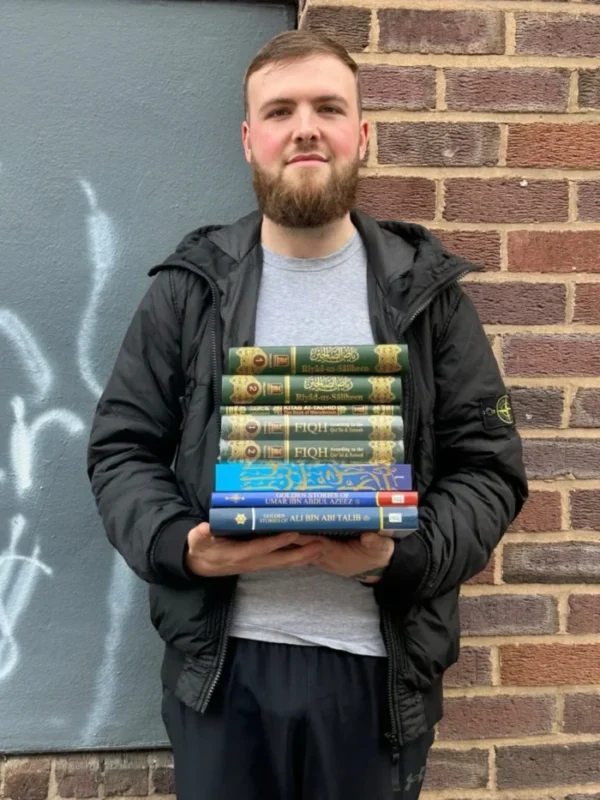
Birmingham creator Kieos tells Britannia Daily about unanswered theological doubts, death threats from former supporters and three consecutive nights of dreams that drew him away from the faith he once championed online
A Birmingham content creator who spent years defending Islam to a TikTok audience of more than 100,000 people has announced his conversion to Christianity, saying he dreamed of Jesus on three consecutive nights while wrestling with doubts about his faith. The creator, known as Kieos, described his journey in an exclusive interview with Britannia Daily, claiming he has received death threats from former supporters since airing his doubts publicly. He says the decision followed months of private questioning, theological concerns that went unanswered, and a fundamental change in how he understood his relationship with God.
A week in the drafts folder
Going public was not straightforward. Kieos told Britannia Daily that the video announcing his decision spent more than a week sitting unpublished in his drafts while he braced for hostility from all sides. “I expected the worst,” he said, anticipating accusations of betrayal from Muslims and ridicule from non-Muslims.
The reception, by his account, proved more varied than he had feared. He estimates that around 80 per cent of his Muslim audience responded badly, with the remaining fifth showing understanding, while roughly 90 per cent of his non-Muslim followers were positive. “I received a lot of love from beautiful people,” he said, adding that most viewers appeared to see him as somebody honestly trying to work out what he believes — a reception that meant a great deal to a man more accustomed, in his words, to being hated. He says he has no regrets about speaking openly.
Three nights of dreams
The episode he finds hardest to explain came after his questioning had already begun. On three consecutive nights, he says, he dreamed of Jesus. “Honestly, I still haven’t made real sense out of it. I never have dreams,” he told the outlet. He accepts that some will reach for a psychological explanation — images absorbed during waking hours resurfacing in sleep — but says he had not been looking at any pictures of Jesus at the time, which makes the experience stranger still to him.
The dreams did not produce an overnight conversion. Instead, he treated them as a prompt to investigate. “I have taken it as a sign from God to look into Christ,” he said, referring to a figure whose divinity he had rejected all his life.
Doubts he could not resolve
By then, his difficulties with Islam had been mounting. They centred on hadith literature and on three Quranic passages — Surah Al-Mulk (67:5), Surah Al-Mu’minun (23:14) and Surah At-Tariq (86:6-7) — which he came to believe sat uncomfortably alongside modern science.
He took his concerns to five Muslims he considered knowledgeable, speaking to two by phone and three others by message. One offered answers on the hadith that he researched further afterwards. Another, citing a hadith, advised him to “leave that which gives you doubts” — a response he says settled nothing. His questions about the Quranic verses arose only after those conversations, and he admits he has yet to put them to anyone, though he says he would welcome an explanation.
The strain was sharpened by his public role. He concedes there were “many things I couldn’t logically defend”, yet he continued to argue for them during livestreams while privately unsure — something he says he feels bad about. For months he kept the turmoil to himself, partly out of respect and a wish not to plant doubts in others, and he describes his departure from Islam as gradual rather than sudden.
Death threats from former supporters
Once his doubts surfaced in public, he says, sections of the online Muslim community turned on him. He claims he was insulted, targeted in videos and sent death threats by people who had “not tried to answer a single one of my doubts” — treatment that, he says, only pushed him further away. He also accuses some Muslim creators of spreading lies about him to attract attention.
Not everybody walked away. Three Muslim friends from his old circle have stood by him, he says, because they recognise a sincere search for truth. The attacks have continued since his announcement, coming from “the same people that used to call me ‘brother'” — but he insists he will remain respectful and concentrate on bettering himself.
An atheist upbringing and a self-taught faith
Kieos’s original route into Islam was itself unconventional. Raised in Birmingham by an atheist family — “Faith was not a part of my childhood at all,” he said — he nonetheless always believed in God in some form, describing himself as agnostic about organised religion while drawn to the idea of spirit and oneness. His searching took in philosophy and, by his own admission, psychedelics.
He discovered Islam at 25 without a single Muslim friend, led first by social media videos and then by books he bought to study the faith. What convinced him was the logic of strict monotheism, a message he found simple and commonsense: “One God, worship that alone.”
His family struggled to understand that first conversion, he says. There was no major confrontation, only low-level gossip, though some relatives stopped speaking to him after finding out. His practice, he insists, was serious rather than nominal: daily prayers with the occasional lapse, consistent fasting, and considerable sums spent on books and courses alongside conversations with people he regarded as learned. “I was fully committed, I believe,” he said.
‘Like a checklist’
Beyond the theology, Kieos identifies a deeper turning point: a change in how he understood God altogether. For years he approached faith as a matter of compliance — rules kept, rituals performed, mistakes avoided — until his relationship with God “started just feeling like a checklist”. What shifted his thinking, he says, was the realisation that “only God can see what’s in the heart”, perceiving a person’s struggle, love and sincerity in a way other people cannot.
His prayers changed with it. Speaking to God in his own language rather than repeating set words each day has made prayer feel “more like a conversation”, he says. Where he once felt he was striving to earn God’s love, he now feels open to receiving it — a shift he credits with bringing him an inner peace he had not previously known.
Five weeks of questions
While stressing that he remains completely open, he describes his position today plainly: “In my heart, I have given my life to Christ.” The declaration follows five to six weeks spent privately exploring Christianity and pressing knowledgeable Christians with what he calls a million questions. He now prays in English, from the heart, and reports the result simply: “I truly feel happy.”
On doctrine, he says Christianity fits his long-held sense that God is fundamentally spirit. He points to the Bible’s description of God the Father as spirit, notes the Holy Spirit’s place within the Trinity, and understands Jesus’s oneness with the Father as a unity “in essence” — an essence he regards as formless.
His advice to other doubters
Asked what he would say to anyone experiencing a similar crisis of faith, he put honesty above approval, arguing that being truthful about one’s journey matters more than keeping strangers on the internet happy. His practical counsel was blunt: “Speak to people. If they slander or don’t answer, block them.”
He finished with a warning against wasting energy on critics, urging others to guard their time and attention closely. “Ignore them,” he said, “focus on yourself and speak the truth no matter what.”
