


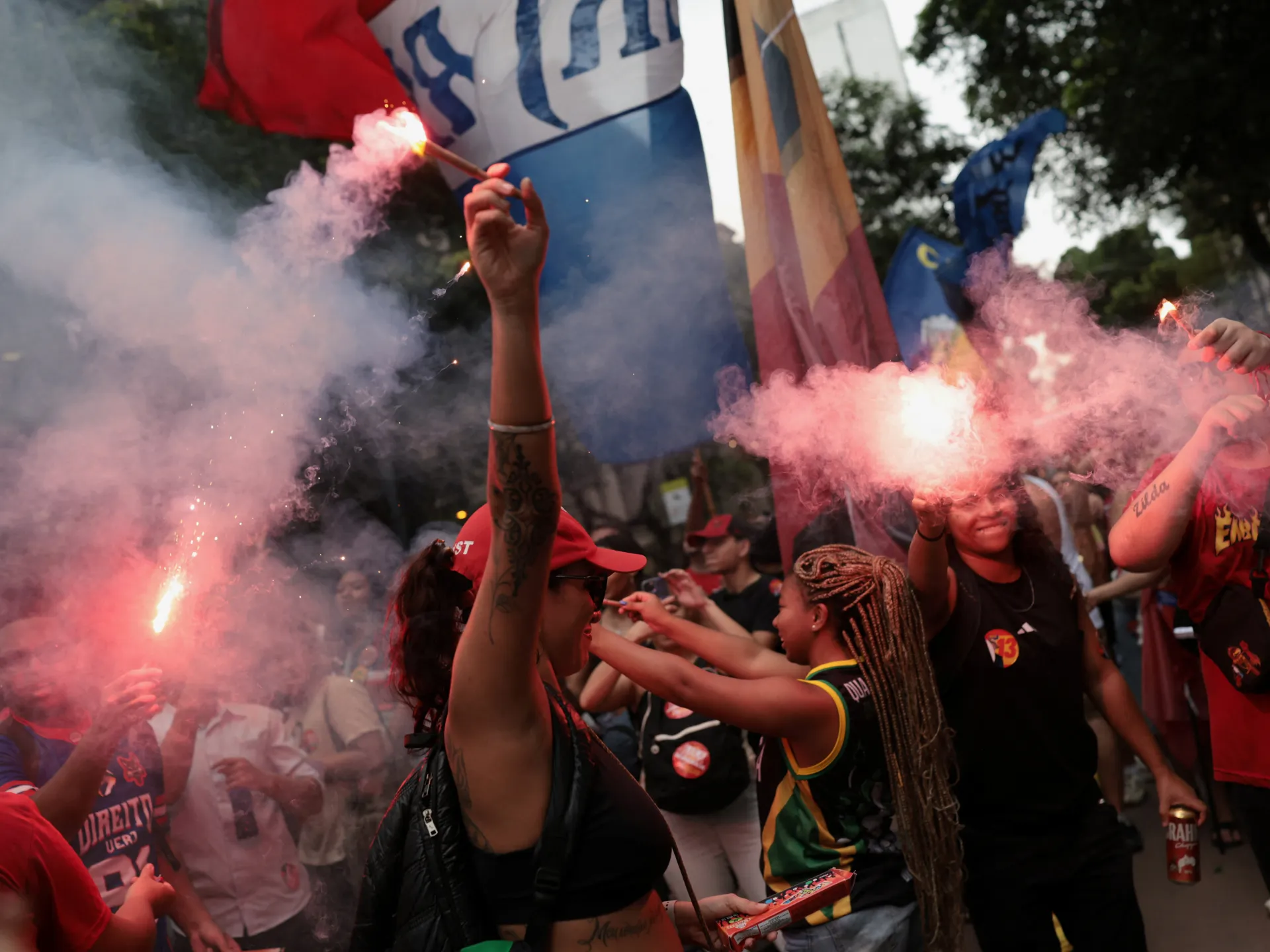
Thousands of people joined a student-led protest in Rio de Janeiro on Wednesday against presidential candidate Flavio Bolsonaro and the growing influence of Brazil’s far right.
The march followed the first round of Brazil’s presidential election, in which Senator Flavio Bolsonaro, the son of former president Jair Bolsonaro, secured the largest share of support. He received 47 per cent, compared with 45 per cent for incumbent left-wing President Luiz Inacio Lula da Silva.
Neither candidate passed the 50 per cent threshold, meaning they will face each other in a run-off on October 25. The result has fuelled concern that Brazil could become the latest Latin American country to move from a left-wing government to a right-wing presidency.
Protesters made their opposition clear as they marched through downtown Rio. Some carried signs reading “Never again Bolsonaro” and “No to the father, no to the son”, while others held banners stating “Dictatorship never again” and “Get out Bolsonaro”.
Flavio Bolsonaro has been endorsed by his father and has supported an amnesty for him, a prospect that has heightened concerns among demonstrators.
Jair Bolsonaro led Brazil from 2019 to 2023, during a presidency marked by controversy over his far-right policies. He voiced support for the country’s former military dictatorship and promoted unfounded claims about the accuracy of Brazil’s electoral system.
A court subsequently barred the former president from holding office for eight years. He is currently serving a 27-year sentence after being convicted of plotting to overturn his defeat in the 2022 election.
After Lula was inaugurated in 2023, Bolsonaro supporters stormed government buildings in the capital in what was reportedly an attempt to trigger a military uprising. Critics have described Jair Bolsonaro’s actions as a threat to Brazil’s democracy.
Alice Carneiro, a 25-year-old administrator in maritime shipping, said she had joined the protest because she believed in democracy and feared the consequences of a far-right government for her transgender wife.
“I’m here because I believe in democracy. Because I’m scared,” she said.
Emmanuel Araujo, 19, who is preparing for university entrance exams, said the resurgence of Bolsonarism had left him deeply concerned.
“I find this rise of the far right and the rise of Bolsonarism in Brazil very, very sad,” he said.
Although Lula was not his preferred candidate, Mr Araujo said voters faced a choice between someone they could continue to criticise and someone who might remove their right to speak.
