


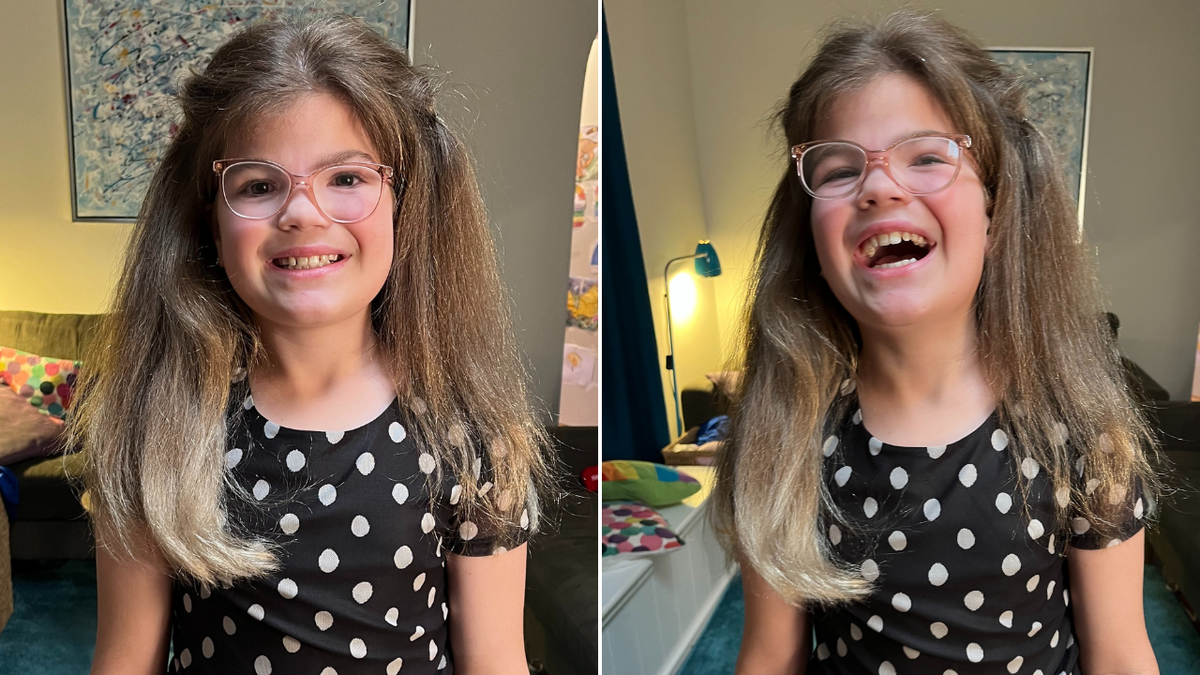
A nine-year-old Australian girl diagnosed with childhood dementia as a baby has reached school age without developing the devastating symptoms, after becoming the youngest person in the world to receive an experimental gene therapy.
Tilly Page was three months old when her parents, Kate and Lachlan, were told to take her home and make memories because she was unlikely to live beyond 10. Doctors now say there is no evidence the disease ever took hold.
Tilly is the only child in Australia to have received the treatment. She attends school, plays netball, roller skates, makes craft and reads to her classmates.
“It’s her averageness that we love the most,” her mother said. “She’s just miraculous in her averageness.”
The Pages kept the diagnosis private for eight years, allowing their daughter to grow up without the attention associated with being described as a medical “miracle”. Until recently, Tilly knew only that she had received “special medicine” as a baby.
Experimental gene therapy for childhood dementia
Childhood dementia is a genetic condition in which nerve cells in the brain stop working and die. Children may initially learn to walk and talk before gradually losing those abilities, and half are expected to die before their 10th birthday.
Tilly’s diagnosis was especially painful for her family. Lachlan’s older brother, Quinnton, had Sanfilippo syndrome, a form of childhood dementia. He never learned to speak and died two months before his 15th birthday.
Kate, a science teacher, and Lachlan, a former SAS mechanic, had previously lost their first baby in a stillbirth at 20 weeks. Although Kate’s family had no history of the condition, she pushed for Tilly to be tested.
When the hospital called at 11 weeks and asked her to attend the following morning, Kate said she immediately understood what it meant. Tests showed that Tilly had the same condition as her uncle.
“I still had this beautiful, healthy baby and they told me she was going to die,” Kate said. “There’s nothing. There’s just, ‘Go home, make memories.’”
Dr Nick Smith, an Adelaide geneticist, had spent years working on a gene replacement therapy developed by the American pharmaceutical company Ultragenyx. The treatment uses a virus to deliver a working copy of the faulty gene into brain cells.
The trial had space for four Australian children and 33 children worldwide, but Tilly was initially too young to qualify. Kate and Dr Smith spent nine months making her case to medical ethics authorities before she was accepted.
The decision carried serious risks. “You have to sign a piece of paper that says, ‘Are you willing for your child to die by taking this experimental drug?’” Kate said. “And we looked at each other and said, ‘Yes, we are, because she’s going to anyway.’”
At the age of 12 months and two weeks, Tilly received a single infusion through a cannula in her arm. Kate breastfed her during the procedure, which took about half an hour.
Dr Smith warned the family that there could be no guarantees. “You’re the captains of this ship. You’re sailing uncharted waters. We don’t know what the outcome is going to be here,” he told them.
There was no immediate indication that the treatment had worked. Instead, the family waited to see whether Tilly would begin missing the developmental milestones associated with the condition.
She remained symptom-free at one, three and four. She continued walking and talking, stacking blocks and drawing circles. Dr Smith said she kept meeting developmental milestones in the same way as children without the condition.
“In Tilly, dementia has not even eventuated,” he said. “She is the only child at her age that I will sit and have a normal, if you will, conversation with. I’ve never done it before. She’s the first.”
A letter of thanks to the doctor who treated her
Tilly has now written to Dr Smith to thank him and to express her hope that other children can receive the treatment.
“I want other kids to have it or they can’t speak, talk, walk and other stuff,” she wrote. “And it really helped me. I’m glad because I would have died. Love Tilly. PS. Thank you.”
For other families, however, the therapy has come too late. Megan Maack, chief executive of the Childhood Dementia Initiative, campaigned to bring the trial to Australia. Her children, Isla and Jude, have the same condition as Tilly.
Isla was eight when she received the treatment, but by then the disease had progressed too far. She is now 17 and has lost all speech. Her last word to her mother was “happy”.
The gene therapy has not been approved anywhere in the world. Ms Maack estimated that almost 1,000 Australian children with childhood dementia had been born since the trial involving Tilly began, and said the treatment remained held up by red tape.
Tilly’s grandmother Margaret Page, who watched her own son die from the condition, said children diagnosed today still faced the same outcome.
“If a child’s born with this today, there’s no treatment,” she said. “They’ve still got the same outcome as Quinnton had 43 years ago, and it’s wrong.”
Neurologist Professor Matthew Kiernan said the process affecting a child’s brain in childhood dementia was comparable to that seen in older people with dementia: nerve cells stop working and eventually die.
He said Tilly’s case could help inform research into genetic forms of adult dementia, including Huntington’s disease and some forms of frontotemporal dementia, Parkinson’s disease and motor neurone disease.
“I think Tilly does hold the key to unlocking many of the forms of adult dementia,” Professor Kiernan said, while warning that the technology had not yet been fully used in adults.
He said the long-term possibility could be preventative treatment for children carrying genetic mutations linked to dementia. “It’s early. But there’s a huge focus now on vaccinations, and I think preventative approaches and never developing the disease is the way forward,” he said.
Tilly’s parents remain cautious about describing the treatment as a cure. “They don’t like to use the word cure,” Lachlan said. “And we don’t want to call it a cure either. But it’s looking pretty good.”
