


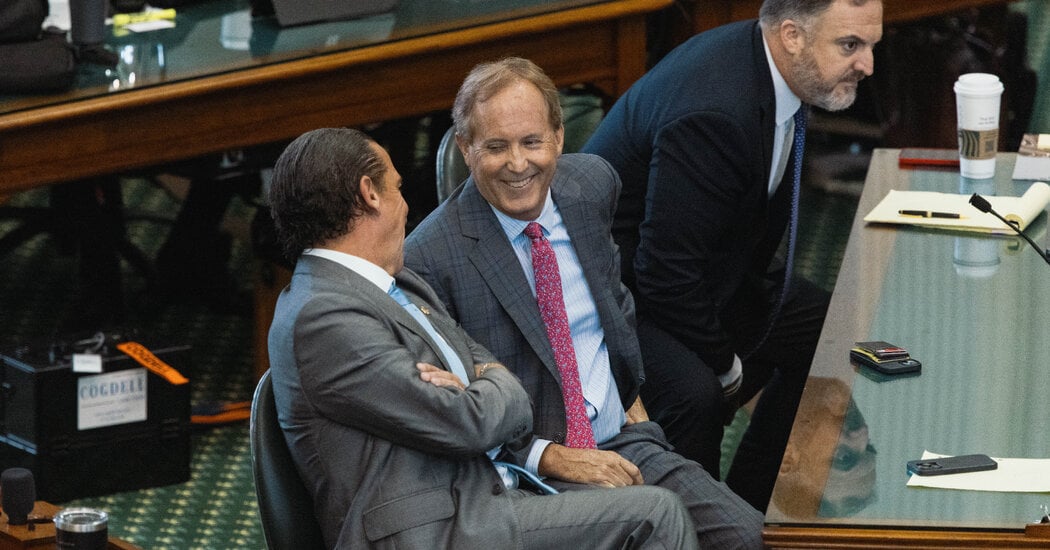
Ken Paxton’s acquittal at his impeachment trial has become the defining episode of his scandal-plagued political career as he campaigns for a seat in the US Senate, demonstrating how a carefully managed defence and intense pressure from the Republican right helped him survive the gravest threat to his position.
Texas’s Republican attorney general was accused of using his office to protect Nate Paul, a real estate investor and campaign donor facing a federal investigation. Prosecutors alleged that Mr Paul helped renovate Mr Paxton’s home and conceal an extramarital affair in return for political favours.
The Texas House voted 121-23 to impeach Mr Paxton in May 2023, temporarily removing him from office. The 16 articles included allegations of bribery, abuse of the public trust, obstruction of justice and dereliction of duty.
But after a nine-day trial before the Texas Senate, Mr Paxton was acquitted on every article. Only two of the 18 Republican senators voted for conviction, far short of the two-thirds majority required on any one charge.
His Democratic Senate rival, James Talarico, has made the impeachment central to his campaign, describing Mr Paxton as “the most corrupt politician in America”. Mr Paxton and his allies dismiss the allegations, with campaign adviser Nick Maddux calling the proceedings “a politically motivated witch hunt orchestrated by the establishment”.
How the Texas impeachment trial turned
The prosecution had expected several key witnesses to give evidence, including Mr Paul, Mr Paxton’s alleged girlfriend Laura Olson and the contractor who worked on the attorney general’s home. None was compelled to take the stand.
Mr Paxton himself was absent for most of the proceedings and never gave evidence under oath. On the first day, Dan Patrick, the Republican lieutenant governor who presided over the trial, ruled that prosecutors could not call the attorney general as a witness.
The Senate rules limited the prosecution’s presentation to 24 hours and gave Mr Patrick extensive control over the proceedings. Senator Sarah Eckhardt, a Democratic former prosecutor, described his authority as “near total control over the proceedings”.
Mr Patrick had recently accepted $3 million in contributions and loans from a political action committee attacking lawmakers who supported impeachment. He rejected suggestions of bias after the acquittal, saying: “There is no bias. I ran a fair trial.”
Mr Paxton’s wife, Angela, a Texas senator, was allowed to sit through the trial but could not vote or take part in deliberations. Because she was counted as present, one additional vote was needed to reach the threshold for conviction.
The decision to keep Mr Paxton away from the chamber divided his own legal team. Mr Cogdell, one of his lawyers, said: “I thought that was a horrible look for Ken not to be there.” Tony Buzbee, another defence lawyer, argued that his absence prevented the press from turning him into a distraction.
The trial’s most damaging moments for the prosecution were also challenged by the defence. A former Paxton aide, Drew Wicker, said he had overheard a contractor discussing a $20,000 upgrade to the attorney general’s kitchen and saying he would “check with Nate”, apparently referring to Mr Paul.
But under cross-examination, Mr Wicker said photographs shown by the defence appeared to show that the kitchen fixtures had not been altered. Other evidence included emails about renovations elsewhere in the house and records indicating that Mr Paxton paid for the work only after staff had reported concerns to law enforcement.
Ms Olson’s lawyer also argued that she should not have to testify because she intended to invoke her constitutional right against self-incrimination. Mr Patrick accepted the argument, preventing prosecutors from calling a witness whose evidence had been widely anticipated.
Pressure from the Republican right
The proceedings unfolded alongside a pressure campaign by Mr Paxton’s supporters, who portrayed him as a conservative fighter against the Obama and Biden administrations. Donald Trump, then preparing a return to the White House, warned lawmakers who backed impeachment: “I will fight you.”
The defence presented the trial not as a conventional examination of evidence, but as a political attack by an anti-Paxton establishment. Mr Buzbee said his closing argument was intended to reach Republican senators through their constituents, while activists rallied online against the impeachment effort.
Republican senator Bob Hall, who voted to acquit, said he had expected prosecutors to produce a decisive final piece of evidence. “They’re going to drop the big bomb,” he recalled thinking. “But they didn’t, and that’s because they didn’t have anything.”
Robert Nichols, one of the two Republican senators who voted for conviction, said he had received 1,400 threats of political retaliation by email, text and telephone. He concluded that the proceedings had become “a trial of social media and public pressure”.
After the vote, Mr Patrick criticised House Republicans who had supported impeachment, saying millions of taxpayer dollars had been wasted. Mr Cogdell said the intervention brought shame on the process and questioned whether Mr Patrick’s views had influenced his decisions.
From impeachment threat to Senate campaign
The allegations at the heart of the impeachment never led to federal charges. In 2024, shortly before Mr Paxton was due to face trial on separate securities fraud charges, he agreed to pay $300,000 without admitting guilt.
The former aides who had raised concerns about his conduct later secured a $6.6 million award from a judge, although the payment still required approval by the Texas Legislature. Their prospects dimmed after several Republicans who had backed impeachment left politics or lost their seats following campaigns by Mr Paxton and his supporters.
Some of the surviving lawmakers who once accused him of abusing the public trust have since appeared at events supporting his political career. At a recent gathering in Frisco, Representative Jeff Leach, who helped lead the impeachment effort and is now seeking re-election, introduced Mr Paxton to the crowd.
“You might be surprised to see me standing in front of you tonight,” Mr Leach said. “The choice in November for all of us is clear.”
Mr Cogdell, who still maintains that Mr Paxton did not commit a crime, has nevertheless endorsed Mr Talarico, arguing that the attorney general has become too dependent on Mr Trump. Mr Buzbee remains confident in his former client’s prospects, saying: “Ken Paxton won that trial fair and square.”
