


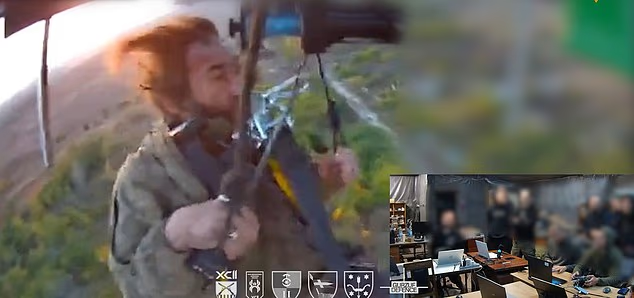
A Ukrainian infantryman who spent 491 days trapped on the frontline has become the first soldier to be evacuated by aerial drone, after cutting through his own injured leg to survive, according to his account.
Kostiantyn Vlasenko, 49, was stranded in heavily mined territory in Ukraine’s Kharkiv region after Russian drones made a conventional rescue impossible. He was eventually lifted from the battlefield beneath a heavily modified bomber drone and flown 18 kilometres to safety.
The drone rose about 120 metres into the air, carrying the 80kg soldier from Petropavlivka while three Ukrainian Vampire drones escorted it. One of the escort drones was captured by Russian forces, Vlasenko said.
“I have no words… A wonder. It is a miracle,” he said after reaching safety.
Trapped on the frontline
Vlasenko, known by the callsign Kostya, had been serving with the 2nd Battalion of Ukraine’s 30th Mechanised Brigade. Before the war, he worked as a lorry driver at a quarry in Kryvyi Rih, Volodymyr Zelensky’s hometown, and went to a recruitment office to demand that he be enlisted.
He was sent to relieve an injured comrade at a position inside a concrete drainage pipe. There, he and another soldier, known as Baski, took turns keeping watch and sheltering in a small underground space dug beneath the pipe.
The pair were expected to be replaced after two months, but heavy Russian drone activity made it impossible for them to leave. “They had so many Mavics, the sky was dirty,” Vlasenko said. “If you didn’t see it, it saw you.”
An attempted relief mission failed, and other soldiers were later unable to recover those who had been killed. Vlasenko said he told his commanders there was no point sending more men for him.
After eight months, the pipe flooded during a period of severe frost, forcing the two men to crawl out and make their way to an abandoned school. Ukrainian drones dropped dry clothing and supplies, but Russian forces detected the deliveries and began attacking the building.
Vlasenko suffered further injuries to his legs. Baski was killed while leaving the ruins to collect food, dying on his 50th birthday. Vlasenko said he heard his comrade’s groans through the night but could not treat him in the darkness.
“By morning, my brother-in-arms had died. I couldn’t save him,” he said. “I was left alone on February 16. When it began to get light, I covered him up.”
Surviving inside a cast-iron furnace
After Baski’s death, Vlasenko tried to move position, but his injuries left him barely able to walk. A Russian speaker was dropped nearby, urging him to surrender and promising that he would be taken into captivity before being exchanged and sent home.
Instead, Vlasenko answered with the defiant phrase associated with the defenders of Snake Island: “Russian warship, go f*** yourself!”
A Russian bomber drone then attacked. Vlasenko survived two large explosions by crawling inside a cast-iron furnace among the ruins of the school.
He remained there for a further eight months, emerging only to collect food and medical supplies delivered by Ukrainian drones. Despite his condition, he continued reporting enemy movements by radio.
His left foot eventually rotted and fell away after severe frostbite and poor circulation. His right leg, damaged in an earlier injury, became numb and began to hang loosely.
“I realised I had to cut it off,” he said. “I put it on a brick and took a knife. Tears were flowing, but I had to cut. So I cut.”
Vlasenko said his comrades continued sending him food, sweets, tea and cigarettes. His wife, Tetyana, also sent a parcel containing a copy of Stephen King’s novel The Outsider.
He said thoughts of his daughter, Khrystyna, helped him endure the isolation, although he had already accepted that he might die in the ruins.
First aerial drone evacuation
About a month before the rescue, Sergeant Lysyi contacted Vlasenko by radio to tell him that an evacuation was being prepared. He initially assumed that soldiers would come by vehicle or quad bike.
Instead, his commanders dropped a phone and written instructions in Ukrainian and Russian. A video showed him how to secure himself to a harness beneath the drone.
When the aircraft arrived, Vlasenko attached himself to its underside and made a heart sign and a thumbs-up towards its camera. He said he feared being dropped into a river because he could not swim.
The aircraft used in the operation, known as Heavy Shot, was manufactured by Gurzuf Defence and is capable of carrying up to 90kg. After the flight to the evacuation point, Vlasenko was taken to hospital, where he is receiving treatment and undergoing rehabilitation.
He said he was grateful to everyone involved in the mission, even though he did not know all their names.
Despite the historic nature of the operation, Vlasenko said he was uncomfortable being described as the first soldier to be evacuated by aerial drone. “I don’t like being first,” he said. “I prefer being second.”
