


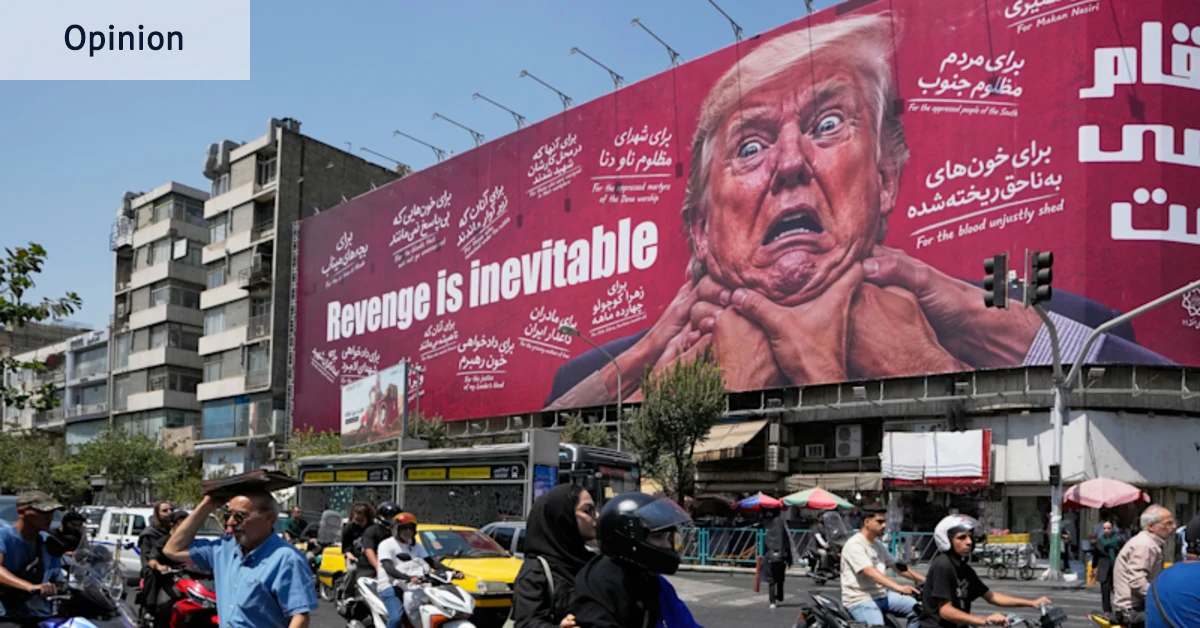
Iran could respond to the economic and military pressure imposed by the United States by escalating the conflict rather than surrendering, analysts have warned, raising the risk of attacks on shipping and oil infrastructure around the Persian Gulf.
The warning comes as the Trump administration continues to describe its campaign against Tehran as a success, despite the financial and military costs of the war and growing concern that the conflict could make Iran more determined to pursue nuclear weapons.
Ali Vaez of the International Crisis Group has described the conflict as a “new forever war”, saying it is “nowhere near over”. Treasury Secretary Scott Bessent has maintained that the blockade is working, telling Fox News in September: “The blockade is working; it’s working like nothing we’ve ever seen.”
But the United States has already spent more than 43 billion US dollars on the war, according to a low estimate from the Pentagon. Higher prices linked to the conflict have cost the typical American family about 1,000 US dollars, economist Mark Zandi said, while diesel prices at some Californian stations have reached 9.99 US dollars a gallon.
The war has also depleted the American arsenal, cost American and Iranian lives and exposed vulnerabilities in the US military position. It has been alleged that war crimes may have been committed, while access to some American bases has been lost and US military credibility has been weakened as far away as East Asia.
Iran may choose to escalate
Washington’s belief that economic pressure will force Iran to concede comes as the Iranian economy has deteriorated sharply. The rial is now trading at more than 2.5 million to the US dollar, around one-tenth of its value in 2021, leaving ordinary Iranians to bear much of the impact.
Vali Nasr, an Iran expert at Johns Hopkins University’s School of Advanced International Studies, said Tehran may instead conclude that its survival depends on fighting back. “They’ve come to the conclusion that the only way they survive is to shoot their way out,” he said.
Mr Nasr suggested that Iran could intensify attacks on shipping and, particularly if it came under further attack, target oil infrastructure around the Persian Gulf.
Esfandyar Batmanghelidj, an Iran watcher at a British think tank, said Iran had not yet pursued a scorched-earth campaign but might do so if the current situation continued. “That is what everyone who actually follows this region and its dynamics is worried about,” he said.
A negotiated settlement appears difficult, with both Donald Trump and Iran accused of overreaching. The President’s chief negotiators, Jared Kushner and Steve Witkoff, are real estate investors whose closeness to Mr Trump was cited as a reason for their selection.
Iranian officials have also adopted a defiant tone. Ahmad Vahidi, commander-in-chief of Iran’s Revolutionary Guard, said in August that Iran had brought the United States “to its knees”. Foreign Minister Abbas Araghchi told NBC’s Meet the Press that Iran was prepared for another round of fighting, “even if it comes to a doomsday war”.
War may increase nuclear fears
Preventing Iran from acquiring nuclear weapons remains a central US objective. Mr Trump has said: “Iran will never have a nuclear weapon,” and has publicly considered whether to “annihilate the Islamic Republic and do it quickly”.
However, the war may have made an Iranian move towards nuclear weapons more likely. The conflict began with the killing of Iran’s previous supreme leader, who had issued a religious ruling against developing such weapons. His son, who became the new supreme leader, has not issued a similar ruling, and Mr Nasr said there was now “a serious conversation in Iran” about pursuing nuclear weapons.
A proposed measure before the Iranian parliament would withdraw the country from the Nuclear Nonproliferation Treaty, while 32 Iranian figures have called for such a move. Mr Araghchi told reporters: “Any other country but Iran would have pulled out of the NPT if treated the same way.”
The conflict has also been placed within a wider history of American policy towards Iran. The United States helped topple a democratically elected prime minister in 1953, supported the shah and provided Iran with a nuclear reactor in the 1960s and 1970s. The 2003 Iraq War removed Saddam Hussein, an enemy of Iran, and empowered Shiite militias aligned with Tehran.
Mr Trump’s decision in 2018 to withdraw from the Obama-era nuclear agreement was followed by this year’s war, which has strengthened military hardliners in Tehran and allowed Iran to project greater influence over the Persian Gulf and global oil markets.
