


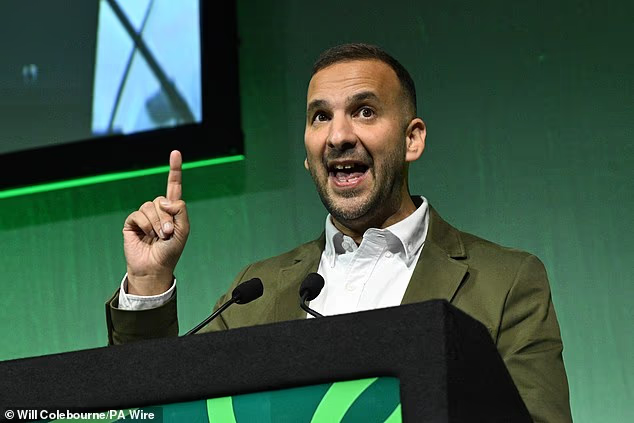
The Green Party conference in Brighton has highlighted the party’s sharp shift towards the political Left under leader Zack Polanski, with activists backing campaigns on Palestine, rent controls, immigration, gender issues and Net Zero.
Mr Polanski used his address to argue that the Greens’ role was to push Labour further to the Left. “Vote Green and see Labour move,” he told members, as he presented the party as a force capable of reshaping the policies of its larger rival.
His leadership has coincided with a rapid increase in Green Party membership, which he said had risen from about 70,000 to more than 220,000. But the party’s recent surge appears to have weakened, with its support in polling described at the conference as having fallen from around 20 per cent to about 11 per cent.
Mr Polanski is also facing a significant test in next Thursday’s Holborn and St Pancras by-election, where he is standing as the Green candidate. There has been speculation that a defeat by Labour could lead to a challenge to his leadership.
Green Party conference focuses on Palestine and identity politics
The Brighton gathering exposed tensions between the Greens’ traditional environmental agenda and the priorities of a newer membership drawn towards hard-Left causes.
Fringe meetings included discussions on migration raids, queer liberation, sex workers’ rights and “punk politics”. Another session asked when tree planting might be considered a tool of ethnic cleansing, while activists were offered advice on appealing specifically to Muslim voters.
The party’s commercial hall included groups representing Muslim Greens, Jewish Greens, Young Greens, Vegan Greens, Feminist Greens and the Green Left. The range of affiliated groups reflected what has become a more fragmented and identity-focused movement.
The conference is due to debate a proposal on Sunday to classify as racist anyone who embraces Zionism, described in the material as the belief that Israel has a right to exist.
That proposal has intensified scrutiny of the party’s position on Israel and Palestine. Mr Polanski has previously said he is of Jewish descent and opposed Jeremy Corbyn’s Labour leadership because he regarded its policies as antisemitic. A party spokesman said it was “astonishing that the only Jewish leader of a political party in Britain is having his family history raked over by the Press”.
Mr Polanski has also faced questions over claims he made about his family’s history. The material states that he had long claimed his family was persecuted by the Nazis, while reporting that his grandparents and parents were born in Britain.
Leadership under pressure
Mr Polanski, who was born David Paulden, joined the Greens after previously belonging to the Liberal Democrats. He became a London Assembly member in 2021, later served as deputy leader and was elected leader last autumn.
His rise coincided with the troubled launch of Jeremy Corbyn’s hard-Left Your Party, giving left-wing activists dissatisfied with Keir Starmer’s Labour an alternative political home.
The Greens’ increased membership has altered the character of the party. Long-standing members were portrayed as more traditional environmentalists, while the newer activist base has placed greater emphasis on Palestine, social identity and opposition to property ownership.
Mr Polanski’s speech repeatedly returned to the message that a stronger Green vote would force Labour to adopt more left-wing policies. He argued that the party’s influence could already be seen in Labour’s movement on issues including Israel’s West Bank settlements, public-sector pay, North Sea drilling licences and the prospect of closer ties with the European Union.
The party’s growing profile has nevertheless created potential divisions. Mothin Ali, one of its two deputy leaders, could emerge as a challenger if Mr Polanski loses in Holborn and St Pancras, according to the material.
Mr Ali has taken a strongly pro-Palestinian position. After winning a seat on Leeds City Council in 2024, he described his victory as “a victory for the people of Gaza” and shouted “Allahu Akbar”. He later accused critics of Islamophobia.
The conference also featured opposition to police use of Tasers and facial-recognition technology. A Green council in Stroud was described as wanting to prohibit security lights on new homes in order to avoid disturbing bats.
The party’s direction has raised questions about whether it is losing touch with voters in areas where it has made electoral gains. The material points in particular to North Herefordshire, where the Greens won an MP in 2024 after the Conservative and Reform vote was divided.
Mr Polanski’s leadership has undeniably given the party a louder national presence. But with its polling support falling and internal tensions over Israel, identity politics and the direction of the movement, the Brighton conference also underlined the risks of its rapid transformation.
