


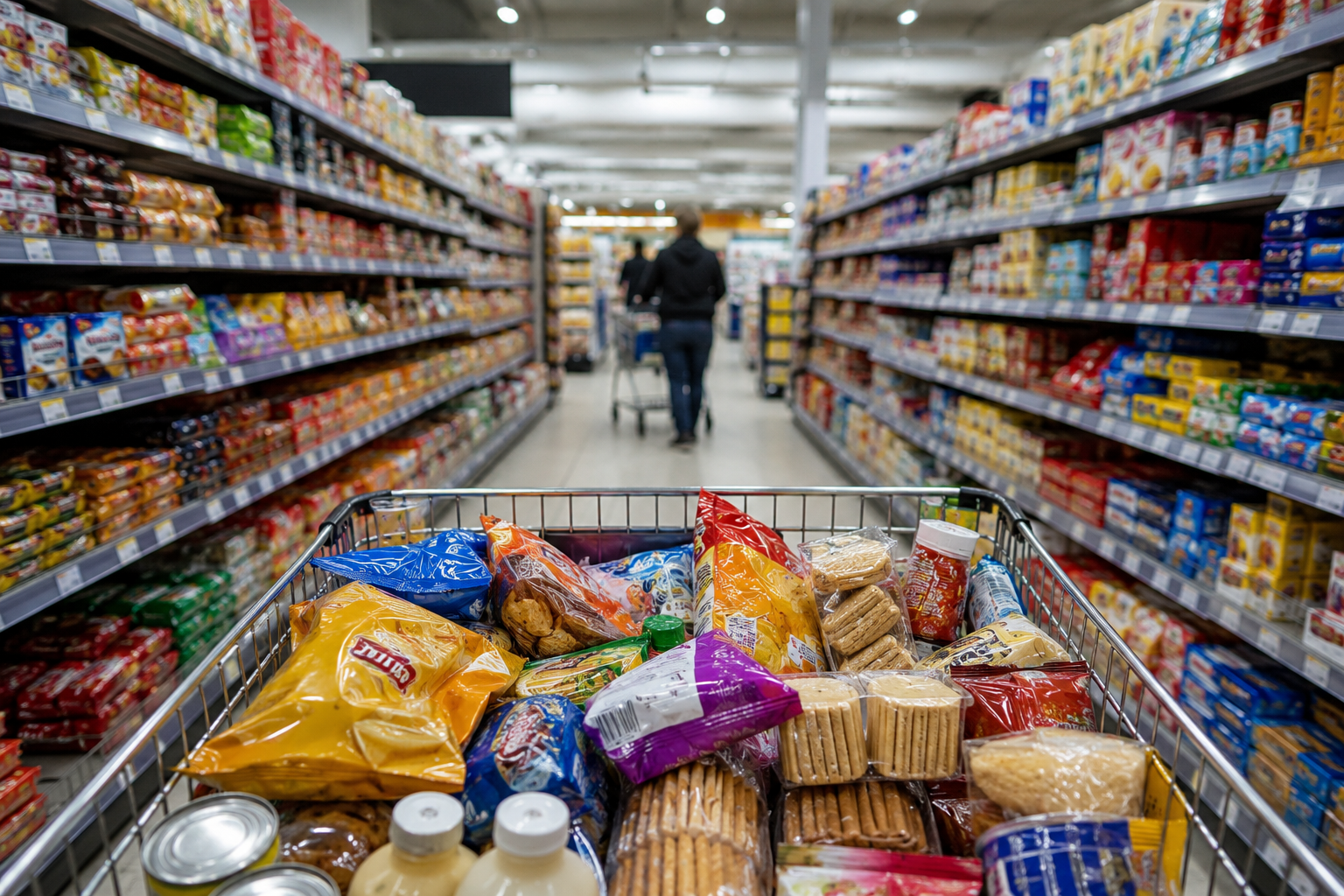
An evidence-based guide to the chains, store brands and additives that scientists and watchdogs have flagged as the most problematic for health — with every claim attributed to its source.
Why this matters
“Ultra-processed food” (UPF) is no longer a fringe concern. It is the single biggest category of what most people in Britain and America actually eat, and a growing body of research links it to obesity, type 2 diabetes, heart disease, certain cancers and earlier death.
A few headline figures set the scene:
- In the UK, roughly half of the food households buy is ultra-processed — about 50.7% of the diet, the highest share in Europe, according to research across 19 European countries published in Public Health Nutrition and reported by The Guardian.
- For UK adults, an analysis of the National Diet and Nutrition Survey found that around 54% of calories come from ultra-processed foods such as ready meals, cereals, sausages, biscuits and cakes (study summarised by TABLE / TableDebates, co-authored by NOVA system creator Carlos Monteiro).
- In the US, UPFs make up an estimated about 60% of daily calorie intake, with even higher rates among lower-income and lower-education groups, according to the medRxiv study “Ultra-processed food staples dominate mainstream U.S. supermarkets.”
The medical framing is stark. A blog citing The Lancet noted that UPFs have been described as a “corporate-engineered public health crisis” — industrial products designed for profit rather than nutrition.
A note on fairness before the list: the issue is mostly about what is stocked and how it is formulated, not about any single shop being “dangerous.” Every major chain sells both whole foods and ultra-processed ones. The differences below are about proportions and formulation, as measured by independent researchers and watchdogs.
First, the key terms
The NOVA classification. Researchers group foods into four NOVA categories by how much industrial processing they undergo. NOVA 4 = ultra-processed: industrial formulations made from extracted substances (oils, sugars, starches, proteins) plus additives such as flavourings, colours, emulsifiers and sweeteners. NOVA was developed by a team led by Carlos Monteiro and is referenced by the UN’s Food and Agriculture Organization (FAO).
UPF “markers.” A UK food-market analysis published in Public Health Nutrition found that almost 90% of UPF products can be detected by just six markers, the three most common being flavourings (58.4% of UPF items), emulsifiers (35.7%) and colours (26.5%). Researchers using these markers can score how processed a product is.
The UK has no legal UPF definition. The Food Standards Agency confirms there is currently no formal UK definition; the NOVA system is the most widely used globally, as noted by the AHDB consumer-insight team.
The United States: the chains ranked by processing
The most detailed public data comes from two research efforts.
1. GroceryDB / Northeastern University (Walmart, Target, Whole Foods)
A team led by Giulia Menichetti (Brigham and Women’s Hospital / Harvard Medical School) and Albert-László Barabási (Northeastern University) built GroceryDB, a database of over 50,000 food items sold by Walmart, Target and Whole Foods, with results published in Nature Food and made searchable on the “TrueFood” website.
Findings, as reported by Northeastern, Scientific American, StudyFinds and VegNews:
- About 73% of the US food supply analysed is ultra-processed, and on average ultra-processed items are roughly 52% cheaper per calorie than minimally processed alternatives — meaning the unhealthiest options are often the cheapest.
- All three chains are dominated by UPFs, but they differ. Whole Foods offered more minimally processed and fewer ultra-processed items.
- Target stood out for a “particularly high fraction” of ultra-processed offerings, the researchers said, with Walmart also heavily skewed toward UPFs.
- In categories like cereals, soups and snacks, shoppers at Walmart and Target had little to no access to less-processed alternatives.
- Barabási’s team warns that thousands of brands give shoppers only the “illusion of choice,” because the nutritional variation between them is small.
2. The “staple foods” study (medRxiv, 2024)
A separate study compared basic staples (bread, canned goods, cereals, eggs, milk, vegetables, yogurt) at Walmart, Target and Whole Foods in the US against Carrefour (France) and Mercadona (Spain).
Key results:
- UPF prevalence in staples averaged 58% at Walmart and 58% at Target, versus 41% at Whole Foods. So Walmart carried about 42% more UPFs and Target about 41% more than Whole Foods in staple categories.
- Walmart’s ultra-processed staples carried the most additive “markers” — about 75% more UPF markers than Whole Foods, with Target about 57% more.
- 61% of Walmart’s UPFs had three or more markers, compared with 56% at Target and 32% at Whole Foods.
- The European leaders studied (Carrefour, Mercadona) had roughly the same UPF level as Whole Foods — and US supermarkets overall had about 41% more UPFs than the European ones.
Bottom line for the US: by these measures, Walmart and Target rank as the most heavily ultra-processed of the three big chains studied, with Walmart’s products carrying the most additives; Whole Foods is the least processed but still majority-UPF.
The United Kingdom: the chains ranked on health
The “Big Four” and the additive problem
A study in Public Health Nutrition examined more than 32,000 products from the UK’s “big four” — Tesco, Sainsbury’s, Asda and Morrisons. Among eligible products reviewed:
- Emulsifiers were present in 51.7% of products.
- They appeared in 95% of pastries, buns and cakes, 81.9% of milk-based drinks, 81% of industrial desserts and 77.5% of confectionery.
- Half of emulsifier-containing foods had more than one emulsifier; the most common was lecithin (23.4% of products).
This was, the authors said, the first study to show how widespread emulsifiers are across the UK food supply — and these chains dominate the market, so their formulation choices shape the national diet.
The health league table (ShareAction / Access to Nutrition Initiative)
The Access to Nutrition Initiative (ATNI), with investor group ShareAction, produced what they called the world’s first ranking of food retailers by their contribution to consumer health, scoring 11 UK retailers across eight areas (formulation, promotions, pricing, placement, labelling and more).
Results, as reported by The Grocer, ShareAction, the Food Foundation, FoodNavigator and NationalWorld:
| Rank | Retailer | Score (out of 10) |
|---|---|---|
| 1 | Tesco | 5.2 |
| 2 | Sainsbury’s | 4.8 |
| 3 | Aldi UK | 4.3 |
| … | (mid-table: Lidl, M&S, Morrisons, Co-op, Waitrose, Asda) | various |
| 10 | Iceland | 0.6 |
| 11 | Ocado | 0.5 |
Key takeaways:
- Performance across the whole sector was poor — the average score was just 3.3 out of 10, ATNI said.
- Iceland and Ocado scored lowest (0.6 and 0.5). ATNI noted both had very limited public information on nutrition action and did not submit data.
- Iceland was singled out as the only retailer not using traffic-light front-of-pack labels on its own-brand products.
- Asda ranked lowest among those that participated, found to lack specific commitments to cut sugar, calories and salt; Asda did not respond to a request for comment, per NationalWorld.
Important nuance: a low ATNI score reflects weak strategy, targets and transparency on health — not proof that a shop’s food is more toxic than a rival’s. Tesco topping the list largely reflects its public commitment to lift healthier products from 58% to 65% of sales, a target it reported hitting by the end of 2025, according to The Grocer.
The wider UK trend
There are signs of change. GlobalData (reported by ESM Magazine, Nov 2025) found 60.1% of UK shoppers say they cut UPF consumption over the past year, led by younger shoppers — 71.5% of Gen Z and 67.9% of millennials reducing intake, said analyst Ashley Adeyemi.
The additive gap: ingredients allowed in the US but banned or restricted in the EU/UK
A recurring theme — covered by Time, GoodRx, the ANSI Blog, the Levels blog and others — is that the US allows additives the EU and UK restrict, because the US relies on the “Generally Recognized As Safe” (GRAS) system. Commonly cited examples:
- Potassium bromate — a flour treatment, a possible carcinogen; banned in the EU, UK and Canada, still permitted in the US (per the Levels blog and ANSI Blog).
- Titanium dioxide — a whitening agent; the European Food Safety Authority banned it in 2022 over potential DNA damage, but the FDA still considers it safe. The Environmental Working Group’s Melanie Benesh argued such a chemical “should not be in candies and treats marketed to children,” per Time.
- BHA and BHT — synthetic preservatives; banned in the EU, still legal in the US; animal studies suggest possible cancer risk, though human evidence is not conclusive (per GoodRx and Organic Soda Pops). Brands cited as having used them include Kellogg’s cereals and others — always check the current label.
- Azodicarbonamide — a dough conditioner; banned in the UK and EU (per the Levels blog).
- Brominated vegetable oil (BVO) — used in some sodas; the FDA moved to ban it after California did, and major makers like PepsiCo and Coca-Cola phased it out, though some smaller and store-brand sodas reportedly still used it (per GoodRx and the Levels blog).
- Certain synthetic food dyes (e.g., tartrazine / Yellow #5) — restricted or requiring warnings in the EU, more freely used in the US (per the ANSI Blog).
Caveat worth stating plainly: “banned somewhere else” does not automatically mean “proven harmful at dietary levels.” US and EU regulators weigh evidence differently. The honest summary is that the US tolerates a wider additive list, which is one reason its food supply scores as more heavily processed.
The product categories that are the worst offenders
Across the UK and US research, the same categories repeatedly score highest for processing and additives:
- Breakfast cereals — among the most consistently ultra-processed; few minimally processed options at Walmart/Target (GroceryDB).
- Pastries, cakes and buns — emulsifiers in 95% of UK products (Public Health Nutrition).
- Industrial desserts, ice cream and confectionery — high additive loads.
- Soft drinks and “milk-based” / flavoured drinks — sweeteners, colours, and historically BVO in some sodas.
- Packaged snacks, crisps and biscuits — flavourings, colours, emulsifiers.
- Ready meals and reconstituted/processed meats (sausages, nuggets) — multiple markers.
- Mass-market sliced bread — often contains emulsifiers and dough conditioners, unlike traditional bread.
What this means for shoppers (practical takeaways)
- Read the ingredient list, not the front of the pack. If you see flavourings, emulsifiers, colours, glucose/glucose-fructose syrup, modified starch or additives you wouldn’t keep in your kitchen, it is very likely ultra-processed (the six-marker rule from Public Health Nutrition).
- The cheapest option is often the most processed — true in both the GroceryDB and staple-foods US studies. Budget shopping and healthy shopping pull against each other, which the researchers framed as a fairness/equity problem.
- Store choice shifts the odds, not the outcome. In the US data, Whole Foods (and European leaders like Carrefour and Mercadona) offered more minimally processed staples; Walmart and Target fewer. But majorities everywhere are still UPF.
- Watch own-brand labelling. ATNI flagged Iceland for not using traffic-light labels — labelling clarity varies by chain.
- The market is moving. Reformulation pledges (Tesco, Aldi, Lidl, M&S, Sainsbury’s) and falling UPF demand among younger shoppers mean ranges are shifting; today’s worst offender can change.
Sources
- Public Health Nutrition — emulsifiers in UK UPF supply (Tesco, Sainsbury’s, Asda, Morrisons); via NCBI PMC.
- Public Health Nutrition — six markers detect ~90% of UK UPF (flavour, emulsifiers, colour); via NCBI PMC.
- Public Health Nutrition (19-country study) — UK 50.7% of diet ultra-processed; via The Guardian / Sustain.
- National Diet and Nutrition Survey analysis — 54% of UK calories from UPF; via TABLE / TableDebates (Monteiro et al.).
- GlobalData — UK shoppers cutting UPF; via ESM Magazine (Nov 2025).
- ATNI / ShareAction UK Retailer Index — health league table (Tesco top; Iceland, Ocado bottom); via The Grocer, ShareAction, Food Foundation, FoodNavigator, NationalWorld.
- The Grocer — Britain’s Biggest Brands 2026; Tesco’s 65% healthier-sales target.
- The Lancet (quoted) — “corporate-engineered public health crisis”; via taxresearch.org.uk blog.
- GroceryDB / Northeastern University, published in Nature Food (Menichetti, Barabási, Ravandi) — 50,000+ items at Walmart, Target, Whole Foods; via Northeastern News, Scientific American, StudyFinds, VegNews, Food Tank.
- medRxiv (2024) — “Ultra-processed food staples dominate mainstream U.S. supermarkets”; Walmart/Target vs Whole Foods, Carrefour, Mercadona.
- Time (2026) — additives banned in Europe still on US shelves (titanium dioxide; EWG’s Melanie Benesh).
- GoodRx — 6 US food ingredients banned abroad (BHA, BHT, BVO, rBST).
- Levels blog — 7 additives banned outside the US (potassium bromate, azodicarbonamide, BVO).
- ANSI Blog — differences between EU and US food standards (GRAS; dyes; GMOs).
- AHDB consumer insight — UK has no formal UPF definition; NOVA most used.
All figures are drawn from the sources above. Regulatory status of specific additives and the formulation of specific products can change — verify current labels and the latest reports before relying on any single detail. This article is informational and not medical or dietary advice.
