


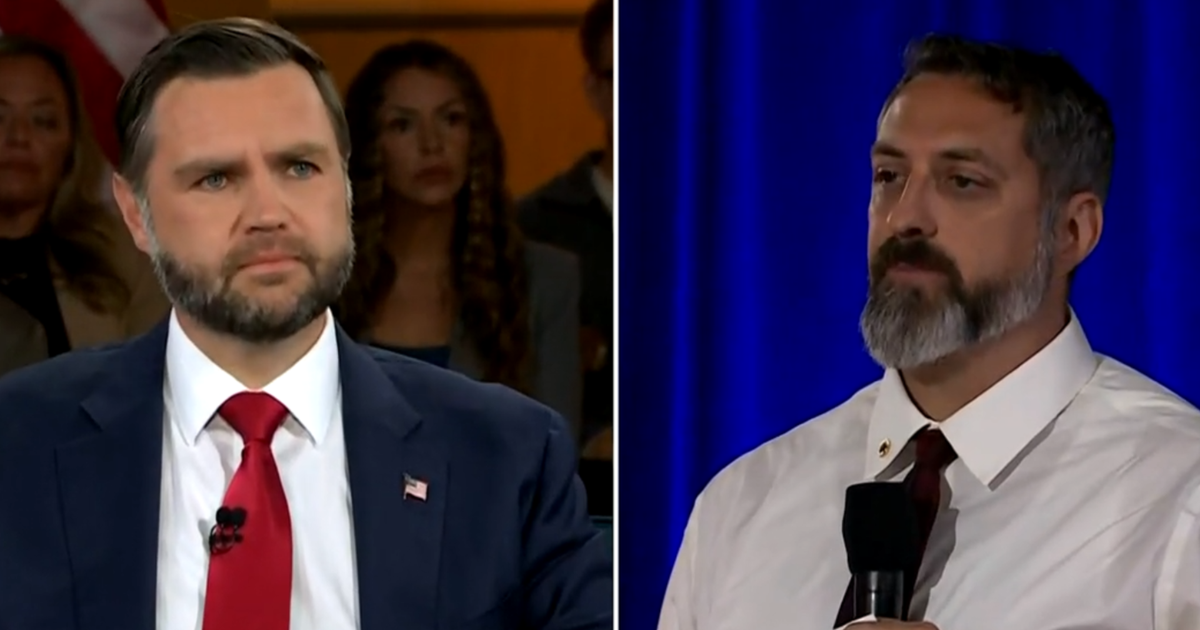
Joey Amor has pressed US Vice President JD Vance over whether the Trump administration will hold leaders accountable for alleged failures surrounding the death of his wife, a US Army reservist killed in an Iranian drone attack in Kuwait.
Master Sgt Nicole Amor, from Minnesota, was one of six people killed at an outpost at Kuwait’s Port of Shuaiba on March 1, one day after the United States began striking Iran. The attack remains the deadliest on US forces during the conflict.
Speaking during a televised “Things That Matter” town hall hosted by CBS Evening News anchor Tony Dokoupil, Mr Amor said the drone was not the only factor behind his wife’s death.
“Though the Iranian drone was the weapon that killed my wife, there were a lot of mistakes and a lot of fundamental failures that led up to that,” he said, adding that his wife had told him about concerns before she died.
“There’s a failure in the leadership. And I want to know how this administration is gonna start holding those leaders accountable for the actions and the deaths of the soldiers that we honor and that we love,” Mr Amor said.
Families affected by the attack have questioned whether the US military did enough to protect personnel at the facility. Concerns raised include whether the outpost was adequately fortified, whether it had the ability to intercept incoming drones, and decisions not to move troops further from Iran or increase medical support.
Mr Vance described Nicole Amor as “a precious human being who served her country honorably” and said he wanted to establish whether failures had occurred.
“Because if there were failures, and I don’t doubt there were, I just … literally the first time I’ve heard of this is this conversation, and I want to fix that stuff. I do not want this stuff to happen,” he said.
The vice president acknowledged that serving in senior office could leave him insulated from information, saying: “You live in a bit of a bubble” and “sometimes information doesn’t filter up to me.”
He promised to investigate what had happened and determine what could be improved, while saying some changes were already under way in response to the threat posed by inexpensive, easily manufactured drones.
“We have changed a lot of our tactics to try to suppress that drone fire, to try to protect our troops to make it so that more people don’t have to pay the ultimate sacrifice,” Mr Vance said.
He also acknowledged there had been problems with the positioning of troops.
“There are issues with … where troops were located that we realized was a huge mistake, and that we could do better on. And we have changed that,” he said.
Mr Vance declined to provide details, saying he did not want to give Iran information that could be used to target other service members or their families. He told Mr Amor that he would not forget the incident and wanted to speak with soldiers involved, as well as with him, to understand what could have been done differently.
