


Violent protests over the cost of living, education and Emmanuel Macron’s government have spread across France, with more than 1,200 people arrested and about 550,000 taking to the streets.
Businesses were looted and set alight during Saturday’s demonstrations, while police used tear gas and water cannon to disperse crowds. Sixty officers were injured, including two who were taken to hospital unconscious, according to Interior Minister Laurent Nuñez.
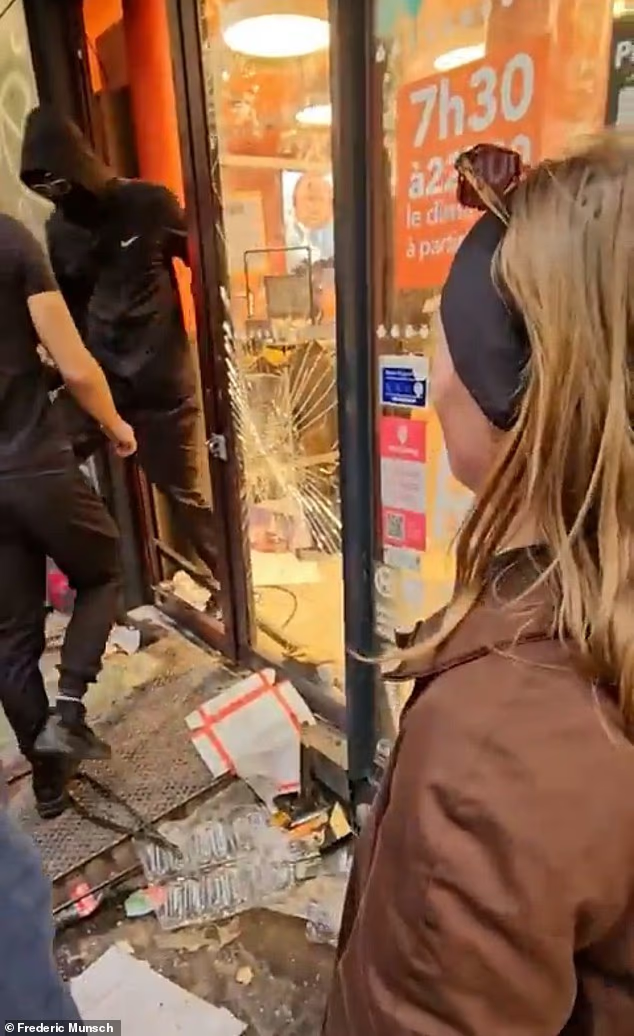
In one video, a woman is shown pleading with a group of rioters not to enter her shop. She asks, “why are you doing this” and screams, “this is not the cause”, before being pushed aside as masked men appear to leave with stolen goods.
The footage showed the shop being ransacked as onlookers appeared to cheer the looters. Authorities said looting or attempted looting was recorded in Paris, Rouen, Nantes, Toulouse and Marseille.
In Limoges, the town hall, built in 1883, was engulfed by flames and collapsed. The building had played a significant role in the French Resistance during the Second World War.
Other damage was reported in cities including Lyon, Bordeaux and Marseille. A tourist office in Lyon was set on fire, while a recently renovated Galeries Lafayette store in Bordeaux was reportedly stormed by hundreds of protesters.
Young people wearing balaclavas and black clothing were seen throwing baguettes at riot police in Paris. Cars and a tourist office were also set alight, while barricades were built from bins and wooden boards.
In Marseille, masked youths briefly broke into the town hall and vandalised a statue of Marianne, the female personification of the French Republic. Fighting was also reported in Paris near the Place de la République and Gare du Nord Eurostar station.
Shops barricaded their doors and windows, while several Paris Metro stations were closed as the unrest intensified.
Prime Minister Sébastien Lecornu said peaceful demonstrations had a legitimate place in France but condemned arson, looting and attacks.
“No one will impose their political agenda through violence,” he said. “The instructions given are clear: prevent abuses, protect property and people, apprehend the perpetrators, and bring them before the courts.”
Mr Lecornu added that those responsible should pay for the damage, saying public money should fund public services rather than “endlessly repair what vandals destroy”.
He also accused far-Left groups of orchestrating violence, an allegation denied by France Unbowed. “We will not be intimidated,” the prime minister said, warning that no one would use violence to impose a political agenda.
Macron had called for calm and urged protesters to show “respect for people and property”. His appearance at a Céline Dion concert in Paris with his wife, Brigitte, on Friday night drew criticism as the demonstrations gathered pace.
The protests have brought together students, trade unionists and members of the Yellow Vest movement, which began in 2018 over diesel tax rises before becoming a wider campaign against living costs and inequality.
Students have also been protesting for almost five weeks against what they describe as a deteriorating education system. In Saint-Etienne, a protester suffered the loss of a hand after a police crowd-control grenade exploded, according to a police source.
The incident came days after a 15-year-old student lost his left hand when a stun grenade exploded outside his school in Lens. Police tactics have faced criticism, with France’s internal police watchdog investigating at least two dozen cases of alleged police violence.
The unrest has now spread beyond France. In Milan, police fired tear gas after protesters allegedly threw stones at officers during a demonstration against the cost of living.
Shops in the Galleria Vittorio Emanuele II luxury shopping centre closed their shutters and tourists left the area. The Duomo Metro station was temporarily closed, while several people were reported injured and arrests were made.
In Brussels, several hundred people, mainly young demonstrators, protested against rising education costs and reforms they fear could make higher education less accessible. Some stood on an overturned car and clashes with police were reported.
Mr Lecornu described France as being in an “atmosphere of perma-crisis” because of wars, inflation and pressure on household purchasing power. Jordan Bardella, leader of the National Rally, said he was “extremely concerned” and expected “a day of chaos for France”.
The unrest comes as Macron approaches the end of his presidency, having completed the maximum two terms allowed for a French president. His government is also facing pressure over public finances, with borrowing costs rising as investors retreat from French debt.
