


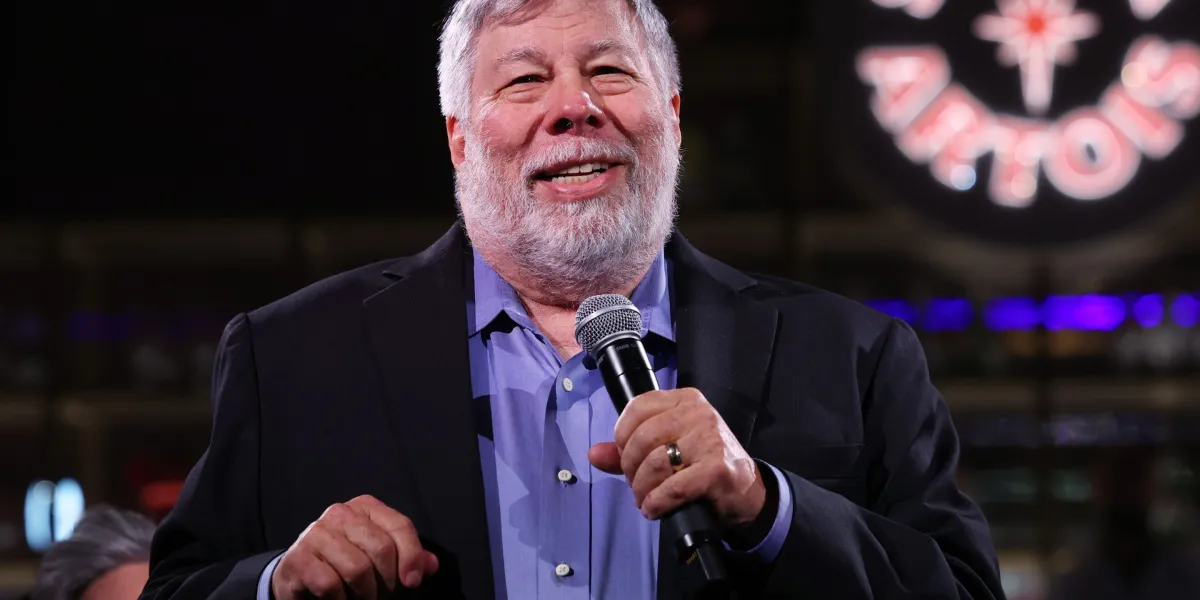
Steve Wozniak has told graduates that money was not the reason he co-founded Apple, saying he was instead driven by the ambition to build a personal computer and earn the respect of fellow engineers.
Speaking at a commencement ceremony for Grand Valley State University in May, Wozniak urged students to avoid simply following conventional career paths. “Don’t follow the same steps as a million other people,” he said. “Think: ‘Is there something I can do a little different?’”
Wozniak, Steve Jobs and Ronald Wayne founded Apple in 1976. The company has since become one of the world’s most valuable businesses, producing products including the iPhone, iPad and iMac.
But Wozniak said building a technology empire had never been his objective. “When we started Apple, did I want to make money? Start a company? Start an industry? No,” he said.
His motivation, he explained, was to turn his idea for a personal computer into reality and gain recognition from other people working in the field.
“I wanted other engineers or other computer people to look at my designs and say, ‘Whoa’ and appreciate me and my brilliance, ‘How did he come up with these things?’” he said.
Steve Wozniak’s advice on taking an unconventional career path
Wozniak had originally expected to spend his working life at Hewlett-Packard, where he secured a job after taking a break from his degree at the University of California, Berkeley.
He said he presented his personal computer idea to the company five times and was rejected on each occasion. The setbacks helped persuade him to consider Jobs’ proposal that they establish a business of their own.
Jobs and Wozniak each initially received a 45 per cent stake in Apple, while Wayne held 10 per cent. Wayne sold his share back days after the company was formed.
Wozniak also eventually parted with much of his holding. During the 1980s, he sold shares gradually, gave some to early employees who had not received equity and donated money to charity.
Had he retained his original stake, his wealth could theoretically have made him the world’s first trillionaire. Instead, Wozniak has spoken of his reluctance to allow money to shape his decisions.
“I do not invest. I don’t do that stuff,” he previously said. “I didn’t want to be near money, because it could corrupt your values.”
He remained an Apple employee after stepping back from full-time involvement in 1985. In a 2020 podcast interview, he said he had received a weekly pay cheque since the company was founded, with about 50 dollars reaching his bank account after savings and tax.
Wozniak tells graduates they do not need their careers mapped out
Wozniak also described a career shaped by interests beyond business and technology. He had wanted to become an electrical engineer like his father, but also dreamed of teaching fifth grade.
Education remained important to him, and he returned to the University of California, Berkeley 12 years after co-founding Apple to complete his degree. He graduated at 35 using the alias Rocky Raccoon Clark to avoid attracting attention.
He later spent a decade teaching computing to elementary and middle school pupils.
Drawing on that experience, Wozniak told graduates they did not need to identify their permanent profession immediately. “It doesn’t even have to be working in the job you want to do for the rest of your life,” he said. “Take some job to get enough money for an apartment. That’s the most important thing.”
He recalled once typing college term papers overnight for strangers for five cents, saying he enjoyed the work and did not feel the need to charge more simply to demonstrate its value.
“If you do something you love—and I love typing—you don’t need to prove it by charging a huge amount of money,” he said.
His final message to the graduating students was brief: “Do your best.”
