


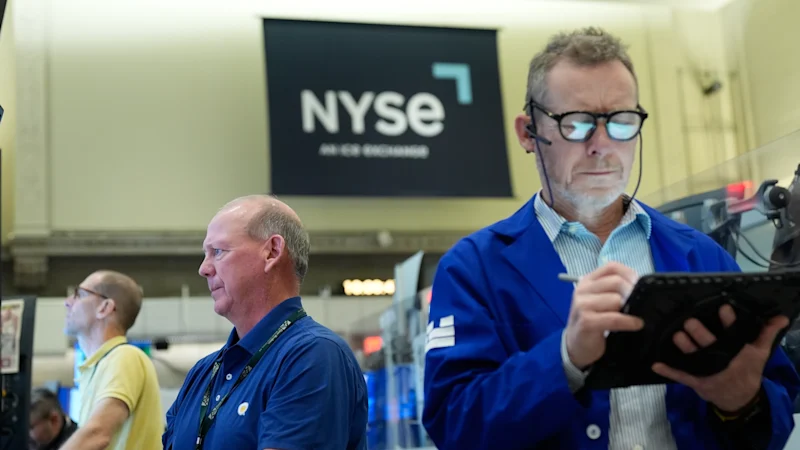
Australian shares are set to fall sharply after renewed pressure in the US bond market sent Wall Street lower, while oil prices jumped on fears that the war with Iran will continue to disrupt supplies from the Middle East.
ASX futures pointed to a decline of about 100 points, or 1.1 per cent, at the open on Thursday after the Australian market finished flat the previous day.
On Wall Street, the S&P 500 fell 0.8 per cent, the Dow Jones Industrial Average lost 352 points, or 0.7 per cent, and the Nasdaq composite dropped 1.1 per cent.
The sell-off followed a sharp rise in the yield on the benchmark 10-year US Treasury bond, which climbed to 5.10 per cent from 4.96 per cent. It briefly approached 5.14 per cent, its highest level since 2007.
Higher bond yields can weigh on shares by making other investments more attractive, while increasing borrowing costs for households and businesses. Investors have also been concerned about persistent inflation and the scale of US government debt.
US growth report adds to inflation concerns
Pressure intensified after a preliminary report indicated that US business activity had expanded at its fastest pace in more than five years.
Chris Williamson, chief business economist at S&P Global Market Intelligence, said the report also pointed to business costs rising at their fastest rate in four years, partly because of more expensive oil. Companies could pass those costs on to customers in the months ahead.
The report raised expectations that the Federal Reserve may need to keep interest rates higher for longer. Fed governor Michael Barr said further increases “are likely to be needed” to bring inflation back to the central bank’s 2 per cent target.
Traders now see a greater than 50 per cent chance of an interest-rate rise at each of the Fed’s next two meetings, in October and December.
Oil prices reverse recent decline
Brent crude for November delivery rose 3.9 per cent to 103.08 US dollars a barrel, reversing a recent decline after prices had approached 110 dollars last week. December Brent, which has become the more actively traded contract, gained 2.8 per cent to 98.12 dollars.
Prices remain well above the roughly 72 dollars a barrel recorded before the war with Iran began. Talks involving US and Iranian officials are continuing through mediators, but no concrete outcome has emerged.
The rise in oil prices added to concerns about inflation and helped push shares lower, although strong corporate earnings have provided some support to the US market in recent weeks.
Homebuilder KB Home reported quarterly profits above analysts’ expectations, but its shares fell 3 per cent after executive chairman Jeffrey Mezger said conditions had become more difficult. Higher mortgage rates, geopolitical uncertainty and wider economic pressures were making potential buyers more cautious, he said.
General Mills also exceeded profit expectations, but warned that growth this financial year would remain below its historical record because of a challenging consumer environment. Its shares ended 1 per cent higher.
The S&P 500 fell 58.61 points to 7,706.03. The Dow closed at 51,511.59, down 352.10 points, while the Nasdaq composite dropped 308.24 points to 26,936.04.
Markets also declined across Europe and Asia. Hong Kong shares fell 1 per cent and Shanghai’s market lost 0.4 per cent ahead of Chinese president Xi Jinping’s state visit to Washington, where leaders are expected to seek to stabilise strained relations between the world’s two largest economies.
