


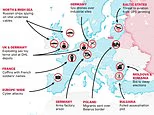
Russia’s shadow war against Europe has spread across a widening network of military bases, airports, ports and energy sites, according to a new assessment of suspected drone activity linked to the Kremlin.
The warning comes after Germany formally blamed Moscow for an attempted attack at Leipzig/Halle Airport, where an explosives-laden drone was discovered close to a Ukrainian cargo aircraft on August 4.
German Interior Minister Alexander Dobrindt said on September 1 that investigators had identified features of the drone, including its configuration, components, explosives and detonator, which were known from previous Russian hybrid operations.
Berlin described the incident as part of a broader and increasingly aggressive campaign designed to disrupt infrastructure, intimidate European governments and weaken support for Ukraine. Russia has denied conducting a sabotage campaign against Europe.
Russian drone activity across Europe
Research by the International Institute for Strategic Studies identified 144 suspicious drone incidents across Europe between August 2024 and February 2026. The cases included sightings in Germany, France, Belgium, the Netherlands, Denmark, the UK and other NATO countries.
The report said the pattern was unlikely to be explained solely by hobbyist or commercial drone use. Many of the flights took place near sensitive military facilities, nuclear-related sites, airports, ports and energy infrastructure.
Investigators and security analysts have also examined whether vessels linked to Russia’s so-called shadow fleet were used as launch or recovery platforms. The ships operate under complex ownership structures and are already used by Moscow to evade sanctions imposed over the war in Ukraine.
The suspected operations have varied from surveillance and airspace incursions to disruption and attempted sabotage. In several cases, however, governments have stopped short of publicly attributing responsibility because of the difficulty of proving who controlled the aircraft.
Leipzig represents a significant escalation because the drone was carrying explosives and was found near aircraft involved in supporting Ukraine. Germany’s decision to assign responsibility to Russia followed a review of the device and intelligence shared with its allies.
The European Union has expressed full solidarity with Germany and condemned what it called Russia’s attempted drone attack. European officials have promised further sanctions and other measures, while Nato has reiterated that its members will be protected against hostile activity.
The incidents have intensified concern that Moscow is testing the limits of Europe’s response with operations designed to remain below the threshold of open warfare. By using drones, cyber attacks, disinformation and recruited proxies, Russia can create disruption while preserving the possibility of denying direct involvement.
