


What is emerging from inside the Red Zone
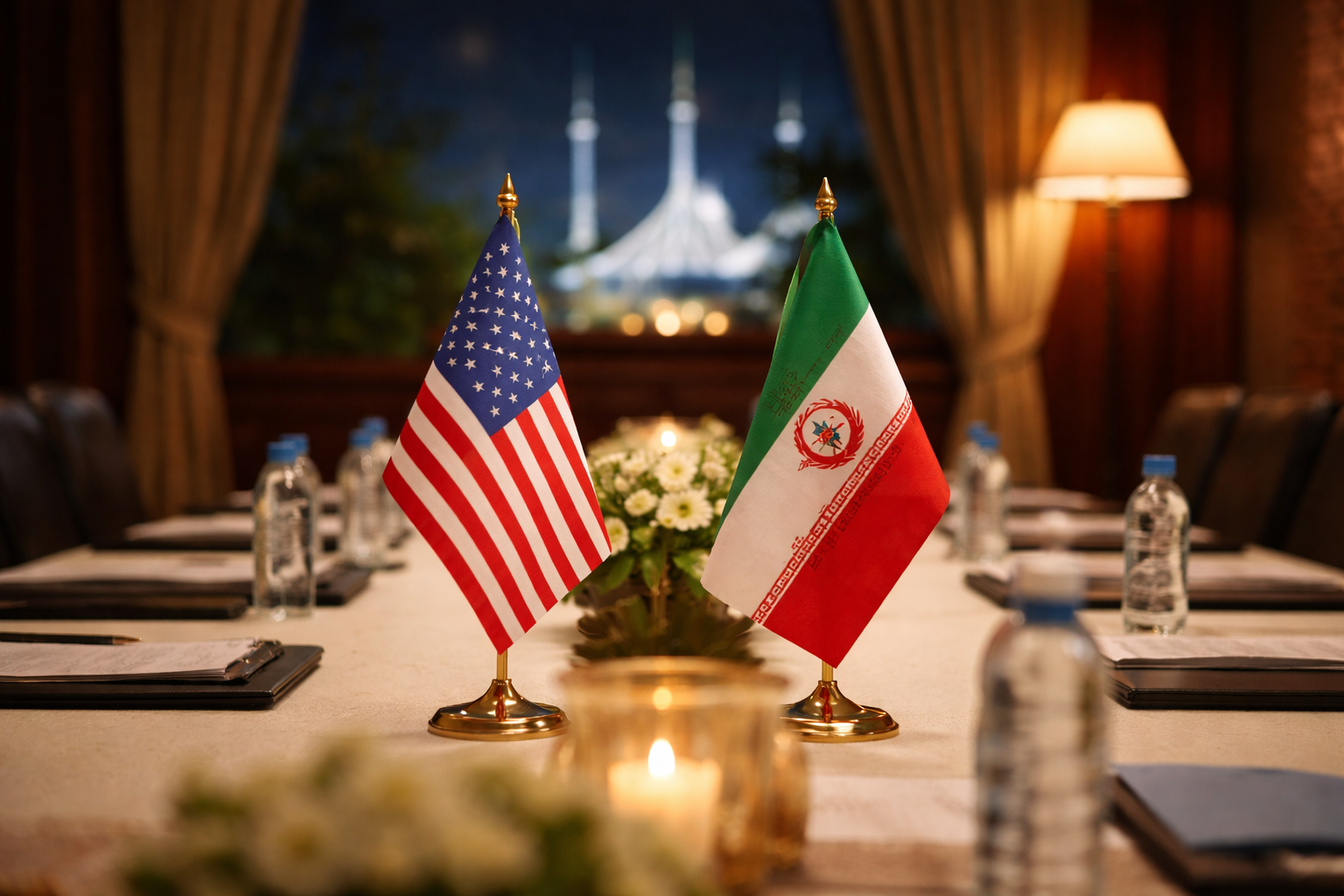
American and Iranian negotiators have spent Saturday locked in face-to-face discussions in the Pakistani capital, in what amounts to the first direct talks between Washington and Tehran since the 1979 Islamic Revolution. Sources close to the mediation told Al Jazeera that the two delegations have exchanged written texts during the session, a tentative but symbolically significant step in an encounter initially expected to take place only through intermediaries.
Al Jazeera correspondent Abid Hussain, reporting from Islamabad, said the meeting had begun as “proximate talks” but that, according to sources close to the mediation, the two teams were now “involved in direct negotiations, with the Pakistani mediators also present” in the room.
Vice-President JD Vance is leading the US delegation alongside special envoy Steve Witkoff and President Donald Trump’s son-in-law, Jared Kushner. The Iranian side, which reportedly numbers around 70 officials, negotiators and experts, is being led by parliament speaker Mohammad Bagher Ghalibaf and foreign minister Abbas Araghchi.
Why the talks nearly did not happen at all
The fact that the two delegations are in the same room at all is itself a diplomatic achievement. In the hours before the meeting, Tehran had hardened its public posture considerably. Ghalibaf warned on Friday that the negotiations could not begin unless Israel halted its attacks on Lebanon and Washington released Iran’s frozen assets, saying in an X post that “two of the measures mutually agreed upon between the parties have yet to be implemented: a ceasefire in Lebanon and the release of Iran’s blocked assets prior to the commencement of negotiations.”
On Saturday, Iran’s Tasnim news agency went further, publishing a list of what it called four “non-negotiable conditions” presented to mediators in Islamabad: “full sovereignty over the Strait of Hormuz, complete war reparations by the aggressor, unconditional release of blocked assets, and a durable ceasefire across the entire West-Asia Region.” Iranian state TV also spoke of “red lines” that included war reparations and a firm ceasefire.
Despite that opening posture, Iranian state media later confirmed that three-party talks had begun after what it described as a reduction in Israeli strikes on Lebanon. Al Jazeera’s Osama Bin Javaid, reporting from Islamabad, cited sources saying that “there has been some progress made on basic conditions, including on the need for a ceasefire in Lebanon”, and that while no formal Lebanon ceasefire had been reached there were reports of a possible understanding to confine strikes to the south of the country. The same sources suggested there “could be some movement on the unfreezing” of Iranian assets, although Bin Javaid cautioned that “it is still early hours and a lot of this needs to be confirmed”.
A senior US official denied that Washington had agreed to release frozen Iranian assets held in Qatar or other foreign banks as a precondition for reopening the Strait of Hormuz. A US official also told CBS News that no agreements had so far been reached.
Pakistan’s turn in the spotlight
Before the main session, both delegations held separate bilateral meetings with Pakistani Prime Minister Shehbaz Sharif. In a statement, Sharif’s office said that “as the Islamabad Talks commenced today”, the prime minister had praised both sides for their “commitment to engaging constructively” and “expressed the hope that these talks would serve as a stepping stone toward durable peace in the region”.
US warships transit Strait of Hormuz as Washington prepares mine-clearing operation
Security around the so-called Red Zone in Islamabad has been extraordinary, with streets emptied, roadblocks in place and successive rings of armed forces deployed around the luxury hotel hosting the negotiations. CBS News senior foreign correspondent Imtiaz Tyab described the stakes for Pakistan as being on “a scale rarely ever seen here before”. A two-day public holiday was declared to enforce the lockdown.
Army Chief and Field Marshal Asim Munir — described by CNN as Trump’s “favourite field marshal” — was among the Pakistani officials who greeted Vance at the airport, and has been credited with helping broker this week’s two-week ceasefire thanks to his close relationship with both Washington and Tehran. Saudi finance minister Mohammed al-Jadaan was also in Islamabad on Saturday in what a source familiar with the matter told AFP was a show of “economic support”.
Vance’s tone and Tehran’s mistrust
Speaking to reporters before boarding his flight on Friday, Vance struck a cautiously optimistic note. “We’re looking forward to the negotiation. I think it’s going to be positive. We’ll, of course, see,” he said, adding that President Trump had given him “pretty clear guidelines” for the meeting. “If the Iranians are willing to negotiate in good faith, we are certainly willing to extend an open hand, that’s one thing,” he continued. “If they’re going to try to play us, they’re going to find that the negotiating team is not that receptive.”
Some observers have read the last-minute decision to place Vance at the head of the delegation as a signal that Tehran preferred dealing with him over Witkoff and Kushner, who had previously led indirect negotiations on Iran’s nuclear programme. Vance, a former US Marine, is regarded as belonging to the less hawkish, anti-interventionist wing of Trump’s MAGA movement.
Ghalibaf, for his part, arrived in Islamabad expressing deep wariness. “Our experience in negotiating with the Americans has always been met with failure and broken promises,” he said shortly after landing, adding that Iran was nonetheless prepared to reach a deal if Washington offered what he described as a genuine agreement and respected Iran’s rights. Ali Vaez, Iran project director at the International Crisis Group, warned that the two sides were “miles apart, and there’s tremendous amounts of mistrust”, arguing that they were “beginning from a negative starting point” after two rounds of US military strikes on Iran during earlier diplomacy.
What is actually on the table
The core issues now being hashed out include Iran’s continued control over the Strait of Hormuz, through which only a handful of ships have transited since the ceasefire took effect; the release of roughly $6 billion in Iranian assets frozen in Qatar; guarantees around Iran’s nuclear programme; and the fate of Israel’s parallel conflict with the Iran-backed Hezbollah in Lebanon. Iran has been pressing its own 10-point negotiation plan, under which an end to Israeli attacks on Hezbollah would form part of any permanent settlement.
Trump, speaking to reporters on Friday, said the central US objective was straightforward. “No nuclear weapon. That’s 99 per cent of it,” he said. Earlier in the week, he told the New York Post that Washington was simultaneously reloading its warships with “the best ammunition, the best weapons ever made” in case the diplomacy failed, adding: “If we don’t have a deal, we will be using them, and we will be using them very effectively.”
A diplomatic moment shadowed by events on the ground
Even as the negotiators talked, Israel’s military said it had struck more than 200 targets affiliated with Hezbollah in Lebanon over the previous 24 hours. Hezbollah, meanwhile, urged the Lebanese government to refrain from direct talks with Israel, according to a statement posted on Telegram. Lebanese and Israeli representatives are expected to meet separately next week in a bid to de-escalate cross-border strikes.
There were also warnings about the wider geopolitical picture. CNN reported that US intelligence assessments indicate China is preparing to deliver new air defence systems to Iran within the coming weeks, a development that, if confirmed, would add a further complication to whatever emerges from the Islamabad room.
For now, both sides have said little in public about what is being discussed behind closed doors, and no formal agreements have been announced. What can be said is that, after more than four decades of estrangement, American and Iranian officials are once again trading written proposals at the same table — and that, in the cautious words coming out of Islamabad, is itself being treated as progress.
