


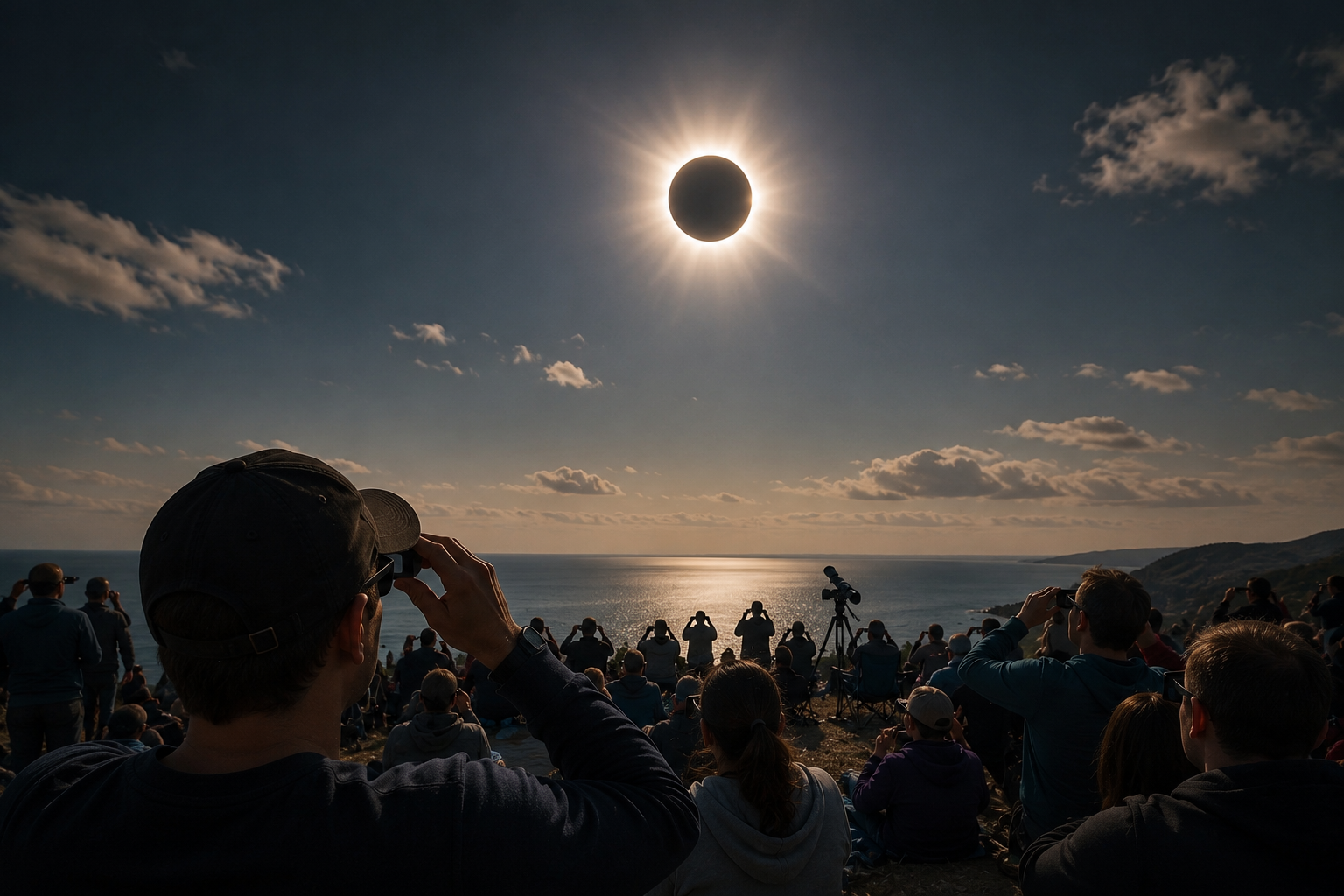
On Wednesday, August 12, 2026, the Moon will pass directly in front of the Sun in the first total solar eclipse visible from mainland Europe since 1999. The path of totality — where day briefly turns to night — sweeps across Greenland, Iceland and northern Spain, while the UK and Ireland witness their deepest partial eclipse in 27 years, with over 90% of the Sun blotted out in the early evening sky. Parts of the northern United States and much of Canada will catch a partial eclipse too. Here is everything you need to know: exact times, the best viewing locations, and how to watch without damaging your eyes.
Solar Eclipse August 2026: Quick Facts
- Date: Wednesday, August 12, 2026
- Type: Total solar eclipse (partial across a much wider region)
- Path of totality: Arctic Russia, Greenland, western Iceland, the North Atlantic, northern Spain, the far northeastern tip of Portugal and the Balearic Islands
- Maximum duration of totality: about 2 minutes 18 seconds
- UK & Ireland: deep partial eclipse in the evening — roughly 89–96% of the Sun covered depending on location
- US & Canada: a smaller partial eclipse visible from northern parts of the US and much of Canada
- Historic milestone: the first total eclipse over mainland Europe since 1999 — and the first over mainland Spain since 1905
- Bonus: the Perseid meteor shower peaks the very same night, under a dark, moonless sky
Why This Eclipse Is So Special
Total solar eclipses happen somewhere on Earth roughly every 18 months, but any single location waits centuries between them. Europe has waited since August 1999 — the famous eclipse that crossed Cornwall — for totality to return to the mainland.
This one comes with two unusual twists. First, it is a “sunset eclipse”: in Spain, totality arrives during the golden hour, with the Sun hanging low above the western horizon shortly before sunset — a rare and dramatic sight for photographers. Second, the Moon reaches perigee (its closest point to Earth) just two days earlier, on August 10, making it appear slightly larger in the sky and stretching totality to over two minutes along parts of the path.
Where Will the Total Eclipse Be Visible?
The narrow band of totality — up to 294 km (183 miles) wide — begins near the North Pole and tracks south across the Northern Hemisphere:
- Greenland — the eclipse crosses eastern Greenland in the late afternoon. Totality is long here, but the region is remote and hard to reach.
- Iceland — western Iceland, including the area around Reykjavík, sits inside the path, with the eclipse arriving in the late afternoon or early evening. The whole country sees at least a very deep partial eclipse. The main risk is weather: this date has a poor cloud record in the North Atlantic.
- Northern Spain and the Balearic Islands — the star destination. Totality sweeps across northern Spain in the late evening, just before sunset, and also covers the far northeastern corner of Portugal. Spain hasn’t seen a total eclipse from its mainland since 1905, and hundreds of thousands of eclipse-chasers are expected to travel there. Because the Sun will be very low, viewers need an unobstructed western horizon — hilltops and west-facing coastlines will be prime real estate.
Everywhere along the path, totality lasts under two and a half minutes — most locations get less than two — so positioning and preparation matter.
Solar Eclipse in the UK & Ireland: What You’ll See and When
Britain and Ireland miss totality by a few hundred miles — but only just. What they get instead is the deepest partial solar eclipse since 1999, far deeper than the 2015 event, with the Sun reduced to a thin crescent across the whole country. Astronomers say the UK won’t get closer to a total eclipse for decades.
How much of the Sun is covered depends on where you are — the further southwest, the deeper the eclipse:
| Location | Sun Covered (approx.) |
|---|---|
| Land’s End / West Cornwall | up to 96% |
| Cork, Ireland | 96% |
| Dublin, Ireland | 94% |
| Cardiff | 93% |
| Belfast | 93% |
| London | 91% |
| Edinburgh | 91% |
| Shetland Islands | ~88% |
Eclipse Times for the UK (BST)
This is an early-evening event, with the Sun already well down in the western sky:
- Around 6:15–6:17pm — first contact: the Moon takes its first “bite” out of the Sun (timings vary by a few minutes across the country)
- Roughly 7:05–7:13pm — maximum eclipse: only a slim crescent of sunlight remains; the light turns noticeably dim and eerie, and temperatures can dip
- By about 8:10pm — the Moon fully clears the Sun and the eclipse ends
Because the Sun will be low in the west, pick a viewing spot with a clear, unobstructed western horizon — a hilltop, a west-facing beach or open countryside. Tall buildings and trees could block the whole show.
One warning for UK viewers: August evenings are a gamble. Historical records suggest cloud cover on this date more often than not, so keep an eye on the forecast and be ready to travel to clearer skies if you can.
Can You See the Eclipse From the United States?
Yes — partially. The Moon’s outer shadow brushes North America, so much of Canada and parts of the northern United States will see a partial eclipse, with a modest portion of the Sun covered. The effect will be far subtler than in Europe: no dramatic darkening, just a visible notch taken out of the Sun (through proper eclipse glasses only).
Because coverage and timing vary a lot by location, US and Canadian readers should check an interactive eclipse map (NASA and timeanddate.com both offer one) for their exact local circumstances. Americans wanting the full spectacle have two options: travel to Spain or Iceland this year — or wait for the next total eclipse over Alaska in 2033, with the contiguous US not seeing totality again until the mid-2040s.
How to Watch the Eclipse Safely
This part is not optional. Looking directly at the Sun — even when 95% of it is covered — can cause permanent eye damage or blindness. The rules:
- Use certified eclipse glasses meeting the ISO 12312-2 standard. Ordinary sunglasses, no matter how dark, are NOT safe. Check your glasses for scratches or pinholes before use, and buy from reputable sellers — counterfeit glasses flooded the market before previous eclipses.
- Never look at the Sun through binoculars, a telescope or a camera lens without a proper solar filter fitted to the front. Concentrated sunlight through optics can burn the retina in a fraction of a second — even through eclipse glasses.
- No glasses? Build a pinhole projector. Two pieces of card and a pin are all you need to project a safe image of the crescent Sun onto a surface. A colander or even the gaps between tree leaves will cast dozens of tiny crescent images on the ground.
- The only exception: viewers inside the path of totality (Spain, Iceland, Greenland) may look at the Sun with the naked eye only during the brief moments of totality, when the Moon completely covers the solar disc. The instant sunlight reappears, glasses go back on. In the UK, US and everywhere outside the path, there is no safe moment to look unprotected — the eclipse never becomes total there.
Double Feature: The Perseid Meteor Shower Peaks the Same Night
By pure cosmic coincidence, the night of August 12–13, 2026 is also the peak of the Perseids — the most popular meteor shower of the year. And because the Moon is new (that’s what makes the eclipse possible), the sky will be completely moonless and dark, ideal conditions for meteor watching.
That makes August 12 arguably the best skywatching date of the decade: a deep solar eclipse at sunset, followed a few hours later by up to dozens of meteors per hour streaking across a black sky. If you’re planning one night outside under the stars this year, this is the one.
FAQ: Solar Eclipse August 2026
What time is the solar eclipse on August 12, 2026 in the UK?
The partial eclipse begins around 6:15pm BST, reaches its maximum between roughly 7:05pm and 7:13pm depending on location, and ends by about 8:10pm. The Sun will be low in the western sky throughout.
Will the eclipse be total in the UK?
No. The UK and Ireland see a very deep partial eclipse — about 91% of the Sun covered in London and Edinburgh, rising to roughly 96% in west Cornwall and southern Ireland. Totality is only visible from Greenland, Iceland, northern Spain, the far northeast of Portugal and the Balearic Islands.
Can I see the August 2026 eclipse from the US?
Partially. Northern parts of the United States and much of Canada will see a small partial eclipse, with a modest fraction of the Sun covered. Check an interactive eclipse map for exact local times and coverage.
Is it safe to look at a partial eclipse without glasses?
No — never. Even a thin sliver of uncovered Sun can permanently damage your eyes. Use eclipse glasses certified to ISO 12312-2, or project the image with a pinhole viewer. Regular sunglasses offer no protection.
When is the next total solar eclipse after August 2026?
The next one comes quickly: August 2, 2027, when totality crosses southern Spain, North Africa and the Middle East, lasting over six minutes near Luxor, Egypt — one of the longest eclipses of the century. The UK, however, won’t see totality on home soil until 2090.
Why is this eclipse called a “sunset eclipse”?
Because in Spain — the most accessible part of the path — totality occurs in the late evening with the Sun very low over the horizon, shortly before sunset, creating unusually dramatic golden-hour conditions rarely seen during total eclipses.
