


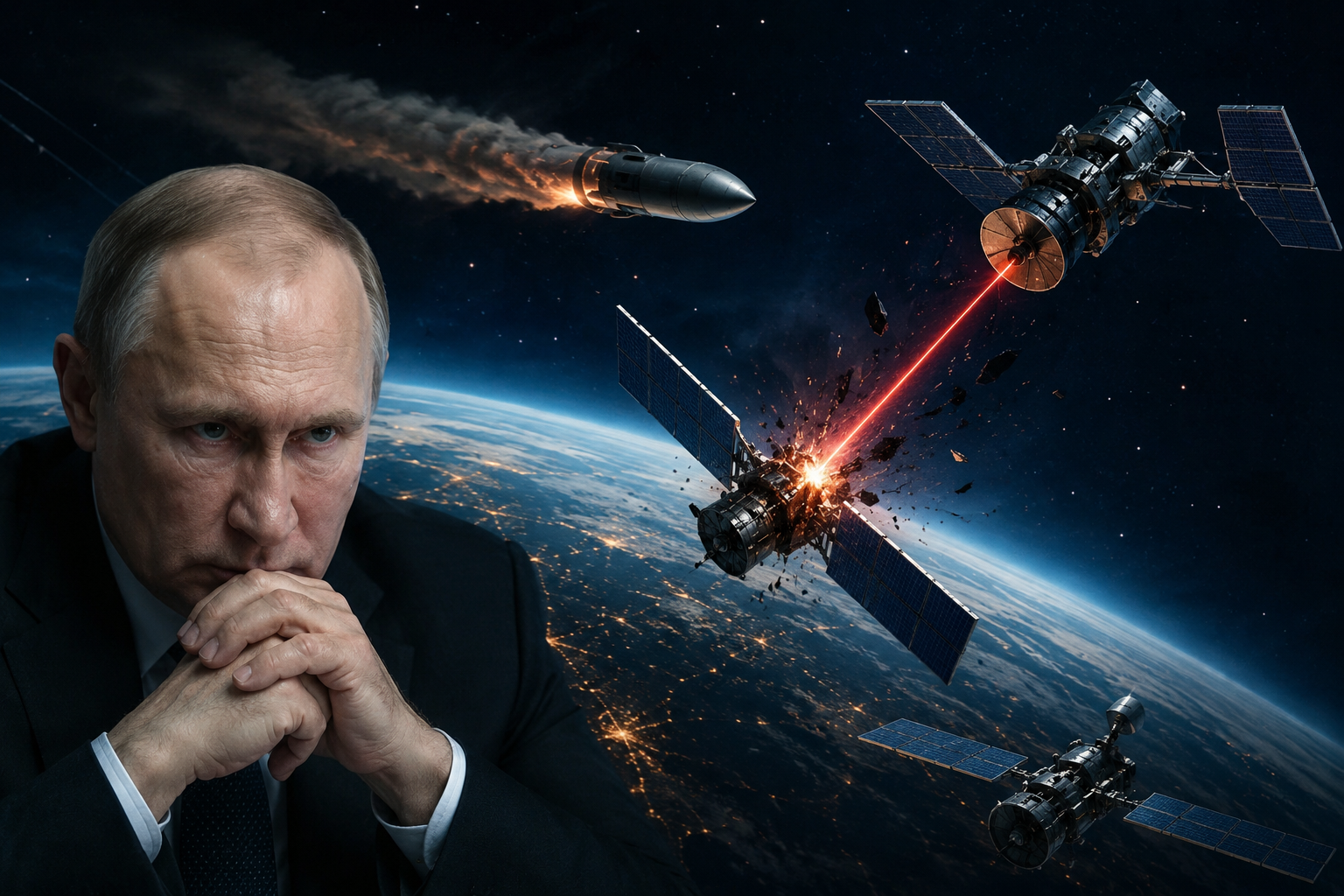
The alliance has declared that attacks in orbit could trigger its mutual-defence clause and launched an eight-nation military satellite network, as researchers trace vast GPS interference to Russian spacecraft and intelligence reports point to a Kremlin nuclear anti-satellite programme.
NATO is racing to harden its defences in orbit amid mounting evidence of Russian aggression in space — from vast satellite-based jamming across Europe to intelligence reports that Moscow is developing a nuclear anti-satellite weapon.
The alliance’s newly updated space policy, published on 8 July, formally states that attacks “to, from or within space” could be serious enough to trigger Article 5, the NATO treaty’s collective-defence clause. Days later, eight member states — Canada, Denmark, Finland, Germany, the Netherlands, Norway, Sweden and Türkiye — launched a military space initiative called HALO, which will link sovereign military satellites into a networked mega-constellation supporting high-speed communications, intelligence-gathering and missile tracking. NATO says the network is designed to reduce the vulnerability and coverage gaps of individual national fleets. Separately, the alliance’s STARLIFT project, now involving 15 allies including Britain and the United States, is examining a network of launch capabilities that would allow satellites to be replaced or reinforced at short notice from spaceports across the alliance during a crisis.
The most alarming threat driving that activity is nuclear. Victoria Samson, chief director of space security and stability at the Secure World Foundation, told The Sun: “It’s very possible that Russia could start a war in space.” She said intelligence reports suggest Russia is working on a nuclear warhead that, if placed on a satellite, would function as a crude but extremely effective anti-satellite weapon. A nuclear detonation in low orbit would likely destroy more than 80 per cent of the satellites in space, potentially knocking out internet access, mobile phone signal and GPS for much of the world. General Stephen Whiting, head of US Space Command, has told The Times he is “very concerned” about the Kremlin’s nuclear plan.
Placing such a weapon in orbit would breach the 1967 Outer Space Treaty, to which Russia, the US and China are all parties. But a recent scientific paper highlights a critical weakness: there is no established mechanism for verifying whether a nuclear weapon is hidden aboard a satellite. Researchers have proposed detecting an orbiting thermonuclear device from several kilometres away using the neutron signatures produced when cosmic rays strike it.
Meanwhile, new research suggests Russia’s interference with satellite navigation is already far more extensive than previously understood. A study published in June, analysing GNSS data gathered between 2019 and 2026, detected powerful, transient interference across Europe, Greenland and Canada, and said researchers could “confidently identify” the source as a constellation of Russian early-warning satellites in highly elliptical Molniya orbits. The team documented 75 days of wide-area interference events, with individual bursts lasting under ten seconds yet registering simultaneously across enormous areas; analysis of one event in February this year traced the signal to Russia’s Kosmos 2546 satellite. The work remains a preprint and has not yet completed peer review.
Samson told The Sun that Russia has already demonstrated a suite of counter-space capabilities: destroying one of its own satellites using another satellite in orbit, striking a satellite with a ground-launched interceptor, and routinely conducting jamming — blocking electronic broadcasts — and “sweeping,” in which broadcast information is swapped out and replaced. She said Russian interference with GPS is now regularly disrupting civil aviation in the Baltic region. Moscow has also shown it can manoeuvre a satellite close to a rival country’s spacecraft and release high-velocity objects at it — a tactic Samson likened to raking the target with gunfire, and one she said serves as a warning that interference will be answered by satellites being shot down.
Paradoxically, Russia’s weakness in space may make it more dangerous. Moscow operates only around 370 satellites, against roughly 11,000 for the US and about 1,000 for China. Samson described a former global space power now beset by corruption and quality-control problems in its civil programmes, with no commercial space sector to speak of. Russia still keeps researchers aboard the International Space Station, but with the ISS expected to be retired within five or six years, it will soon have no orbital outpost at all. With so little infrastructure of its own at risk, she argued, the impact of a conflict on Russia would be limited — while the West’s deep dependence on space gives adversaries every incentive to deny, degrade, disrupt or destroy its capabilities.
Britain has felt that pressure directly. Major General Paul Tedman, the head of UK Space Command, warned last year that Russia was attempting to jam British military satellites on a weekly basis, while Germany’s defence minister has accused Moscow of eavesdropping on satellites used by European armed forces. In May, Russia was accused of knocking out the GPS signal of an RAF jet carrying John Healey, then the UK defence secretary. The Kremlin has refused to respond to any of the allegations.
The UK is responding with new defensive infrastructure of its own. The Ministry of Defence — which says 20 per cent of the British economy relies on satellite services — has introduced Borealis software at the National Space Operations Centre, combining data on debris, active satellites and environmental conditions to give military and government commanders faster warnings. Britain has also released the first imagery from its Noctis-1 space telescope, including observations of the military SKYNET communications satellites, as part of a growing surveillance architecture for tracking objects near strategically important British spacecraft.
The battle over satellite signals is already playing out in Ukraine. Ukrainian commanders have told Reuters that Russian forces are deploying ground-based electronic warfare systems, including one known as Volna Kupol Garant, to disrupt Starlink connectivity for satellite-linked Ukrainian drones across areas of up to 20 square kilometres. Drone units have made the jammers priority targets and say they have destroyed at least two.
Samson believes an all-out Russian first strike in orbit remains a last resort — the kind of step Moscow would take only in a desperate, regime-in-collapse scenario. If a space conflict did begin, she told The Sun, it would likely open not with explosions but with an intensification of what is already happening: jamming, spoofing and cyber attacks. Physically destructive strikes are easy to attribute and therefore highly escalatory, she said, and would probably come only alongside a ground war between Russia and an adversary such as the United States. The West, she added, is taking the threat seriously — reflected in the rapid proliferation of national military space organisations.
