


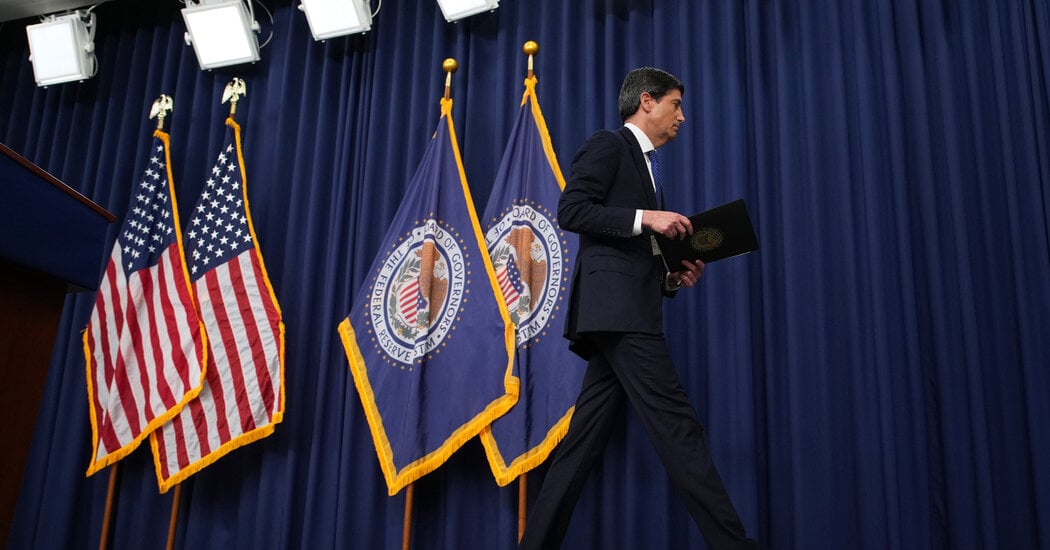
The Federal Reserve has raised interest rates by a quarter of a percentage point, taking its target range to 3.75% to 4%, as chairman Kevin M Warsh signalled that the US central bank is likely to tighten policy further to combat persistent inflation.
The decision was widely anticipated by financial markets, but officials’ latest projections pointed to at least one more increase before the end of the year. Sixteen of the 18 policymakers who submitted forecasts expected rates to rise by another quarter of a point.
That would put the range at 4% to 4.25%. Most officials also expected rates to remain at or above that level throughout 2027, while raising their longer-term estimates compared with projections made three months earlier.
Mr Warsh did not submit an individual forecast, as he opposes the use of the so-called dot plot to communicate policy. However, his remarks after the meeting suggested he shared the view that the Federal Reserve’s work on inflation was unfinished.
He avoided committing to a precise path for future decisions, saying he did not want to “prejudge any future decisions we make”. But the chairman adopted a firm tone on price pressures, while describing economic growth and the labour market positively.
Federal Reserve signals further rate rises
Mr Warsh said the unanimous decision showed that officials were “serious about this”. He also made clear that he was dissatisfied with the recent lack of progress towards the Fed’s 2% inflation target.
The most closely watched part of his news conference was his description of the decision as having “removed a dose of accommodation so that financial and credit conditions would be more consistent with our ultimate objectives”.
The language suggested that Mr Warsh did not believe interest rates were significantly restraining the economy. Instead, it conveyed a more hawkish message, leaving economists and investors to assess how many further increases he considers necessary.
Asked about the neutral interest rate — the level that neither stimulates nor suppresses growth — Mr Warsh said the “academic” concept had no bearing on Wednesday’s decision.
The prevailing view is that the Fed could raise rates twice more through the early part of 2027. Patrick Harker, the former president of the Federal Reserve Bank of Philadelphia, expects the central bank to reverse cuts made late last year as it seeks to protect against a weakening labour market.
Mr Harker predicted that officials would skip the next meeting in late October, partly because it falls only days before the midterm elections and partly because there was “no rush” after the latest increase.
“I don’t think they’re looking at a long cycle of increasing rates,” he said. “I don’t think they were mildly restrictive and this is moving them there.”
Further action will depend on incoming economic data, although Mr Warsh said he was more interested in inflation trends than individual figures, which he described as “noisy”.
“Data point dependence is a dangerous preoccupation,” he said. “It’s not something that concerns me. Markets over time will come to understand how this Fed makes its decisions, what’s relevant and not.”
Seth Carpenter, a former Fed economist now at Morgan Stanley, said officials faced “very clear tension” over how much weight to place on any single statistic. Derek Tang, an economist at LHMeyer, warned that divisions could emerge if efforts to curb inflation began to threaten the labour market.
“Warsh is willing to hike right now and do this for inflation because there’s a low cost to doing so,” Mr Tang said. “What’s not answered is: What if the cost of doing so is higher?”
For now, unemployment remains low, consumers are continuing to spend and growth has stayed solid. But Daleep Singh, formerly of the New York Fed and the Treasury Department, forecast three quarter-point increases before a pause, with moves in October and December.
He cautioned that the Fed could ultimately need to raise rates by more than 0.75 percentage points if supply-side pressures continued and growth driven by artificial intelligence proved less sensitive to higher borrowing costs.
President Trump criticised Wednesday’s decision, repeating his view that the United States should have the “lowest interest rate anywhere in the world because we have the strongest credit”. He did not directly blame Mr Warsh, whom he appointed to lead the central bank, instead targeting the other six members of the Board of Governors.
Mr Trump said he had told Mr Warsh he “might as well vote with the board because it’s just not going to matter”. He described the board as “very hostile” and “very political”, adding: “They’re doing the wrong thing. They’re a bunch of politicians.”
