


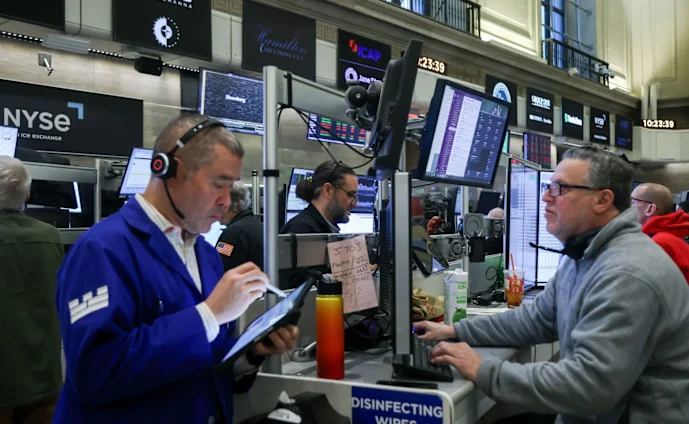
Wall Street fell as oil prices rose, with technology shares leading a broader retreat from recent records. The S&P 500 lost 0.5 per cent for a second consecutive session, while the Nasdaq dropped 1.3 per cent and the Dow Jones Industrial Average finished broadly unchanged.
US markets were weighed down by a fresh slide in technology and artificial-intelligence-linked stocks. Nvidia fell 2.9 per cent, while Oracle also declined after a report that it was transporting natural gas to server farms to work around power supply bottlenecks.
OpenAI was also under pressure after the Financial Times reported that its annualised revenue was $US20 billion (£15.2 billion) below a figure previously signalled. Shares in Taiwan Semiconductor Manufacturing Company, a key indicator for the chip industry, fell 1.4 per cent in the US despite stronger-than-expected growth reported for September.
Oil prices added to the pressure on markets. Brent crude, the international benchmark, climbed 3.8 per cent to $US104.08 a barrel, having moved between about $US96 and almost $US110 over the past month as investors assessed when the war with Iran would allow the global energy industry to return to normal.
In Australia, sharemarket futures pointed to a modestly higher opening on Friday, with the ASX expected to gain eight points, or 0.1 per cent. The index fell 0.8 per cent on Thursday, while the Australian dollar was trading at US69.57 cents.
Markets were also unsettled by sharp movements in US government bond yields. The yield on the 10-year Treasury note moved from 5.28 per cent late on Wednesday to 5.35 per cent early on Thursday, before falling back to 5.26 per cent.
It remains close to its highest level since 2002 and well above the 3.97 per cent recorded before the conflict with Iran began. Concerns over inflation and high levels of government debt have contributed to the rise.
Higher yields can make borrowing more expensive and put pressure on share prices, particularly for companies valued on expectations of rapid future growth. Analysts are forecasting nearly 30 per cent earnings-per-share growth for S&P 500 companies in the upcoming reporting season, setting a demanding benchmark for results.
US unemployment benefit applications fell last week, in the latest indication that the economy continues to hold up. The figures may suggest companies are carrying out fewer redundancies.
Corporate results produced mixed reactions. Levi Strauss shares dropped 2.4 per cent despite reporting stronger-than-expected quarterly profit and raising its full-year profit forecast, as revenue growth fell short of expectations.
PepsiCo gained 3.7 per cent after exceeding forecasts for quarterly profit and revenue and reporting strength outside North America. It nevertheless lowered its forecast for an underlying measure of profit for the financial year.
Markets elsewhere were also weaker. South Korea’s Kospi fell 2.6 per cent, while Samsung Electronics dropped 2.4 per cent after forecasting a sharp rise in quarterly operating profit that still failed to satisfy investors.
