


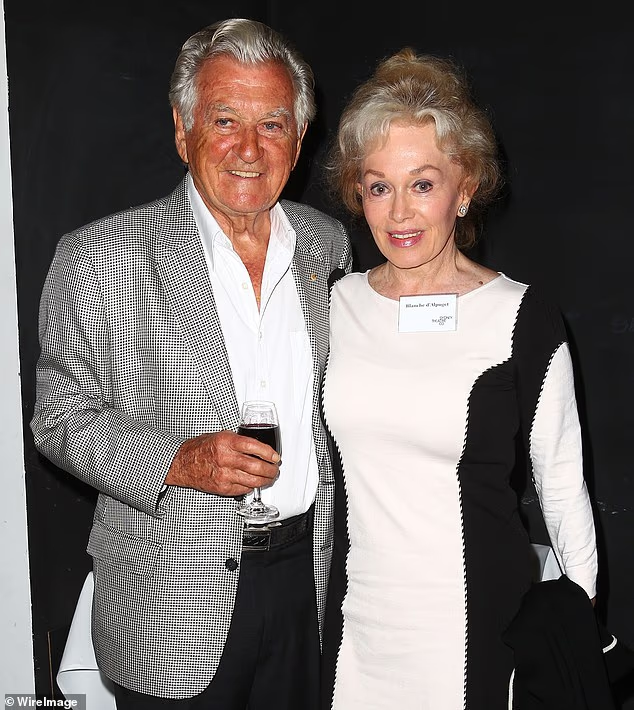
Blanche d’Alpuget’s multimillion-dollar estate could set the scene for a fresh succession dispute between her only son and the three adult children of her late husband, former Australian prime minister Bob Hawke.
The 82-year-old author died on Wednesday, September 9, 2026, after complications from influenza. Her will has not been made public, leaving uncertainty over who will inherit the assets accumulated during her long relationship with Hawke.
D’Alpuget received most of Hawke’s estimated A$18 million estate after his death in 2019. His three children from his first marriage to Hazel Hawke were not named as beneficiaries, although d’Alpuget later gave each of them A$750,000.
That arrangement was challenged by Hawke’s estranged daughter, Rosslyn Dillon, who sought about A$4.2 million in a claim that argued her father had failed to make adequate provision for her. Ms Dillon told the court she was living in severe financial hardship, including in a cockroach-infested flat where she struggled to meet the A$500 weekly rent.
The dispute was settled privately, and the amount paid to Ms Dillon was never disclosed.
What could happen to Blanche d’Alpuget’s estate?
It is not known how much of Hawke’s fortune remained when d’Alpuget died. Her assets included a Sydney apartment overlooking Hyde Park, bought for about A$4.5 million, as well as proceeds and royalties connected to her writing career.
She published 11 books between 1984 and 2025, including biographies, novels and historical fiction. Her final novel, The Bunny Club, was released in March 2025 and was set among Sydney’s wealthy eastern suburbs and the Southern Highlands.
D’Alpuget also raised A$671,630 from the sale of 266 lots of Hawke’s personal possessions in 2019. The auction included sporting memorabilia, cigar-smoking items and a Harry Bilson painting, Fairground Carousel, which sold for A$7,800.
The sale caused tension with members of the Hawke family. Paul Dillon, one of Rosslyn Dillon’s sons, objected to the disposal of possessions he believed should have been offered to relatives first.
“Blanche, are you kidding with this auction?” he wrote in a message disclosed in court documents. “Selling all the Harry Bilsons? No thought to ask the family to take furniture or anything?!! Don’t you have a limit?”
When d’Alpuget said she had found the messages threatening, Mr Dillon replied: “Which part?” She told him she had the right to sell belongings that were legally hers.
D’Alpuget was understood to have remained close to Hawke’s children Sue Pieters-Hawke and Stephen Hawke. It is unclear whether either was included in her will, or whether her estate was left primarily to her son Louis Pratt, her daughter-in-law Brianna and her granddaughter Sienna.
Under New South Wales succession law, stepchildren do not automatically have the same standing as a biological child when seeking provision from a step-parent’s estate. A claim may be possible where the applicant was dependent on the deceased and was a member of the household, but eligibility depends on the individual circumstances.
The law does not set a fixed period for which a stepchild must have lived with a step-parent, nor does it prescribe a particular level of dependency. Any successful application is assessed according to future need and the circumstances of the estate.
The Hawke and d’Alpuget fortunes were built against the backdrop of a property portfolio assembled during their 43-year relationship. They sold their five-storey home in Northbridge for about A$9.2 million shortly before Hawke’s death. The property had been bought for A$1.23 million in 1991, while Hawke was still prime minister.
The couple also owned a luxury cottage on Scotland Island, near Pittwater in Sydney’s Northern Beaches, which is now being marketed with a price guide of A$3.6 million.
D’Alpuget bought the Hyde Park apartment after Hawke’s death, having sold the A$3.6 million unit where he spent his final weeks. The extent to which those transactions affected her final estate is not known.
The author’s death was announced by her family, who also released a final message she had asked them to share: “Our highest calling and greatest achievement is love, the rule of life. Love one another.”
She is survived by Mr Pratt, her son from her first marriage to diplomat and journalist Tony Pratt, as well as Hawke’s three children and several step-grandchildren.
D’Alpuget met Hawke in Jakarta in 1970 and began an affair with him six years later while they were both married to other people. Hawke divorced Hazel in 1995 and married d’Alpuget that year, after a relationship that had attracted intense public criticism.
Australia’s Prime Minister Anthony Albanese paid tribute to d’Alpuget as a writer who worked with “a keen eye for every telling detail” and brought humanity to her subjects. Her biography of Hawke won the New South Wales Premier’s Award, while her later work included a five-book series about Henry II and Eleanor of Aquitaine.
Derek Rielly, who wrote Wednesdays With Bob, described d’Alpuget as having lived “a beautiful, complete and electric life” and said she continued to radiate love for humanity until her death.
