


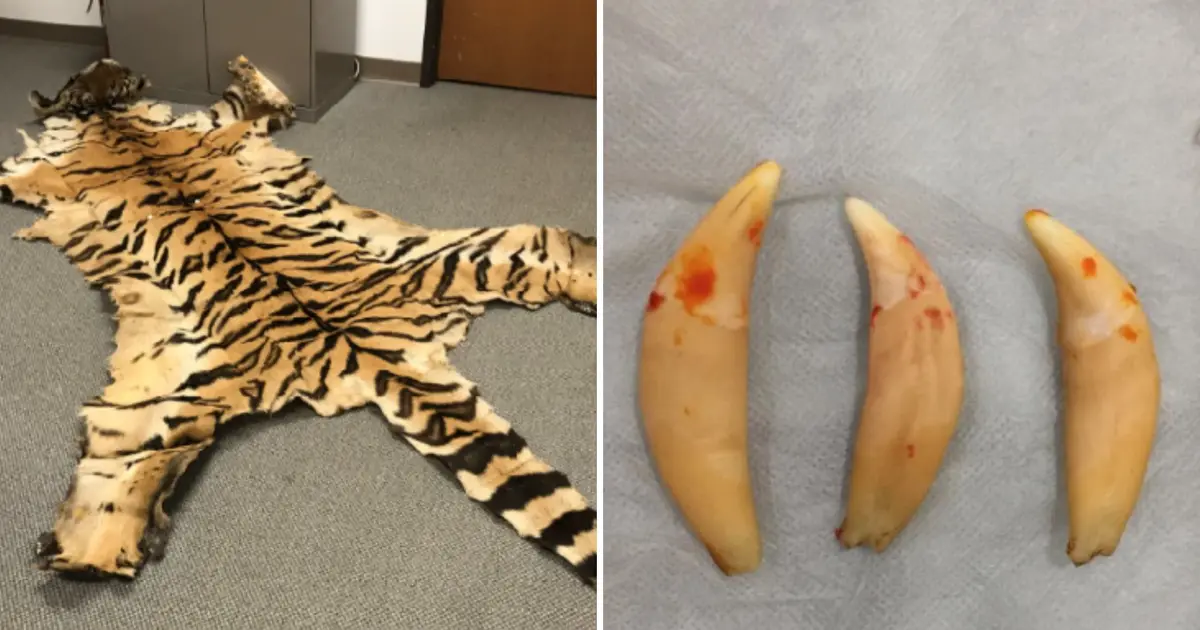
An Anaheim husband and wife have been sentenced to three years’ probation and fined $20,000 after admitting their part in an international wildlife trafficking operation involving rhino horn, a tiger pelt and lion teeth.
Linh Luu and Kevin Le pleaded guilty in federal court in Eugene, Oregon, to violating the Lacey Act, which prohibits the trade in wildlife obtained or transported illegally. They were each ordered to pay a $10,000 fine.
Prosecutors said the couple processed $51,100 in payments between September 2019 and May 2021 to help an associate in Vietnam move protected animal parts between the US and south-east Asia.
Items sent from Oregon included American black bear gallbladders and cougar bones, which are sought in some traditional Asian medicine markets. Shipments arriving in Oregon contained lion teeth, a tiger pelt and sections of black and white rhinoceros horn.
Rhino horn disguised as household decoration
The investigation included an undercover operation by the US Fish and Wildlife Service’s Office of Law Enforcement, with assistance from Homeland Security Investigations and Oregon State Police.
In December 2020, Luu and Le met an undercover federal agent in a car park and accepted $12,000 in cash as a deposit for part of a rhinoceros horn, according to court documents.
The couple discussed methods of avoiding banking scrutiny, prosecutors said. They later received electronic payments of almost $5,000 each, while the horn fragment was sent to Oregon disguised as an ordinary household decoration.
The transaction was described in the government’s sentencing submission as a way to establish trust before pursuing larger deals.
All the species involved are protected under the Convention on International Trade in Endangered Species of Wild Fauna and Flora, known as CITES. Commercial trade in the listed species requires permits, which the defendants did not have.
Black bears and cougars are native to Oregon, while lions, tigers and both black and white rhinoceroses are also protected under US endangered species law.
The Lacey Act, described by the US Department of Justice as the country’s oldest wildlife trafficking statute, also bans buying or selling animals or animal parts that have been illegally imported or exported.
The court documents do not identify the person in Vietnam who allegedly coordinated the shipments with Luu and Le, or state whether that individual has been charged.
They also do not establish who supplied the bear and cougar parts in Oregon, or where the tiger, lion and rhinoceros remains were originally obtained.
