


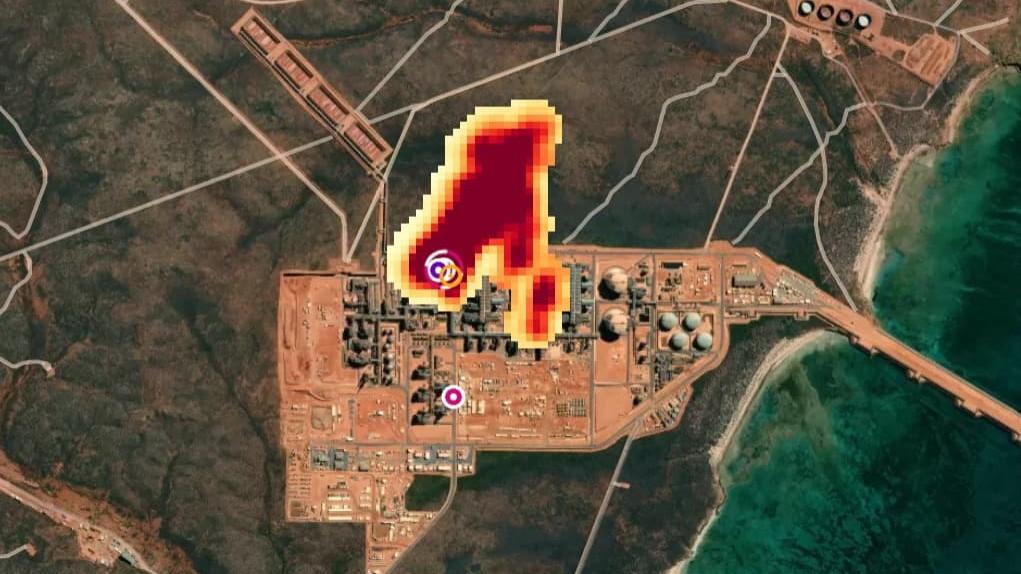
Persistent methane plumes detected at Chevron’s Gorgon liquefied natural gas facility off Western Australia have prompted a warning from the UN Environment Program.
Satellite readings recorded high levels of methane during five consecutive flyovers between November and August. The plumes were reportedly coming from the company’s operation on Barrow Island, off the Pilbara coast.
The latest detection, recorded in August, indicated methane emissions at a rate of 7.8 tonnes an hour. The expulsion was described as equivalent to burning 110 tonnes of coal.
Chevron challenges certainty of satellite readings
Chevron said satellite observations alone were not sufficient to establish the scale or source of the emissions.
“Satellite observations capture a single moment in time and have a wide range of uncertainty,” a company spokesperson said.
“We use them alongside aerial surveys, operating data and on-site checks to enhance how we understand and manage methane emissions.”
The company said it was “seeking further clarification” on the satellite data, adding that its Australian facilities were designed, operated and maintained to manage methane emissions.
“We understand the importance of methane management as well as the community’s expectations on this issue, and our Australian facilities are designed, operated and maintained to manage methane emissions,” the spokesperson said.
“We report emissions from our facilities in line with Australian regulatory requirements.”
Companies are required to submit their emissions figures by October 31 each year, with the reports published by the Australian government annually.
The UN says methane is about 80 times more damaging to global warming than carbon dioxide over a 20-year period and accounts for about 25 per cent of global warming. Its agency uses 30 satellites operated by the non-profit Carbon Monitor to detect methane.
