


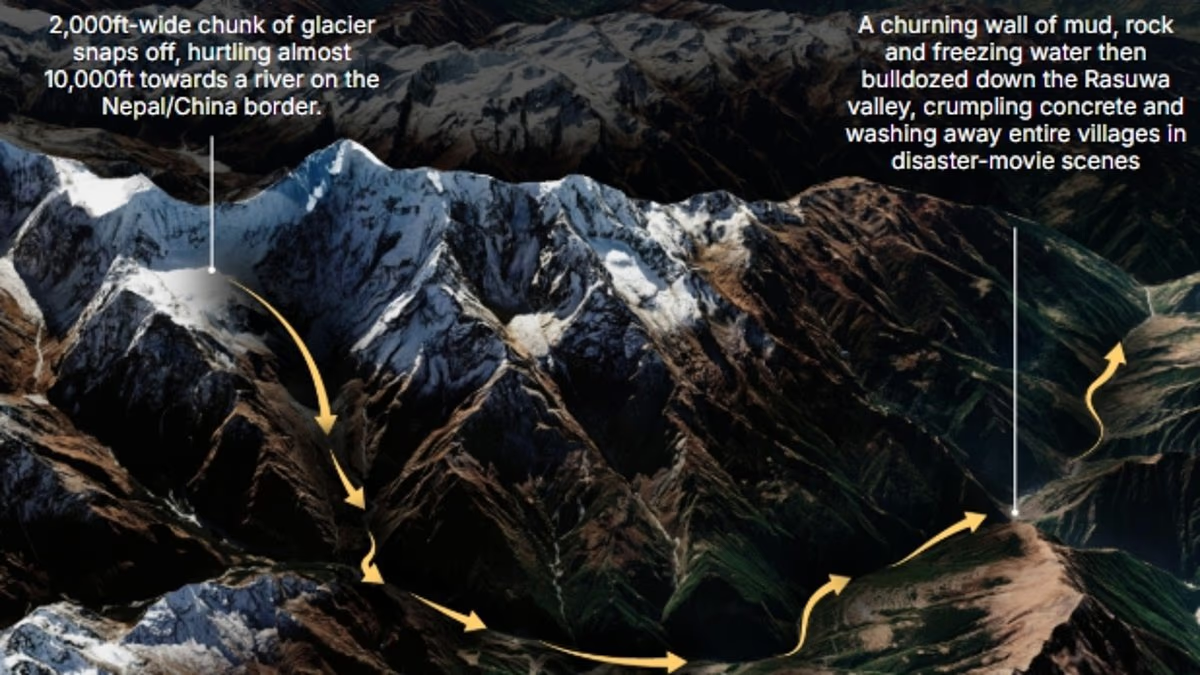
Nepal is facing what officials are describing as ‘devastation beyond imagination’ after flash floods wiped out buildings and bridges along the Nepal–Tibet border.
Horrifying footage shows the moment rushing waters – reportedly reaching up to 650ft high – swept the region yesterday, leaving at least 177 dead.
While details are still emerging, one key question is already being asked: was climate change to blame?
Now, the Daily Mail has uncovered an ominous study published just one month ago that warned global warming could spark glacial collapse in the region.
The study, led by researchers at Kathmandu University, explained: ‘Across the Himalayan region, warming rates exceed the global average, intensifying climate–related hazards and associated losses contributing to the melting of glaciers and increasing the risk of GLOF.’
GLOFs are ‘glacial lake outburst floods’ – the suspected cause of yesterday’s devastating floods.
Dr Adrian McCallum, a Glaciologist and Polar Engineer at the University of the Sunshine Coast, said: ‘I’m yet to fully appraise myself of the situation, but these floods are probably “glacial lake outburst floods” (GLOFs); these are increasingly common in alpine regions globally as our climate changes.
‘As glaciers melt and recede, ice turns to water, the water is stored (temporarily) behind natural moraine dams, but when those dams breach, tremendous amounts of water can be released down a valley, taking out everything in its path.’
Nepal is facing what officials are describing as ‘devastation beyond imagination’ after flash floods wiped out buildings and bridges along the Nepal–Tibet border
Nepal is highly vulnerable to climate change for a number of reasons.
Writing in last month’s study, published in Frontiers in Climate, the researchers explained: ‘Nepal, a mountainous, landlocked and least developed country in the eastern Himalayas, is highly vulnerable to climate change due to its complex topography, fragile ecosystem and limited ability to adapt to rapidly growing climate impacts.
‘The vulnerability is exacerbated with increased frequency and intensity of climate induced disasters, such as floods, landslides, glacier retreat and glacier lake outburst floods (GLOF), among others, leading to loss and damage.’
Flooding is often associated with rainfall.
However, early reports suggest that a GLOF was to blame for yesterday’s event.
Professor Liz Stephens, Professor in Climate Risks and Resilience at University of Reading, explained: ‘Initial reports from Nepal suggest that an earthquake occurred around the same time as a landslide or avalanche, which then led to the catastrophic flooding.
‘One way this can happen in steep mountain valleys is when a landslide blocks a river, allowing water to build up behind it.
‘If that landslide dam, then fails, it can cause a sudden, devastating release of water and sediment downstream.’

Flooding is often associated with rainfall. However, early reports suggest that a GLOF was to blame for yesterday’s event

While yesterday’s GLOF was particularly devastating, it’s by no means the only one in recent years

According to last month’s study, at least 45 GLOF events have occurred across 39 lakes in Nepal – with several resulting in loss of life
While yesterday’s GLOF was particularly devastating, it’s by no means the only one in recent years.
According to last month’s study, at least 45 GLOF events have occurred across 39 lakes in Nepal – with several resulting in loss of life.
At this stage, it’s too early to say if climate change was to blame for this specific GLOF.
However, scientists say that as temperatures continue to rise, they will become more frequent.
‘Nepal is already experiencing significant climate–induced loss and damage across multiple sectors at the current level of global warming,’ the researchers warned.
‘An event specific climate attribution study for September 2024 extreme rainfall in central Nepal shows that in a 1.3°C warmer world, the intensity of the rainfall was approximately 10% higher and the probability of occurrence about 70% greater.
‘With temperature exceeding 1.5°C, the risk of floods, glacier melt, GLOFs and droughts would significantly increase.’
With the true extent of the devastation only just beginning to emerge, scientists hope yesterday’s disaster will trigger the development of future warning systems.

With the true extent of the devastation only just beginning to emerge, scientists hope yesterday’s disaster will trigger future warning systems

Scientists say that as temperatures continue to rise, these types of floods will become more frequent
Dr Nader Naderpajouh, an expert in risk and resilience at the University of Sydney, said: ‘This unique event may trigger the implementation of future warning systems, which is feasible with current state–of–the–art technology.
‘At least the buildup of water can be an early warning sign for downstream communities, a form of seasonal warning for preparation.
‘Such communications and preparations can save lives and reduce the impact at scale.
‘With global warming, there is an expectation that similar patterns of disasters will recur.
‘We can benefit from the implementation of a warning system, similar to those triggered for tsunami warnings after 2004’s tsunami.’
