


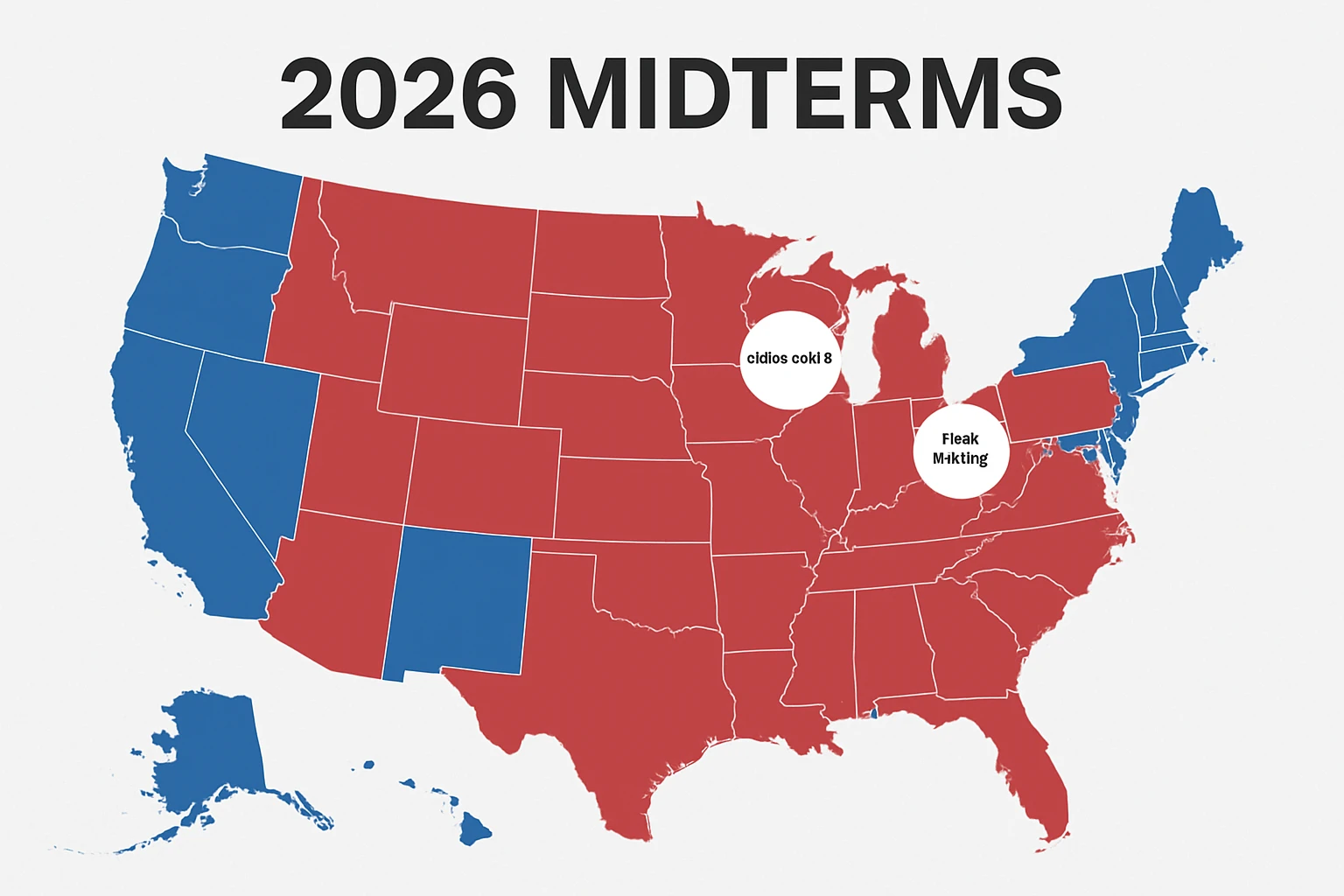
The 2026 midterm elections take place on Tuesday, November 3, 2026, and they will decide who controls Congress for the final two years of Donald Trump’s presidency. Every seat in the House of Representatives is on the ballot, along with 35 Senate seats and 36 governorships. With Republicans defending razor-thin majorities in both chambers and Democrats leading most national polls heading into the fall, the 2026 midterms are shaping up as one of the most consequential — and expensive — election cycles in American history. Here is the complete guide: the key races, the latest numbers, and what each outcome would mean.
2026 Midterms: Quick Facts
- Election Day: Tuesday, November 3, 2026
- On the ballot: all 435 House seats, 35 Senate seats (33 regular elections plus special elections in Florida and Ohio), and 36 state governorships
- Current Senate: Republicans hold a 53–47 majority (including two independents who caucus with Democrats)
- Current House: Republicans hold one of the narrowest majorities in modern history — a margin of just a handful of seats
- What Democrats need: a net gain of four Senate seats and a small handful of House seats to flip each chamber
- Historical pattern: the president’s party has lost ground in almost every midterm election since the Civil War
- Notable exits: nine senators are not seeking reelection, including Mitch McConnell, ending a 40-year Senate career
When Are the 2026 Midterms?
Election Day is Tuesday, November 3, 2026. However, tens of millions of Americans will vote before that date: most states offer early in-person voting (typically starting in late September or October) and mail-in ballots, with rules and deadlines varying by state. The remaining primary elections run through August and September — including Michigan’s closely watched Senate primaries in early August — after which every general election matchup will be set.
Voters can check their registration status, polling place and state deadlines at vote.gov, the federal government’s official voting portal.
Where Things Stand: The Numbers
Republicans enter the cycle controlling the White House, the Senate (53–47) and the House by one of the slimmest margins in decades. That means:
- In the Senate, Democrats must achieve a net gain of four seats to take the majority. Of the 35 seats being contested, 23 are currently held by Republicans and 12 by Democrats — on paper a defensive map for the GOP, but most Republican-held seats are in states Trump won comfortably in 2024, leaving Democrats a narrow path.
- In the House, control is expected to hinge on fewer than two dozen genuinely competitive districts. A shift of only a few seats in either direction decides the majority.
Midterms typically function as a referendum on the sitting president, and history is unkind to the party in power: the president’s party has lost House seats in all but a handful of midterms in the last century. In 2018, during Trump’s first term, Democrats gained roughly 40 House seats; in 2006, under George W. Bush, they gained 31. Whether 2026 follows that pattern is the central question of the cycle.
What the Polls Say (July 2026)
National “generic ballot” polling — which asks voters whether they would back a generic Democrat or Republican for Congress — currently favors Democrats, though the size of the lead varies by pollster:
- Morning Consult’s weekly tracker of tens of thousands of voters puts Democrats ahead 46% to 42%, a lead that has held steady at 3–4 points since spring — a reversal from early 2025, when Republicans led.
- Poll aggregators including Decision Desk HQ and FiftyPlusOne place the Democratic advantage in the D+4 to D+6 range as of late July.
- Individual surveys diverge more widely: an Emerson College poll in July found Democrats up 11 points, while other recent polls have shown margins as small as 2.
Analysts caution against reading too much into summer numbers. Generic-ballot leads for the out-of-power party often narrow as Election Day approaches, and Republicans hold structural advantages in the House: because of how district lines are drawn, election modelers note the GOP could lose the national popular vote by several points and still retain a narrow majority. On the other side of the ledger, polling shows a significant Democratic edge in voter enthusiasm — a Washington Post survey found Democrats 10 points more likely to call voting in 2026 “more important” than in past midterms, an indicator that preceded their strong 2018 performance.
In short: the environment currently favors Democrats, but the outcome remains genuinely uncertain — and both parties have credible paths.
The Key Senate Races of 2026
Forecasters including the Cook Political Report, Sabato’s Crystal Ball and Inside Elections broadly agree on the seats most likely to decide the majority:
| State | Status | Why It Matters |
|---|---|---|
| North Carolina | Open (R-held) | With Sen. Thom Tillis retiring, former Democratic Gov. Roy Cooper faces Republican Michael Whatley in what is projected to be the most expensive Senate race in the country. Early polling has shown Cooper ahead. |
| Georgia | D-held | Sen. Jon Ossoff, who won by a whisker in 2021, is Republicans’ single best pickup opportunity. Rated a toss-up. |
| Michigan | Open (D-held) | Sen. Gary Peters’ retirement triggered crowded primaries in both parties, set to be resolved in August. Trump carried the state in 2024, making it a genuine toss-up. |
| Maine | R-held | Sen. Susan Collins is the only Republican senator from a state Kamala Harris won in 2024. Democrats have targeted her before and failed — but the seat is central to their majority math. |
| Ohio | R-held (special) | Former Democratic Sen. Sherrod Brown is attempting a comeback against appointed Republican Sen. Jon Husted in a special election for the seat J.D. Vance vacated. |
| Alaska | R-held | Former Rep. Mary Peltola, a Democrat who has won statewide before, challenges Republican Sen. Dan Sullivan in a state where ranked-choice voting adds unpredictability. |
| Texas | R-held | A bruising Republican primary battle has Democrats hoping the state becomes competitive; it remains a reach, but one that could matter in a wave year. |
For Democrats, the realistic road to 51 seats runs through winning North Carolina and Maine, holding Georgia and Michigan, and pulling off at least two upsets among Ohio, Alaska, Texas or Iowa. For Republicans, holding the line in North Carolina or Maine — or flipping Georgia or Michigan — likely locks in the majority.
The Battle for the House
All 435 House seats are up, but the fight comes down to a small battlefield: fewer than two dozen districts that both parties consider genuinely winnable. Among the bellwethers analysts are watching are Colorado’s 8th district, Iowa’s 1st, and New Jersey’s 7th — suburban and mixed districts that have swung with the national mood in cycle after cycle.
Republicans are defending a majority so thin that a handful of losses would hand Democrats the speaker’s gavel. A Democratic House would gain the power to block the administration’s legislative agenda and launch investigations with subpoena power; a Republican hold would preserve unified GOP control of Washington through 2028.
Governor Races to Watch
Thirty-six states also elect governors in November. Several contests double as showcases for potential 2028 presidential contenders, and a number of sitting senators — Alabama’s Tommy Tuberville, Tennessee’s Marsha Blackburn and Colorado’s Michael Bennet — left the Senate to run for governor of their home states. Open races in battlegrounds like Georgia and Michigan, where incumbents are term-limited or retiring, are expected to draw enormous spending from both parties.
What’s Actually at Stake
The 2026 results will shape American governance through the end of the decade:
- Legislation. Unified Republican control means the administration’s agenda continues moving; a Democratic flip of either chamber effectively freezes major legislation and forces negotiation.
- Oversight. The majority party in the House controls committees, investigations and subpoenas — a power that defines a president’s final two years.
- Confirmations. The Senate confirms judges, justices and cabinet officials. Its control determines how easily the administration can fill vacancies, including any Supreme Court opening.
- The road to 2028. Midterm results historically reshape both parties’ presidential fields, elevating winners and sidelining the ambitions of those who underperform.
FAQ: 2026 Midterm Elections
When are the 2026 midterm elections?
Election Day is Tuesday, November 3, 2026. Early voting and mail-in voting begin weeks earlier in most states, with dates varying by state.
What is on the ballot in the 2026 midterms?
All 435 seats in the House of Representatives, 35 of the 100 Senate seats (including special elections in Florida and Ohio), 36 governorships, and thousands of state and local offices and ballot measures.
How many seats do Democrats need to win control?
Democrats need a net gain of four Senate seats to reach a 51-seat majority, and a net gain of only a few House seats to flip that chamber, given the GOP’s historically narrow margin.
Who is favored to win the 2026 midterms?
As of July 2026, Democrats lead national generic-ballot polling by roughly 4–6 points and hold an enthusiasm advantage, while nonpartisan forecasters still rate the Senate as leaning toward Republican retention because of a favorable map. The House is considered a genuine toss-up. Polls historically tighten by November, so no outcome is assured.
Which Senate races are most competitive in 2026?
Forecasters point to North Carolina, Georgia, Michigan, Maine, Ohio and Alaska as the races most likely to decide the majority, with Texas and Iowa as potential wildcards.
Why do midterm elections matter if the president isn’t on the ballot?
Because Congress controls legislation, spending, investigations and confirmations. Midterms decide whether the president’s agenda advances or stalls for the final two years of the term — and they historically serve as the nation’s referendum on the White House.
